

Most Popular Upland Gamebirds of 2026
A look at the upland gamebirds the Project Upland community hunts most and how those preferences have changed over the years
As shown in Project Upland’s Annual Community Survey, there are many reasons why people hunt upland birds. Some hunt for the dogs, others for cultural or familial traditions, and many for the adventure and the opportunity to spend more time in wild places. For most bird hunters, the appeal is a blend of all these things.
Each year, the survey helps paint a clearer picture of the upland hunting community, including the gamebirds we pursue, how often we hunt, and where we spend our time afield. Over time, these responses have created an increasingly detailed record of bird hunting trends within the Project Upland community.
Of course, every bird hunter has a favorite species. But when many individual hunting experiences are considered together, broader patterns begin to emerge about the upland gamebirds we hunt most often. Based on the 2026 survey results, these are the five most popular upland gamebirds among our community.
(P.S. Check out the most popular dog breeds of 2026 here.)
The Most Popular Types of Upland Gamebirds
We asked respondents to share which species of gamebirds they hunted for more than three days last season. By categorizing the species into grouse, migratory, quail, partridge, and pheasant groups, we were able to see which types of gamebirds our community hunted the most:
- Grouse: 67.1%
- Pheasant: 67.1%
- Migratory birds: 54.8%
- Quail: 42.0%
- Partridge: 36.1%
Pheasants and grouse were tied at 67.1 percent, with the grouse category including all species of prairie and forest grouse. Migratory birds, including doves, American woodcock, and snipe, followed at 54.8 percent. The six species of native North American quail followed at 42 percent, while 36.1 percent of hunters pursued at least one partridge species.
Top 5 Upland Gamebirds of 2026
We determined the most popular game bird species by asking survey respondents, “What upland birds did you hunt more than 3 days during the most recent hunting season? (Check all that apply).”
1. Ring-necked Pheasant: 67%
The beautiful, delicious, nonnative ring-necked pheasant remains the most popular upland game bird among Project Upland survey respondents. Pheasants have become deeply embedded in American upland hunting culture since the birds were successfully introduced to North America in 1881.
According to our community survey, the states where the most pheasant hunters in our survey reside are Minnesota, Wisconsin, Michigan, Pennsylvania, and Montana. Nearly 39 percent of these hunters split their hunting evenly between their home state and elsewhere or spend most of their hunting time out of state. Among pheasant hunters who travel, South Dakota was by far the most commonly reported primary nonresident hunting destination, followed by North Dakota, Montana, Kansas, Maine, and Iowa. While we don’t know whether these trips were specifically for pheasants, five of the six most popular destinations are well-known pheasant hunting hot spots.
Read: Avoiding Common Pheasant Hunting Mistakes
Despite their popularity, there is some tension between those who primarily hunt pheasants and others who exclusively hunt wild native birds. Some argue that pheasants take funding, resources, and management efforts away from the native gamebirds whose populations are declining. However, if you take a moment to step back and consider the broader picture, it’s not black-and-white. Pheasant habitat creation and management help many other gamebirds, small game animals, big game animals, songbirds, pollinators, and plant communities.
Although they may not be native to this continent, pheasants are an emblem of the uplands and a boon to small-town economies, conservation funding efforts, state wildlife agency budgets, and wild game dishes across the United States.
Check out Project Upland’s pheasant hunting films on YouTube, including our recent film with Dr. Joe Spoo, The Gun Dog Doc Story, Pheasant Brand, Food and Hunting with Hank Shaw, and All About the Dogs. You can also read all of our pheasant hunting articles here.
2. Ruffed Grouse: 49%
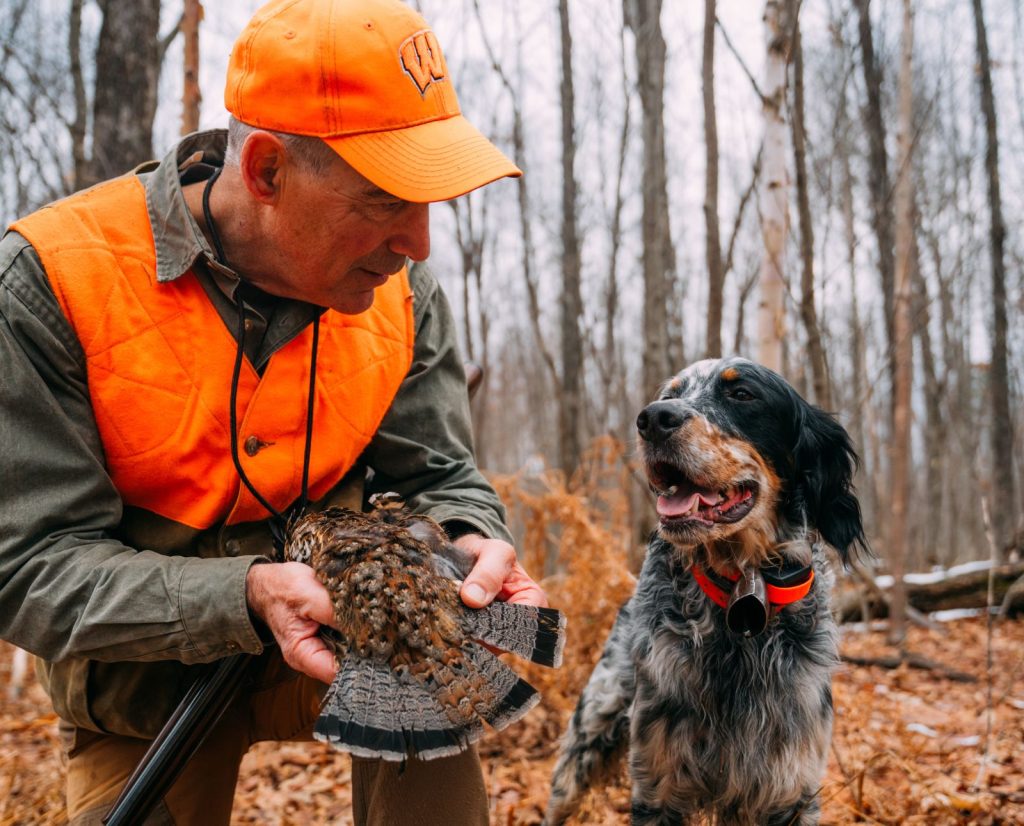
It comes as no surprise that the ruffed grouse, deemed the “king of the birds,” is the second most popular game bird in the Project Upland community. Project Upland was founded in the ruffed grouse covers of the Northeast in 2014, and these places remain a staple among the settings of our print articles, feature films, and podcast episodes today.
Nearly everything about the ruffed grouse contributes to its appeal: thickly vegetated habitat, difficult shooting, an unwillingness to cooperate with bird dogs, excellent table fare, well-known conservation challenges, and a rich cultural history.
Listen: The Mystery of Grouse Drumming: From Thunder to Artificial Intelligence
Ruffed grouse hunting is a classic American pastime that has been well documented in hunting literature for over a hundred years. Some of the most famous pieces of upland literature revolve around this bird, including the works of Burton Spiller, George Bird Evans, and William Harnden Foster, to name a few. Aldo Leopold has also mentioned ruffed grouse many times in his writings. Two of his most beloved ruffed grouse quotes include, “There are two kinds of hunting: ordinary hunting, and ruffed grouse hunting,” and “the autumn landscape in the north woods is the land, plus a red maple, plus a ruffed grouse. In terms of conventional physics, the grouse represents only a millionth of either the mass or the energy of an acre. Yet subtract the grouse and the whole thing is dead.”
According to the survey, ruffed grouse hunters are some of the most active hunters in our community; 47 percent of them spent more than 30 days afield last season. Additionally, 68 percent also hunted American woodcock (which is, spoiler alert, the third most popular bird on this list). Most remarkably, 99.1 percent hunted on public or publicly accessible land; just 0.9 percent of ruffed grouse hunters reported hunting exclusively on private land. This information shows just how intertwined ruffed grouse and woodcock hunting are and how reliant grouse hunters are on public lands for hunting access.
Given that Project Upland was essentially founded because of ruffed grouse, we have a plethora of films, articles, and podcasts about them. Tune into the Project Upland Podcast to learn about the intersection of ruffed grouse drumming and technology. Read all of our online articles on ruffed grouse here. You can also watch:
- Upland Matters, a Wisconsin-based film featuring author Mark Parman and illustrator Jay Dowd (you can also read Parman’s book Upland Matters here)
- The River As Our Guide, a rafting and grouse hunting trip on the Ronde River
- Take It To Here and Those Moments, two grouse hunting videos filmed in Maine
- Some of our oldest films: Searching, Partridge Country, The Experience, and Because They’re Wild, all filmed in the Northeast
3. American Woodcock: 41%
For many people, American woodcock hunting goes hand-in-hand with ruffed grouse hunting, a claim supported with data from our annual survey. Woodcock go by many names, including mud bat, timberdoodle, bog sucker, little russet fellow, Labrador twister, and even blind snipe. Regardless of what you call them, nearly half of the folks in the Project Upland community spent three or more days hunting them last season.
Unlike ruffed grouse and pheasants, woodcock are migratory birds. As such, they fall under federal regulation and occupy two flyways: the eastern flyway, which covers the Atlantic coast from northeastern Canada to Cuba, and the central flyway, which extends roughly from north-central Canada to Louisiana and the mouth of the Mississippi River. In the eastern flyway, woodcock are well-studied thanks to the Eastern Woodcock Migration Research Cooperative, “an international collaborative interested in understanding migratory ecology for the American Woodcock,” according to its website.
Read: Unusual Facts About American Woodcock
Woodcock are known for honoring the dog. It is interesting to see how this notion appeared in our annual community survey data, which showed that dogs are extraordinarily important to woodcock hunters. Seventy-two percent of woodcock hunters stated that 100 percent of their hunts involve a dog. Ninety-two percent of them currently own a bird dog. Additionally, when asked whether dogs played a critical role in their continuing to hunt throughout their lives, 85 percent of them said “very much” or “completely.” Dogs are important to upland hunters generally, but the relationship appears especially strong among woodcock hunters.
Learn about the woodcock’s unusual itinerant breeding strategy in the Project Upland Podcast episode “Rare Itinerant Breeders: How Researchers Discovered the Woodcock’s Unique Breeding Strategy.” You can also check out all of our woodcock articles here. There are also many films featuring woodcock, including Lowcountry, Take It To Here, A Season For Timber, Through The Trees, First Season, Moving Forward, The Opportunity, Because They’re Wild, and more.
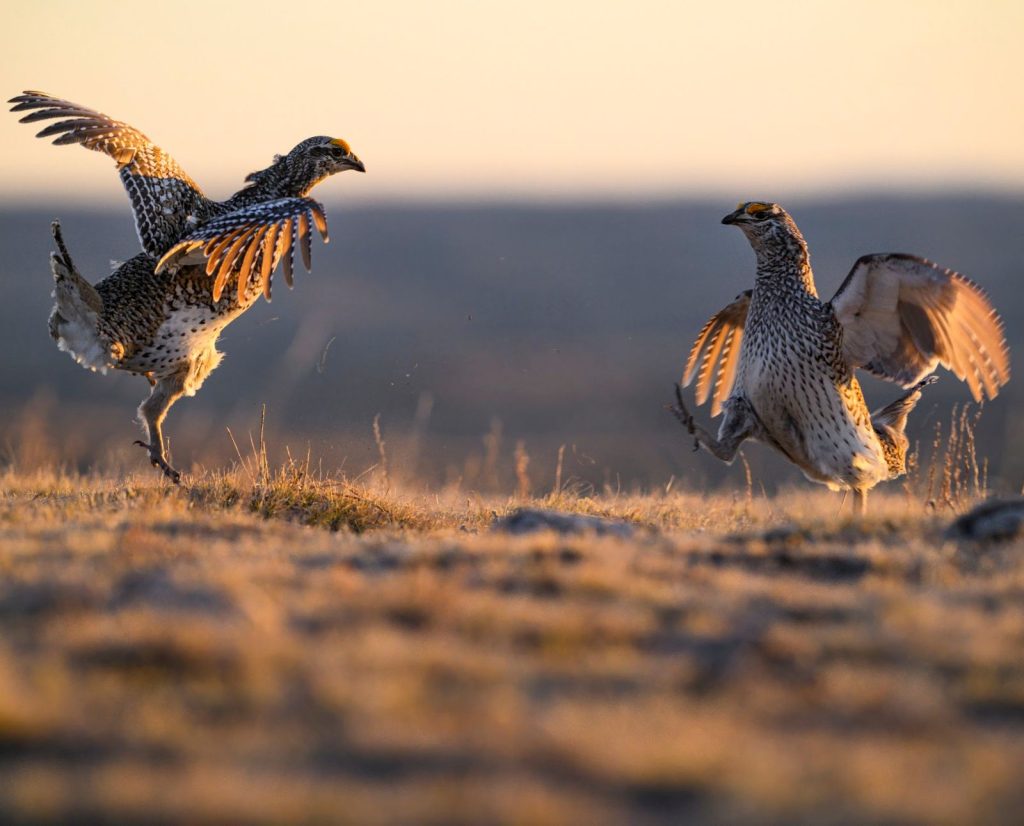
4. Sharp-tailed Grouse: 29%
Sharp-tailed grouse are the only prairie grouse that have made the top five most popular upland gamebirds in the last four years. While the number of folks who hunt them for more than three days in a season pales in comparison to the number of pheasant hunters, there is still a robust following for this beautiful, charismatic native bird.
Read: Firebirds of the Northwest Sands
Sharp-tailed grouse were the subject of our recent film, Dancing at Sunrise. Videographer and photographer Seth Owens captured this bird over the course of a calendar year, documenting the birds and their habitat during the spring, summer, fall, and winter in this Planet Earth-inspired video. Seth wrote a companion article to go along with the film, “Displays of Change,” which was the feature article in the spring 2026 issue of Project Upland Magazine. A pink-and-purple image he took of a sharptail at sunrise was also on the cover.
Sharptails are also the focus of the Project Upland Foundation’s first-ever fundraiser, the Sharp-tailed Grouse Stamp. Featuring original artwork by our art director Josh Powell, the proceeds from this stamp will go directly to Dr. Lance McNew’s research lab at Montana State University. On August 20, 2026, we passed our initial $5,000 goal, and we have now increased it to $7,500. You can learn more about how game bird research is funded and Dr. McNew’s research in “Who Pays for Gamebird Research?,” an episode of the Project Upland Podcast.
According to the community survey, about 56 percent of upland hunters spent at least 22 days in the field last season. Sharptail hunters, however, were even more active; 73 percent of them spent at least 22 days afield. Sharptail hunters are also very willing to travel. Just five percent exclusively hunt in their state of residence. When hunting out of state, their most commonly reported destinations were North Dakota, Montana, South Dakota, Kansas, and Nebraska. They also didn’t just hunt sharpies for three or more days last season; 83 percent chased pheasants, 68 percent hunted Huns, and 27 percent pursued prairie chickens. Additionally, 86 percent reported that every single one of their hunts last season involved a dog. Sharptail hunters are active, traveling, mixed-bag hunters who clearly appreciate hunting with a great dog.
Read all of our sharp-tailed grouse articles here. Also check out How Much Passion and Love Letter to North Dakota, a sharptail and Hungarian partridge hunting film that takes place in—you guessed it—North Dakota, a sharptail hunter’s favorite state.
5. Bobwhite Quail: 28%
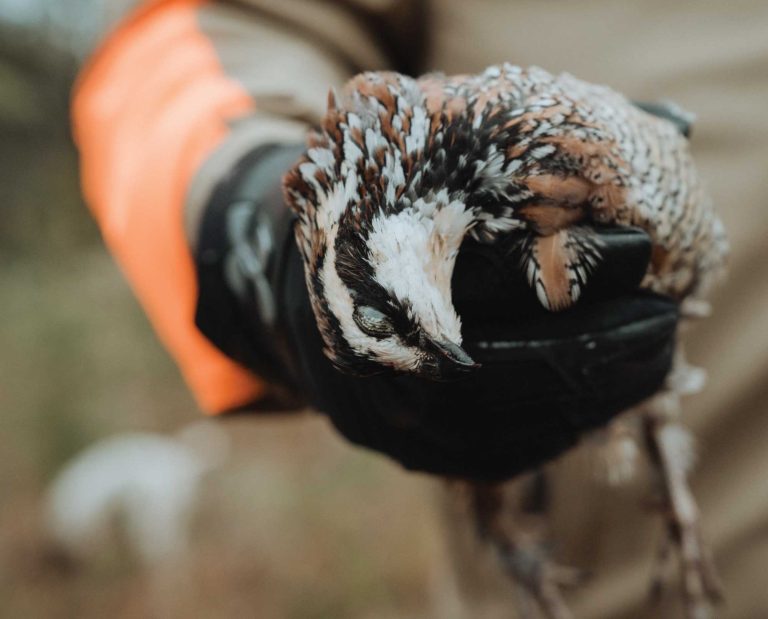
Northern bobwhite quail, despite a significant cultural following for decades, are the fifth most popular bird of 2026. Historically, they’ve been nearly tied with sharptails for several years now; however, if this survey had been going on in the mid-1900s, perhaps bobwhite would be much higher up on this list.
The northern bobwhite, often called the ‘prince of gamebirds,’ is especially iconic in the South. The historical hunting of them on plantations, in open pine forests, and even on the South Texas Sand Sheet has led to a distinct upland culture featuring competitive field trials and guided hunts on private lands. Despite the love and respect upland hunters hold for bobwhite across their range, they are also one of the gamebirds experiencing steep population declines.
In the film Something about a Bobwhite and the article “Midwestern Bobwhite Quail Conservation: The Time for Action is Now,” wildlife biologists Kyle Hedges and Frank Loncarich stressed that “Right now, the opportunity to conserve bobwhite quail at the national level is at an all-time high. State and federal natural resource managers are primed to financially and logistically support private landowners looking to create bobwhite habitat. Restoring native grasslands, especially on private lands, will help conserve this iconic game bird across the eastern United States.” When it comes to recovering bobwhite quail across the United States, there is no time like the present.
Something unique about the bobwhite quail hunter data is just how geographically broad the responses are. The states with the most bobwhite hunters in our survey were Kansas, Colorado, North Carolina, Texas, Florida, and Virginia, although no single state accounted for even 10 percent of bobwhite hunters. Additionally, these folks weren’t bobwhite hunting specialists. Instead, they were mixed-bag hunters because they also hunted pheasants (70%), woodcock (43%), doves (40%), ruffed grouse (36%), sharptails (36%), Huns (25%), and prairie chickens (21%). Based on this information, there may be several distinct types of bobwhite hunters represented in our community, from Southern hunters with strong regional hunting traditions to traveling Great Plains hunters in search of several upland species. Better understanding those distinctions might be a worthwhile goal for our 2027 survey.
Bobwhite made an appearance in several Project Upland films, including the previously mentioned Something About a Bobwhite, Food and Hunting, Plantation Quail, and Hard Day Riding, an exploration of the overlooked culture of African American bird dog trainers in plantation quail culture. You can also read all of our bobwhite quail articles here.
The Top 10 Gamebirds of 2026
If your favorite bird didn’t make the top five, maybe you’ll find it in the top ten. Here are the other five birds that completed the top ten:
6. Hungarian (gray) partridge: 24.7%
7. Doves: 23.2%
8. Chukar: 20.7%
9. California (valley) quail: 11.1%
10. Dusky grouse: 10.1%
Hungarian partridge are generally referred to as “bonus birds.” It’s hard to say whether all those Hun hunters were chasing Huns specifically, or if they were pursuing them in addition to other birds like prairie grouse or chukar at the same time. Either way, these tasty little birds were lining nearly 25 percent of upland vests last season.
Doves have made it into the top five birds before. However, this year, they did not make the cut. Perhaps hunters only pursued them on opening weekend and let them be for the remaining 88 days of dove season; without updating the community survey questions for 2027, it’s hard to say. What we can say is that about 23 percent hunted doves for more than three days last season. How many dove poppers that produced is also a question for next year’s survey.
Cook: Project Upland’s Wild Game Recipes
Despite the seemingly large chukar following on social media, just 20.7 percent of bird hunters pursued them for more than three days last season. Will that information make your local chukar haunt feel less busy? That is for us to speculate on and for you to find out.
California quail and dusky grouse were nearly tied at 11 percent and 10 percent, respectively. These two Western gamebirds tend to be locally loved but generally underappreciated by nonresident hunters, which isn’t a bad thing. They may not have the allure of bucket list trips like sage grouse hunting or burning out your quads chasing Hells Canyon chukar, but for those who live within their ranges, they offer great post-work hunting opportunities and delicious table fare.
ICYMI: Previous Years’ Most Popular Gamebirds
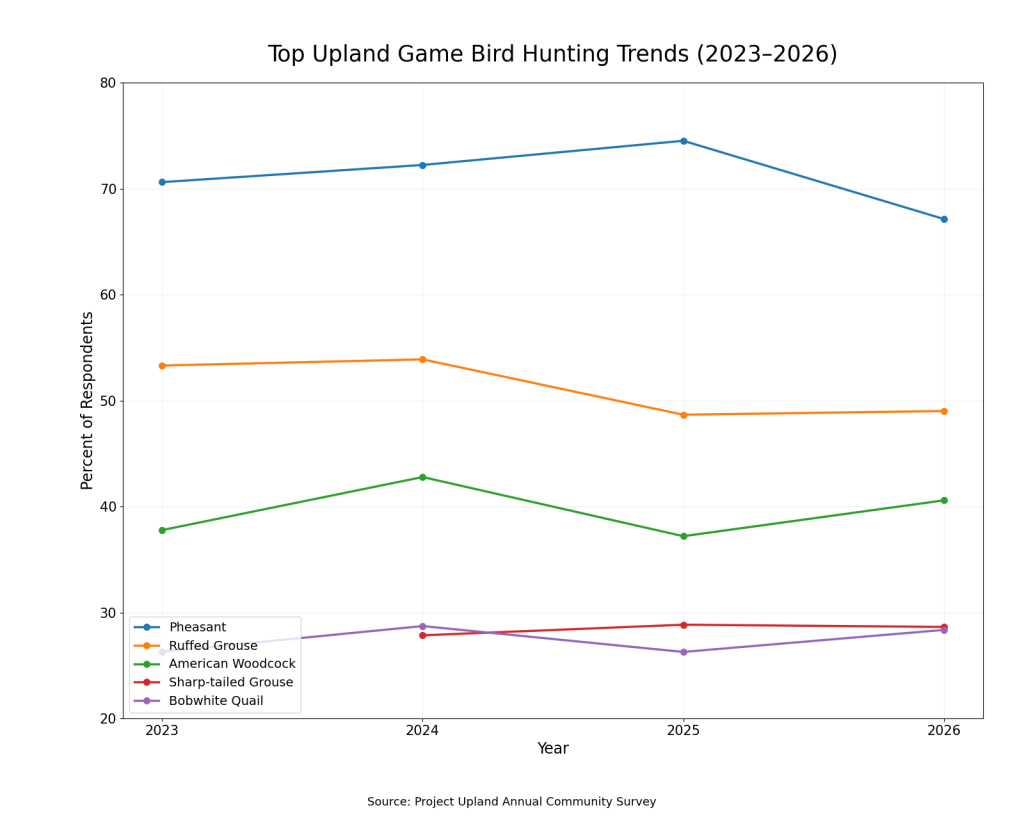
In case you missed it, here are the top ten most popular gamebirds since 2023, according to the Project Upland Community Survey.
| Bird Species | 2026 | 2025 | 2024 | 2023 |
| Pheasant | 67.13% | 74.51% | 72.23% | 70.61% |
| Ruffed Grouse | 49.02% | 48.67% | 53.89% | 53.31% |
| American Woodcock | 40.59% | 37.21% | 42.79% | 37.78% |
| Sharp-tailed Grouse | 28.65% | 28.86% | 27.86% | — |
| Bobwhite Quail | 28.37% | 26.29% | 28.73% | 26.32% |
| Hungarian (Gray) Partridge | 24.72% | 24.87% | 22.45% | — |
| Doves | 23.17% | 24.07% | 29.87% | 27.06% |
| Chukar | 20.65% | 21.23% | 17.55% | — |
| California (Valley) Quail | 11.10% | — | 9.00% | — |
| Dusky Grouse | 10.11% | 10.12% | 9.69% | — |
| Prairie Chickens | 9.83% | 9.77% | 8.65% | — |
Pheasant has consistently ranked as the most popular upland game bird among Project Upland survey respondents, followed by ruffed grouse and American woodcock. Overall, these rankings have remained remarkably stable since 2023. The biggest change came in 2026, when pheasant participation fell from 74.5 percent to 67.1 percent after reaching a four-year high in 2025. Meanwhile, woodcock rebounded, while participation among sharp-tailed grouse, bobwhite quail, Hungarian partridge, and chukar hunters remained comparatively steady.
Upland bird hunting is shaped by geography, access, tradition, bird dogs, and the birds themselves. While pheasants, ruffed grouse, and American woodcock have remained firmly at the top of this list, the Project Upland Community Survey gives us a way to watch these hunting preferences evolve over time. More importantly, the data reveal that popularity is about more than which birds we hunt. It reflects where we travel, how much time we spend afield, the dogs we hunt behind, and the landscapes that make these experiences possible.
Of course, no survey can tell you which game bird should be your favorite. That argument is best settled on a tailgate or around a campfire.