

Why French Pointing Dog Breeds Are Uncommon in North America
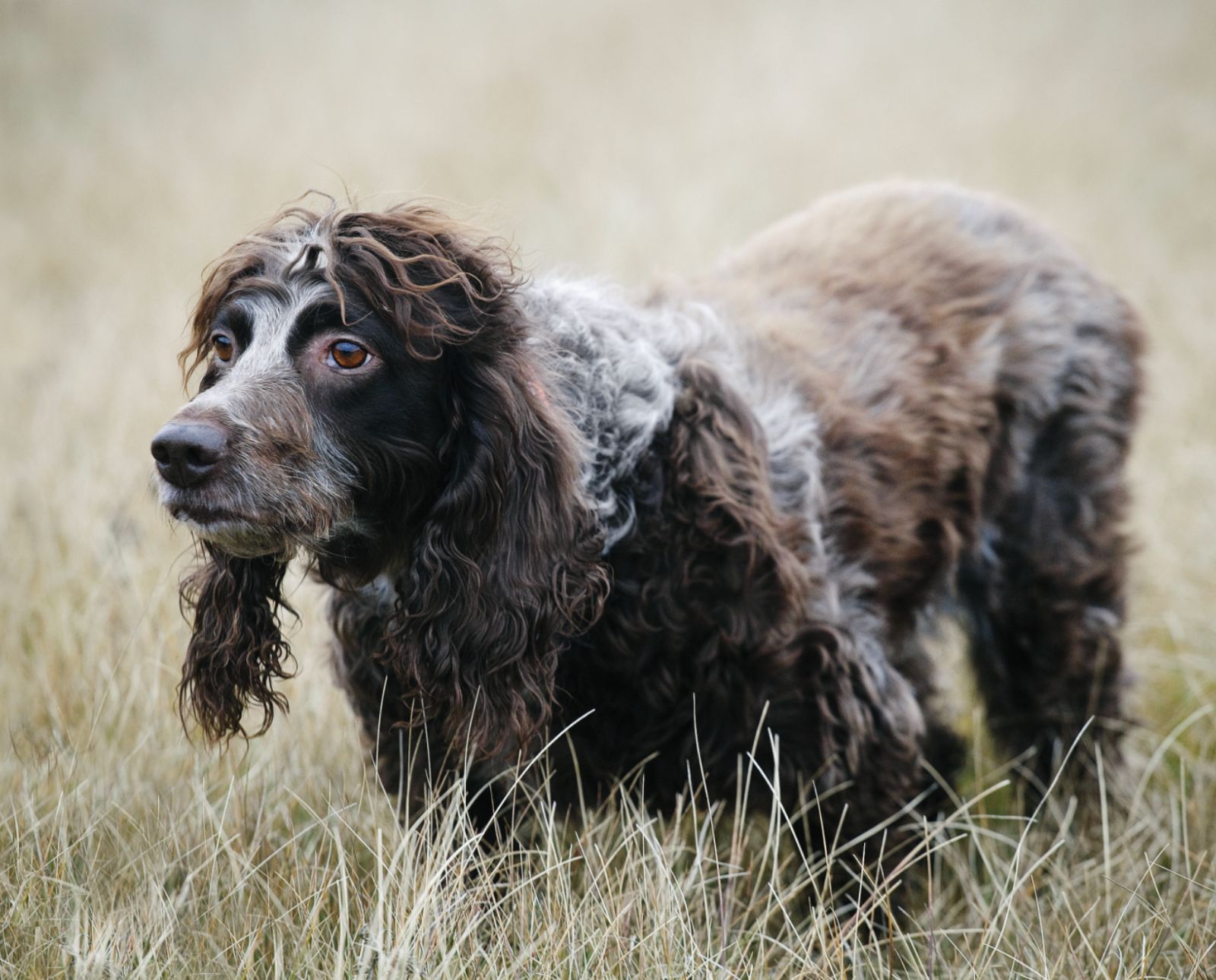
French pointing dog breeds were built for upland hunting, so why have so few become popular in North America?
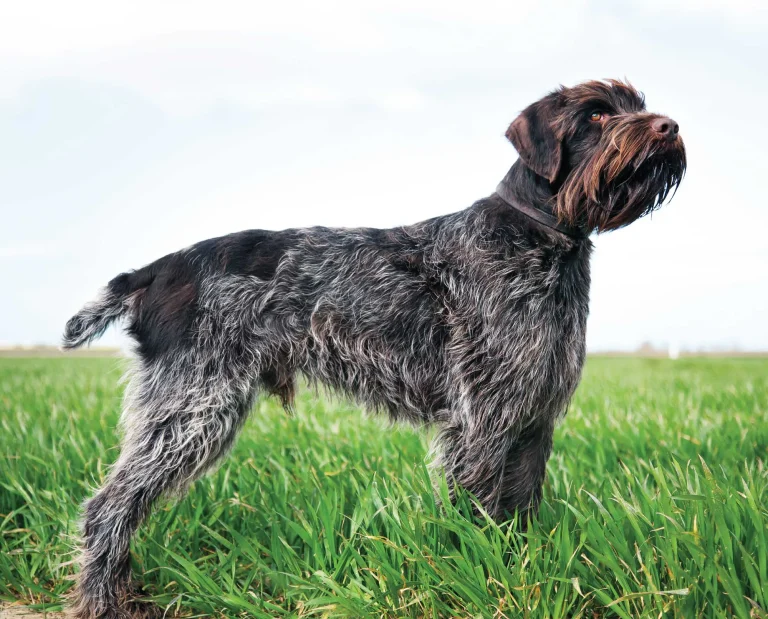
If you are just about anywhere in the United States or Canada and you see a pointing dog that is not a Pointer or setter, odds are it’s a German Shorthaired Pointer (GSP) or a German Wirehaired Pointer (GWP). In some regions, you might see a Pudelpointer, Small Munsterlander, or Weimaraner. But other than the occasional Brittany, any other dog you see will be from one of the German breeds.
Yet upland shooting traditions in France are very similar to our own, which is unlike Germany, where the average hunter will shoot more foxes in a year than pheasants in a lifetime. All the French pointing breeds were developed to excel at upland bird hunting, not blood track, dispatch vermin, or protect the home. Of course, with the proper training, many of them can do those things, but it’s not really their jam.
Most French pointing breeds remain relatively unknown in North America despite being developed specifically for upland hunting. This is largely because they arrived later than German hunting dog breeds, had limited exposure through field trials and hunt tests, and lacked the strong international breed club networks that helped German hunting dogs gain popularity in America.
Understanding why French pointing dog breeds aren’t as popular as German breeds in America requires a look at history, culture, and the evolution of American hunting dog testing.
Why French Pointing Breeds Should Be More Popular in America
In my view, a French hunting dog is a perfect fit for many hunters in North America. In addition to being hard-wired mainly for upland bird hunting, French bird dogs tend to be on the softer, easier-going side, with little to no desire to tangle with predators or chase fur. They also have plenty of run and point, and most are natural retrievers. Some were specifically developed to handle hot, arid conditions in southern France, while others were created for mixed-bag hunting in the cool, wet north.
With some breeds, size played a role in their development. The Braque Francais, Braque du Bourbonnais, and Épagneul Breton were all developed as compact bird dog breeds that don’t take up much space in the truck, but are fully capable of holding their own in the uplands. So, if French hunting dogs are the best fit for many upland hunters in North America, why are there so few around?
To answer that question, we have to fire up the time machine and set the dial to the 1920s.
Louis A. Thebaud and the First French Dogs in America
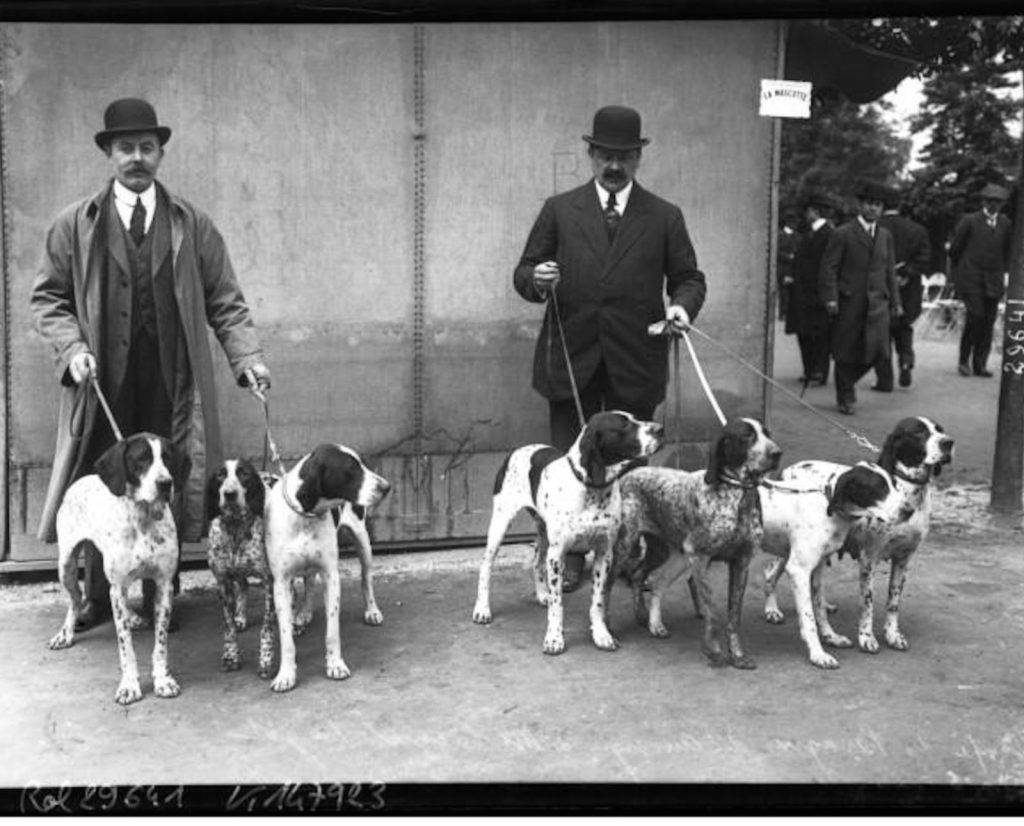
Our first stop will be the home of Mr. Louis A. Thebaud, near Morristown, New Jersey. Thebaud was of French descent and would often travel to France to hunt. There, he was introduced to the Korthals Griffon and was so impressed with their all-around abilities that he decided to import some and, with the help of Dr. E.B. Hyus, Thebaud eventually established a breeding program and club for the breed.
Thebaud followed a similar path with the Brittany. He liked what he saw in France and thought the breed would be a perfect fit for American sportsmen and women.
Thebaud would go on to pour massive amounts of time and money into promoting Griffons and Brittanies. Thanks to his efforts and the dedication of those who followed him, both breeds are still with us today. However, today, the Brittany is one of the most celebrated gundog breeds on the continent, while the Griffon—well-loved and respected by some—is a relatively rare breed.
Why is there such a difference? In my view, it came down to familiarity and adaptability to the North American scene.
Why the Brittany Succeeded While the Griffon Struggled in America
When Griffons first appeared, they were welcomed by hunters who admired them for their all-around capabilities. A few of the imports could even hold their own in field trials, but most were not in the same league as the Pointers and setters of the day when it came to range, speed, and style. That is not to say they were slow “old man’s dogs.” That reputation—unfounded in my view—came later. The main problem was that Griffons were different. They did not look like the bird dogs upland hunters and field trialers were used to seeing, and they soon realized that Griffons were not easy to breed or “Americanize.”

The Challenge of the Griffon’s Wirehaired Coat
Wire-haired coats, something most North Americans had never seen in a bird dog, are notoriously difficult to stabilize. They require a much higher level of selection than the Pointer’s short coat or the long coat of an English Setter.
With those breeds, you know what kind of coat you will get every time. With a wire-haired breed, even with the utmost care, you can get pups with short coats, woolly coats, and perfect wire-haired coats all in the same litter. And if you decide to introduce a bit of Pointer or setter blood into your line to get a bit more speed and range for field trials, then all bets are off. Who knows what kind of coat you will get and how many generations it will take to get a proper wirehaired coat back?
We can only imagine the frustration of those early Griffon adopters. Many, like George Ryman, who founded his own strain of English Setters, only stuck with the breed for a few years before moving on to another.
Brittanies: A More Familiar Bird Dog
The Brittany, on the other hand, was much closer to what hunters and field trialers were familiar with at the time. When they first appeared in North America, the English Setter was top-dog on the field trial scene and the favorite bird dog of tens of thousands of hunters across the continent. To most people in the hunting dog world, Brittanies were easy to understand. Sure, they were smaller and not quite as fast and wide running as the best setters, but if you ignored the bobbed tail, the look was similar, and finding a Brittany that could hang with the big dogs in trials was not as difficult as finding a Griffon that could do the same.
Breeding Brittanies proved to be much easier than breeding Griffons. North Americans were very familiar with the long-haired coat and, as a bonus, if you thought that adding a drop or two of high-octane setter blood into your line was the way to go, it was easy. Just let nature take its course behind the barn on a moonless night, and bingo! Most of the resulting pups could easily be registered as ‘pure’ Brittanies, yet probably run more like setters.
Records indicate that very few Griffons ran in field trials in the U.S. in the early days, and only one or two ever won a placement. But Brittanies found success right off the bat. Here is part of a report from the American Field, published in May of 1935:
“The old saw that there is nothing new under the sun was dealt a body blow when the Brittany spaniel, Fanche du Cosquerou, won third place handily. This is the first time that such a dog has ever been placed in a field trial for pointing breeds in this country. Despite the fact that the writer is not given to making predictions, he wishes to prophesy that, if this mite continues to run the sort of race in the future that he exhibited here and find birds, he will be among the winners on many occasions in time to come. Asking no quarter and giving none, Fanche went into the lists and matched lances with his bigger brothers and sisters and emerged with victory landed upon his shield. His pace and range are pure poetry for the man afoot, but in no manner does it lack in scope. He went everywhere one could expect him to go in a snappy way. His one find out of the bird field and the one in it were pointed stanchly and handled perfectly. He is a gallant little fellow and has won his spurs beyond the slightest question of a doubt. Owned by L.A. Thebaud, Fanche was handled by H.A. Ammerman.”
By the early 1930s, Brittany enthusiasts were making headway with their easy-to-breed, easy-to-understand, competitive bird dogs. Griffon enthusiasts, on the other hand, were struggling. They were having a hard time stabilizing the coat, and, for some reason I still can’t figure out, they were being promoted as slow, close-working “old man’s dogs.”
Then, the Germans showed up.

How German Breeds Changed the North American Bird Dog Landscape
In 1925, Dr. Charles K. Thornton from Missoula, Montana, imported two GSPs: a female in whelp and a male. Soon after, he imported a dozen more. By the outbreak of World War II, Thornton and others had secured a solid foothold for the breed in North America. Like the Brittany, GSPs were easy to understand and easy to breed. Their short coat was familiar and predictable and would not be ruined if, by chance, a GSP had a one-night stand with a Pointer.
After the Second World War, a deluge of dogs from previously unknown continental pointing breeds began to appear on the North American scene. Almost all of them were German. Why? Where were all the French hunting dog breeds?
The Post-World War II German Hunting Dog Boom
Let’s hop in the time machine once again and set the dial to 1945, for just about anywhere in Germany. Upon our arrival, we would find a country devastated by war, a German population just trying to survive, and hundreds of thousands of Allied troops stationed around the country. And even though many dogs and breeders perished in the war, some survived. Inevitably, troops stationed in Germany came across those dogs, and when they did, they liked what they saw.
Let’s not forget that most Allied service members in Germany at that time were young men, many of them keen hunters with dogs of their own back home. And they found themselves in a country filled with millions of desperate people ready to sell just about anything, including their best dogs, just to make it to the next day. With cash in hand, those young soldiers purchased dogs by the thousands.
In the early years, thousands of adult dogs were sold, and almost every pup whelped by a German breeder found an eager Allied soldier ready to take it home. By the early 1950s, the situation was almost out of control. Several breed clubs in Germany passed rules prohibiting their members from selling more than 50 percent of the pups for export.
Meanwhile, in France, no foreign troops occupied the country, and the average French citizen had no need or desire to sell their dogs to a foreigner. The native French pointing dog breeds never really left France, and except for the Brittany and Wirehaired Pointing Griffon, they remained unknown to the rest of the world.
The Return of French Pointing Dog Breeds to North America
It wasn’t until the late 1960s and early 1970s that some of the lesser-known French pointing dog breeds began to appear on the North American scene. Among the earliest adopters were hunters in Quebec who began importing and breeding French Spaniels (épagneul français) and Braque Français. Eventually, American hunters discovered those breeds as well and began importing and breeding others, including the Braque du Bourbonnais and the Braque d’Auvergne.
Meanwhile, selection for field trials and a bit of creative cross-breeding had “Americanized” pre-war lines of Brittanies in North America. The dogs had become somewhat larger, faster, and bigger-running than their cousins back home in France. And those modifications eventually sparked a countermovement among some breed enthusiasts, who began importing Brittanies directly from France. They called their dogs “French Brittanies” to help distinguish them from the Americanized version. In 2002, the UKC recognized those dogs as a separate breed. Today they are called “Épagnuel Bretons.”

French Hunting Dogs and the NAVHDA Challenge
Yet despite the fact that just about every French pointing breed has made its way into North America at some point over the last 50 years, only the Brittany and Wirehaired Pointing Griffon have managed to capture the imagination of more than a handful of hunters. Thankfully, all the French pointing dog breeds can be registered and tested with the North American Versatile Hunting Dog Association (NAVHDA), and the Griffon in particular has greatly benefited from that organization’s testing system. But it is important to remember that NAVHDA’s hunt tests were inspired by a system developed in Germany to evaluate German dogs. Of course, they were modified to suit North American hunting styles and traditions, but key after-the-shot performance requirements, such as tracking and water work, were retained. Naturally, breeds developed for those kinds of things have a leg-up, and breeds that weren’t may struggle to meet the requirements.
You see, none of the French pointing dog breeds were ever developed to be versatile dogs as defined by NAVHDA. They were, and always have been, “chiens de chasse pratique,” or practical hunting dogs bred to be upland hunting specialists that fetch, mainly on land. Sure, there are dogs from every French pointing breed that have what it takes to pass the highest levels of NAVHDA or German hunt tests. But the basic traits hard-wired into them since day one have more in common with Pointers and setters than Deutsch Drahthaars and GSPs. (This also applies to the pointing breeds developed in Spain, Portugal, and Italy. Like all the French bird dog breeds, they were developed to be mainly upland specialists, not the “do-it-all” dogs created in Germany and eastern Europe.)
When a French breed is introduced into North America, breed supporters find themselves in a bit of a quandary. If they want to prove their dogs in competition, they have very little choice; most of the French breeds are not recognized by the American Kennel Club (AKC) or Canadian Kennel Club (CKC). And if they want to participate in hunt tests, their only choice is NAVHDA with its German-inspired testing system. And, to be fair, many of those supporters have done great things with their dogs in NAVHDA and have used the testing system to improve their lines. Still, seeing any French breed other than a Griffon at a NAVHDA test is relatively rare.
How French Pointing Dog Breed Clubs Can Grow in North America
So, what can be done to improve the situation for the French hunting dog breeds in North America? The first step, in my view, would be to follow the Germans’ lead. Let me explain.
When German hunting dog breeds first appeared in North America, there was only one system of evaluation: field trials. Some breeds, particularly the GSP, benefited enormously from that system. Then came NAVHDA. It grew by leaps and bounds and turbocharged the growth of the GWP, Pudelpointer, and others. Eventually, enthusiasts from several German breeds established full-fledged chapters of the German club for their breed right here in North America.
Today, if you own a German hunting dog breed, you have a lot of options for proving your dog in trials or tests. And if you want or need the support of people with strong ties to Germany, it’s just a phone call or email message away.
However, if you have a French hunting dog breed, your options are limited. Most French pointing dog breeds are not recognized by the AKC or CKC, so their field trials and hunt tests are out. You can test your dogs with NAVHDA, which recognizes all the French hunting dog breeds, but NAVHDA tests may not be the best fit for your breeding program. Even worse, if there is a North American club for your French breed, it is probably quite small with little to no connection to the parent club in France.
But there is light on the horizon. In recent years, the Club de L’épagneul Breton of the United States and the newly formed Korthals Griffon Club United States have organized United Kennel Club (UKC) field trials under French rules, overseen by French judges. Many of their events have been open to all French hunting dog breeds, and they seem to be gaining support from the community. Personally, I would strongly encourage anyone with a French pointing dog breed to participate in these events. The key to growth for any bird dog breed is awareness, and there is no better way to raise awareness among hunters than through public competition and tests organized by and for hunters.
But there is another key to success for supporters of the French pointing dog breeds, and it is something they can learn from the Germans.

Learning from the German Hunting Dog Model
Remember the post-World War II influx of dogs from Germany that I mentioned earlier? Well, it never really stopped. To this day, North American hunters import dogs from Germany, and those dogs continue to play a major role in German-affiliated breed clubs and beyond. And every year, German and North American hunters, judges, breed wardens, and club members cross the ocean in both directions to hunt, test, and breed hunting dogs.
A similar robust exchange simply does not exist for the French dog breeds. The only club with a long-standing relationship with the parent club in France is the Club de l’épagneul Breton. All the others are, to one degree or another, trying to make it on their own, without much support from the French kennel club or from other breed clubs based on this side of the ocean. Even individual breeders with excellent contacts in France are at a disadvantage. The French kennel club does not recognize any titles or test scores earned in North America, so the exchange of dogs is almost completely one-way, from France to North America. As a result, the number of French hunters, judges, and club members who come here to hunt, judge, or breed dogs is minuscule, and the number of North Americans who travel to France is equally small.
A Future for French Pointing Dog Breeds
So what is the solution? I believe it lies in the power of unity. There is great strength in numbers, and when like-minded hunters set their sights on a common goal, great things can happen.
A North American umbrella group or alliance representing all the French hunting dog breeds could provide the kind of support that smaller clubs and individual breeders require. They could strengthen existing ties to France and create a formal structure to facilitate the exchange of dogs in both directions, as German-affiliated clubs do now. Such an organization could conduct additional trials and tests in accordance with French rules and bring in more French judges. It could help breeders and hunters from North America contact people in France and organize exchange visits.
Once united, supporters of the French pointing dog breeds can do great things and, in turn, for the thousands of North American hunters who would enjoy great days afield hunting over easy-to-live-with, easy-to-handle, and naturally talented bird dogs.