

Foraging for Salicornia: How to Find, Harvest, and Cook Sea Asparagus
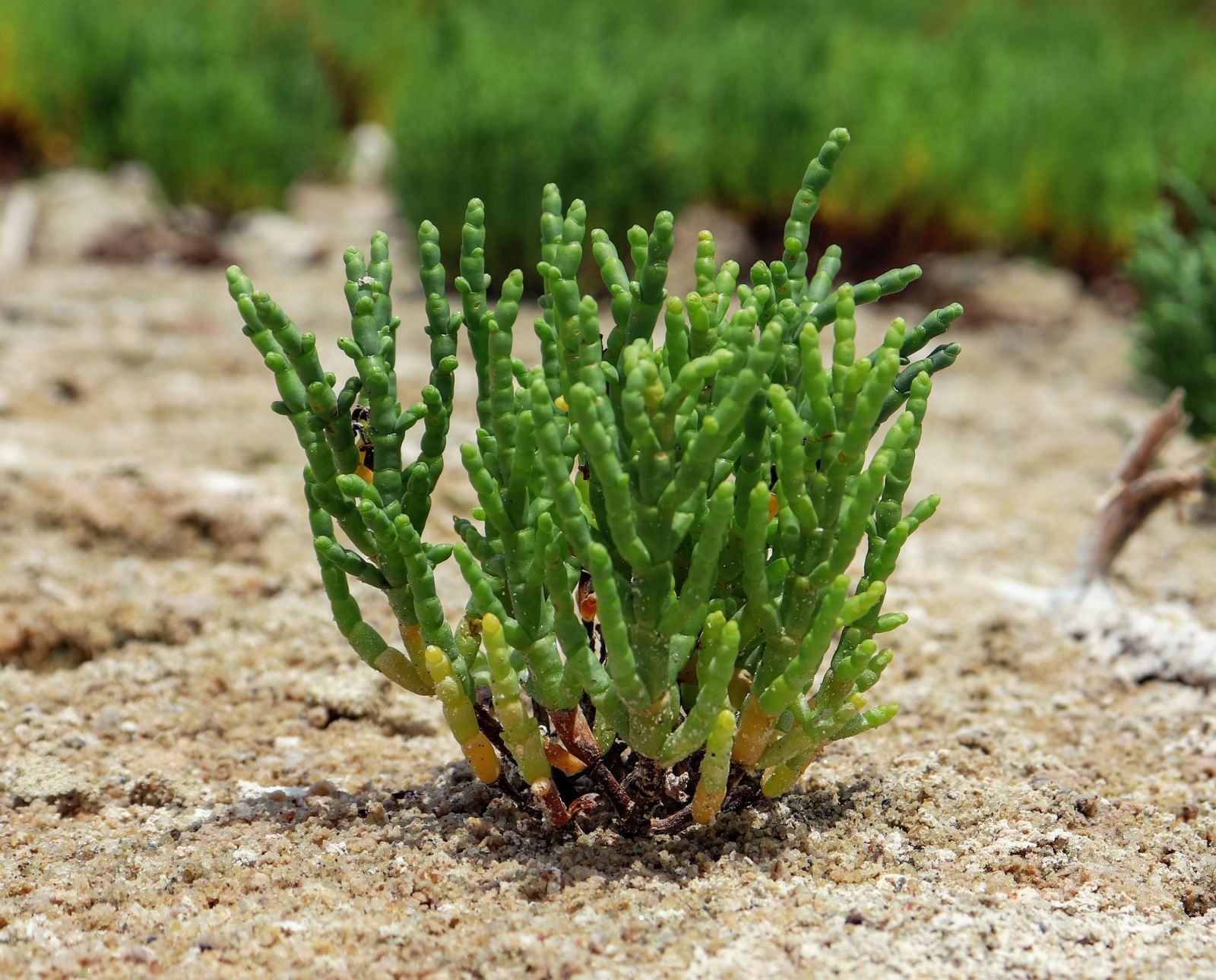
Whether you call them witch fingers, saltwort, sea asparagus, samphire, or just salicornia, this wild and edible coastal plant is easily found in salt marshes
Witch fingers, also known as salicornia, brought me to the salt marsh today. It’s a sun-scorched afternoon in mid-July and the sweltering heat radiates off the burly coat of my duck dog, Boone, as we forage for salicornia together.
At this point, he is no doubt reconsidering his pride as a cold weather-faring, thick-furred Golden Retriever. Just moments ago, we pulled into a gravel parking lot that butts up to an ocean inlet. Cool incoming ocean water swirls the jade green current filled with algae, minnows, and assumptions of larger gamefish beneath. As we approach the bank, I take note of the fluke fishermen drifting in the bay. Rail cackles rattle in the marsh grass while white ibis, egrets, herons, blackbirds, seagulls, skimmers, and terns glide overhead. In an ecosystem as fecund and vibrant as an Atlantic Coast salt marsh, it’s hard not to marvel at how much life one place can produce.
We follow the shore. Boone’s paws slosh overtop oyster shell halves while my waders sluice through the thick stand of cordgrass. When we turn inland, we climb up an imperceptible elevation gradient from the low marsh to the high marsh. I know I’m about to find some salicornia when the cordgrass stops and the salt hay begins.
Salicornia, also called sea asparagus, samphire, pickleweed, or witch fingers, is a salty edible succulent found in coastal salt marshes throughout North America and Europe. It grows in segmented, finger-like green stalks that resemble miniature cactus stems or succulent asparagus tips. Popular among foragers and chefs alike, salicornia can be eaten raw, pickled, blanched, or sautéed, and is one of the easiest wild edible plants to identify in tidal marsh ecosystems.
Common Names for Salicornia
Salicornia, witch fingers, saltwort, glasswort, sea asparagus, pickleweed, or samphire, the name you choose for this underappreciated salt marsh succulent is usually derived from your angle of familiarity with it.
If you find the plant offered on a restaurant menu in Europe or the Mediterranean, for example, it will be invariably called samphire. English, Turkish, French, Irish, and Italian culinary enthusiasts have long appreciated the uses of samphire, including it in dishes where they have pickled it, served it under fillets of cod, or tossed it in garlic and butter and served alongside lobster.
If you were a 16th century glassmaker, who used the ash of burned samphire to lower the melting point of silica, you would refer to the plant as glasswort. Glasswort was an almost necessary ingredient in glassmaking until the 19th century, until a feat of modern chemistry allowed for lowering the melting point of silica without the need for foraging for salicornia.
If, on the other hand, you belong to a crew of ethnobotanists, you might refer to the many species of this plant by their shared genus name, Salicornia. In 2005, a team of such researchers examined the mummified remains of a 550-year-old Native American man who melted out of a British Columbian glacier. The researchers analyzed the pollen grains still contained within his gut and discovered that he had a proclivity for picking and eating salicornia in the days before his death. Elders of the Southern Tutchone who inhabit southern Yukon named the man Kwäday Dän Ts’ìnchi, which means “long ago person found.”
If, in the modern day, you prefer a diet similar to Kwäday Dän Ts’ìnchi, you will probably refer to salicornia by more observational or reverential names, like sea asparagus, sea beans, pickleweed, or, more wryly, witch fingers.
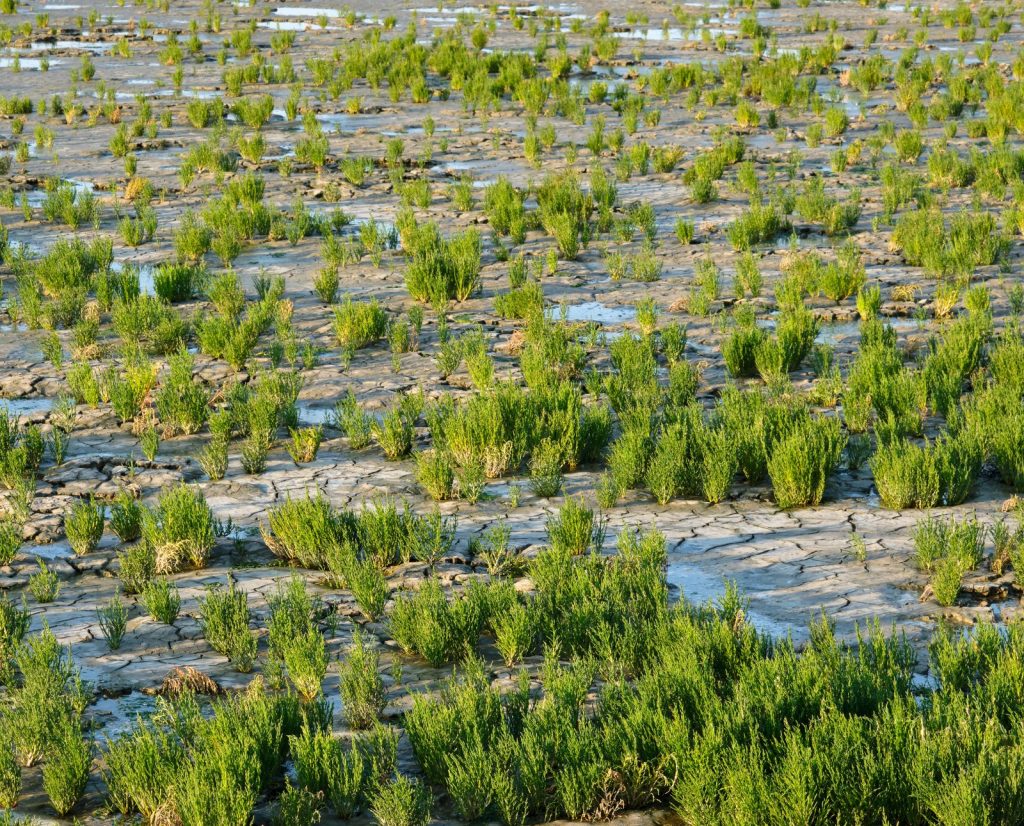
Where and How Salicornia Grows
Salicornia ranks high among that remarkable group of organisms which seem to exist, at least in part, to emphasize nature’s ingenuity. Salicornia thrives where other plants cannot. A defining feature of many plants is the presence of roots. As many of us will remember from our grade school science class, roots exist primarily to extract water from the soil. However, salt can impede that process and kill plants much in the same way that it kills slugs—it sucks all the water out. Plants of the coastal salt marsh, therefore, had to evolve clever means to maintain osmotic balance. Cordgrass evolved to excrete salt through specialized glands located on the surface of its leaves. That’s why careful examination of a cordgrass blade will reveal a coating of tiny, granular salt crystals. Plants like the common reed evolved mechanisms to exclude salt intake at the roots. Salicornia, instead, evolved to store salt in specialized chambers.
As a salt marsh succulent, the salt stored within a stalk of salicornia cannot harm the plant. Instead, it imbues a deep, savory flavor.
Beyond its evolved mechanisms for salt tolerance, salicornia occupies a perfectly catered ecological niche. First and foremost, it avoids the low marsh, as do most salt marsh plants which allow the cordgrass its own space along the deluged and muddy low banks. With the low marsh occupied, Salicornia instead grows in both of the remaining marsh zones: the transition zone from low marsh to high marsh and the high marsh itself.
Salt hay maintains dominance over the high marsh, but fails to outcompete salicornia fully. In fact, salt hay can act as an excellent indicator species for finding salicornia. You will recognize salt hay by its lush, stunted growth which grows in fields as thick and velvety as muskrat fur. In and around the peripheries of salt hay fields, you’re likely to find a few salicornia stalks. To find the monocrop salicornia pastures that provide enough growth for a family’s worth of salad, however, you will need to find where salicornia grows with no competition at all. An ecologically-minded salicornia forager, therefore, will locate a salt marsh panne.
Salt marsh pannes exist as shallow depressions pocked in seemingly random locations throughout the salt marsh. Here, continual cycles of tidal water collection and evaporation leave the soil inundated with salt. In other words, these are plant dead zones. The conditions can be so rough that not even salt hay can survive. This is where salicornia’s tenacity shines. As a pioneer plant, salicornia is among the first plants to colonize regions where the salt marsh has been wiped clean. Again, salicornia can thrive where other plants cannot. So, on these blank slates of mud and salt, salicornia grows without competitors. On a salt marsh panne, you might even find fields of it.
How to Forage for Salicornia
Salicornia can be harvested from early to late summer with September probably being a forager’s last shot. They’re best harvested when young, before they grow too much of a woody pith, so around June is peak salicornia season.
I’m picking at single strands of Salicornia as Boone and I probe the high marsh. I can’t help but eat as many stalks as I’m throwing in my burlap shopping bag. Usually, I stray away from indulgence while foraging. I’d rather practice delayed satisfaction by collecting a heap and preparing a meal later than scarf it all down before I even leave the field. But it takes more than a few stalks of Salicornia to make a salad, so I’ll be here for a while. Besides, I’m trying to find enough Salicornia to make a family’s worth of salads, and to do that, I’m going to need to find a field of it.
Somewhere along our salt marsh expedition, Boone caught the eye of a nesting willet who undoubtedly mistook his crimson red fur and four-legged gait for that of a fox. The willet took low swipes at Boone, closing enough distance to both provoke and not be ignored. I take a break from picking salicornia to let the scene play out. Boone’s already fighting the heat. His tongue hangs out the side of his mouth like a damp beach towel slung over a chair, and through the willet’s background racket of chirps and yodels, I can hear Boone panting.
Read: Protect Your Dog from Overheating and Heat-Related Illness
The willet flies in figure-eights, taking low swoops at Boone and retreating for untouchable air, but on its last descent, it takes a low, soaring glide just above the bristles of salt hay, eventually landing in what looks like a panne. On its open stage, the willet performs a show, extending its wing well past its outstretched foot, hobbling around and feigning a broken limb. This catches the attention of both Boone and I, engaging both of our predatory instincts. Boone, I imagine, sees the willet for an object of retrieval, like the ducks we will be after in just a few months. I’m, however, more focused on the stage. The willet hobbles over a stubby savanna of witch fingers.

Cooking Salicornia
By the time we make it back to the truck, I’m so thoroughly coated in sweat that when I catch a taste of salt on my lips, I can’t tell whether it’s from the sweat or the salicornia I’ve been eating. The burlap bag now sags with the weight of the salicornia, and when I judge the contents inside, I estimate it can accommodate for the dinner party I’m holding this afternoon.
Salicornia can be prepared in a variety of ways. Again, its varied names speak to its most valued purposes. Many who call the plant pickleweed bathe the plant in a sugar and vinegar brine. Can the concoction and let sit in the fridge for a few weeks, and you have pickled pickleweed.
Mediterranean dishes offer a more straightforward, quick-turnaround avenue for preparing salicornia. I’m taking that approach for my dinner party, with a quick garlic-butter salicornia salad served under seared scallops.
When preparing salicornia:
- Rinse it thoroughly
- Blanch it (if you’re not pickling it)
- Remove the hard pith
- Serve it blanched or dress it up with cherry tomatoes or other bright, acidic flavors
Regardless of how you plan to prepare your salicornia, rinse it thoroughly before all preparations. To make my favorite salad, blanch the salicornia for two minutes before submerging the greens in an ice bath. Once cooled, take larger stems and strip them of their pithy interior. To do this, I pinch the salicornia near its base, then pull the salicornia through my fingers. The edible green portions pull away from the interior like a green sock coming off a foot. The salad can be served right away, or you can brighten it however you want. Mix a little butter and garlic, and you have a wonderfully simple side dish. Add some halved cherry tomatoes, and you balance the dish with some acidity. Add some scallops, striped bass, clapper rail, or other local affairs, and you have a dish that showcases all the flavors of the marsh.