

Rock Ptarmigan: Habitat, Range, Life History, and Adaptations
Learn about one of the world’s hardiest grouse species that call the arctic tundra and windswept mountaintops home
“When you stop seeing conifers, keep going up. You’re almost there.” We had passed the last conifer, a mountain hemlock (Tsuga mertensiana), with a deeply twisted and curved trunk. Alpine wind sent shards of late-spring frost and snow across our faces, and the thawing crowberries underfoot left pink footprints behind us. To our right was the Turnagain Arm; to our left, seemingly endless mountain peaks. We continued up the ridge.
Nearing exhaustion and rapidly losing optimism, we sat and rested in a small sheltered crevice in the rock. Wind whipped in frozen vortices. Off a distant ridge, three stark-white orbs plummeted from a cliff. They fell, then they rose, flying within 20 yards of our shelter of stone. These birds were our target, the subject that had pulled us from the plains of North Dakota to the mountains of Alaska: rock ptarmigan (Lagopus muta).
Likely the toughest and most ornery species of grouse in North America, the rock ptarmigan resides in places most humans try to avoid. They’re most at home where we are most alien. But we had found them near the tippy-top of a frozen peak overlooking the distant ocean. Our faces were wind-burnt and shredded by ice, but we smiled as we watched these wonderfully stunning birds fly around the mountaintops.
Rock Ptarmigan Quick Facts
| Characteristic | Details |
| Scientific NameLagopus muta | Lagopus lagopus “Lago-” – Hare “-pus” – Foot. “Muta” – silent or mute “Silent Hare-Foot” Refers to its quiet nature and large feathered feet that act as snowshoes. |
| Taxonomic Order and Family | Order Galliformes, Family Phasianidae |
| Average Body Measurements | Total Length: 32–40 cm (12.6–15.8 in) Wingspan: 54–60 cm (21–24 in) Adult Males: 448–880 g (approx. 15.8 oz to 1 lb 15 oz) Adult Females: 406–700 g (approx. 14.3 oz to 1 lb 9 oz) Variation across populations is expected |
| Egg Characteristics | Buff color with dark brown or black splotches |
| Nest Characteristics | Bowl-shaped ground scrape lined with soft grasses, leaves, moss, and feathers |
| Diet | Highly dependent on buds, twigs, and catkins. The diet of all ages is mainly composed of vegetable matter like seeds, berries, buds, and leaves. Chicks will eat more arthropods than adults. |
| Habitat | Varies across range. Rocky and rugged mountaintops to frozen arctic tundra. |
| Range | Circumpolar with several isolated ranges in alpine habitats. |
| Estimated Population | Estimated at ~8 million birds |
| Conservation Status | Least Concern |
| Conservation Concerns | Climate change, woody encroachment, invasive predators, mesopredator range expansion |
| Similar Species | Willow ptarmigan (Lagopus lagopus), red grouse (Lagopus scotica), and white-tailed ptarmigan (Lagopus leucura) |
Rock Ptarmigan Physical Description
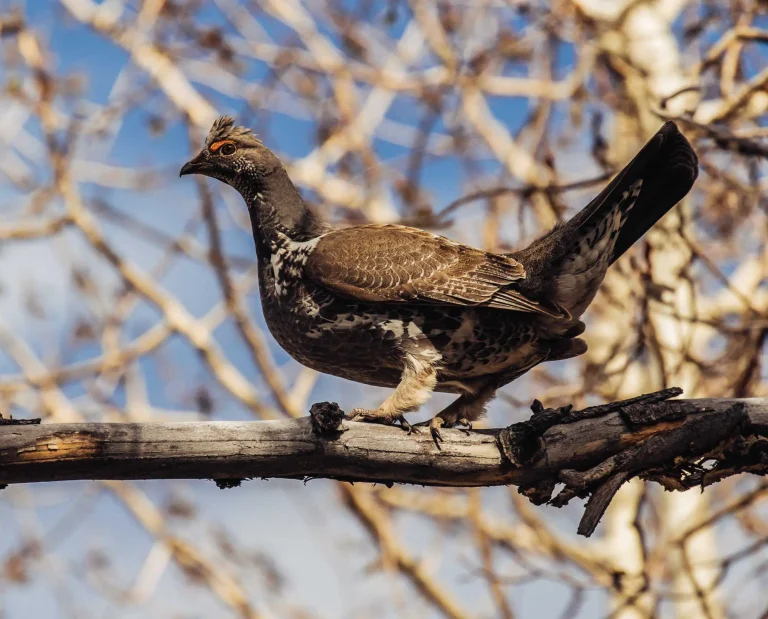
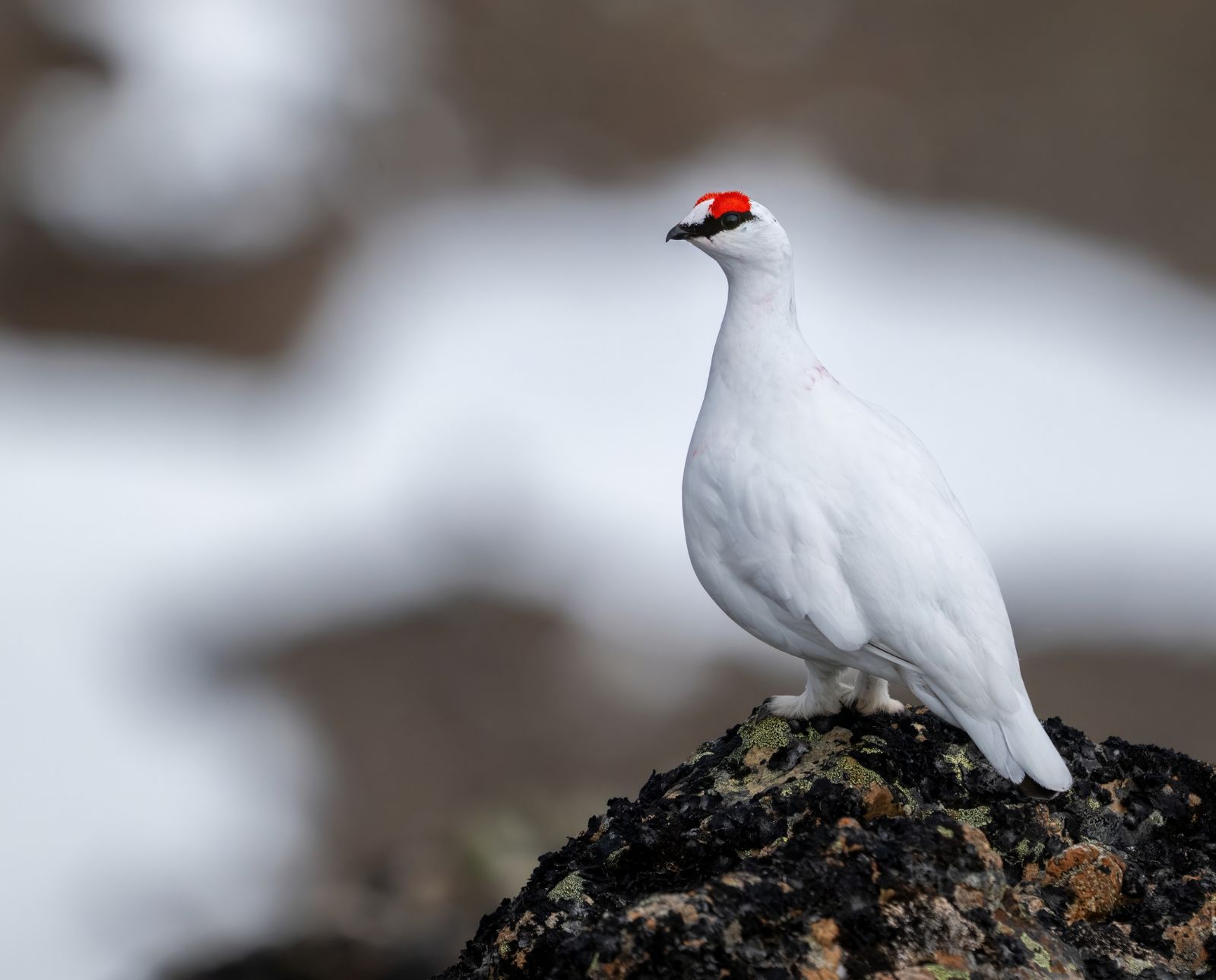
Rock ptarmigan, like the rest of their closest grouse relatives, are chicken-like birds not dissimilar to the overall shape of a sharp-tailed grouse or a shrunken dusky or sooty grouse. They’re round birds with a stocky build and short wings. Rock ptarmigan have a stunning scarlet eye comb, called the supraorbital comb, and it is present on nearly all species of grouse in varying colors. It is most obvious, and at its prettiest, during the breeding and courtship season.
Like the other three species in the Lagopus genus, rock ptarmigan have heavily feathered feet that act like snowshoes to help navigate the arctic and alpine tundras across the northern hemisphere. These feet are much more heavily feathered than what we see in the more familiar northern-tier grouse species like the sharp-tailed grouse, ruffed grouse, dusky grouse, sooty grouse, and the spruce grouse. Comparatively, these non-ptarmigan grouse species have pectinations, or small scales that grow from their toes, that act as snowshoes—only the tops of their feet are heavily feathered. Ptarmigan, on the other hand, have fully feathered feet, covering the entire top and bottom of the foot. Their feet are entirely specialized for the snow.
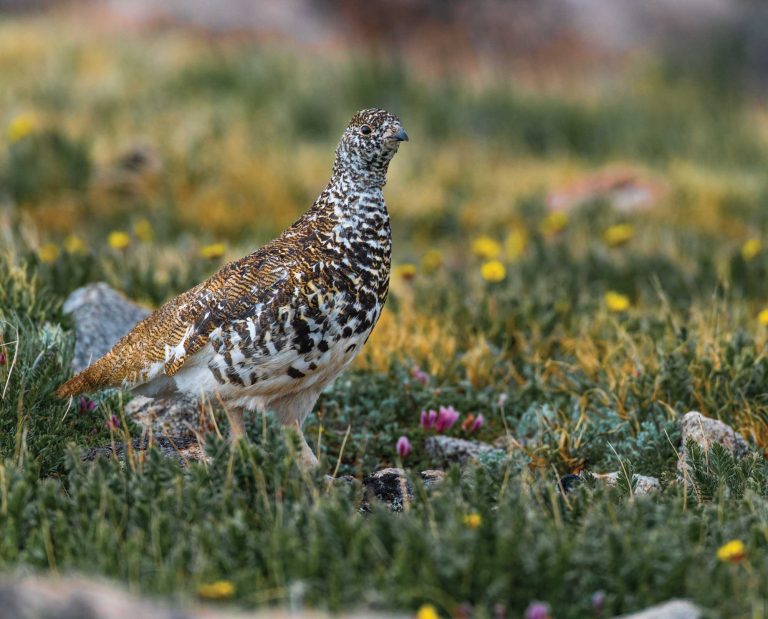
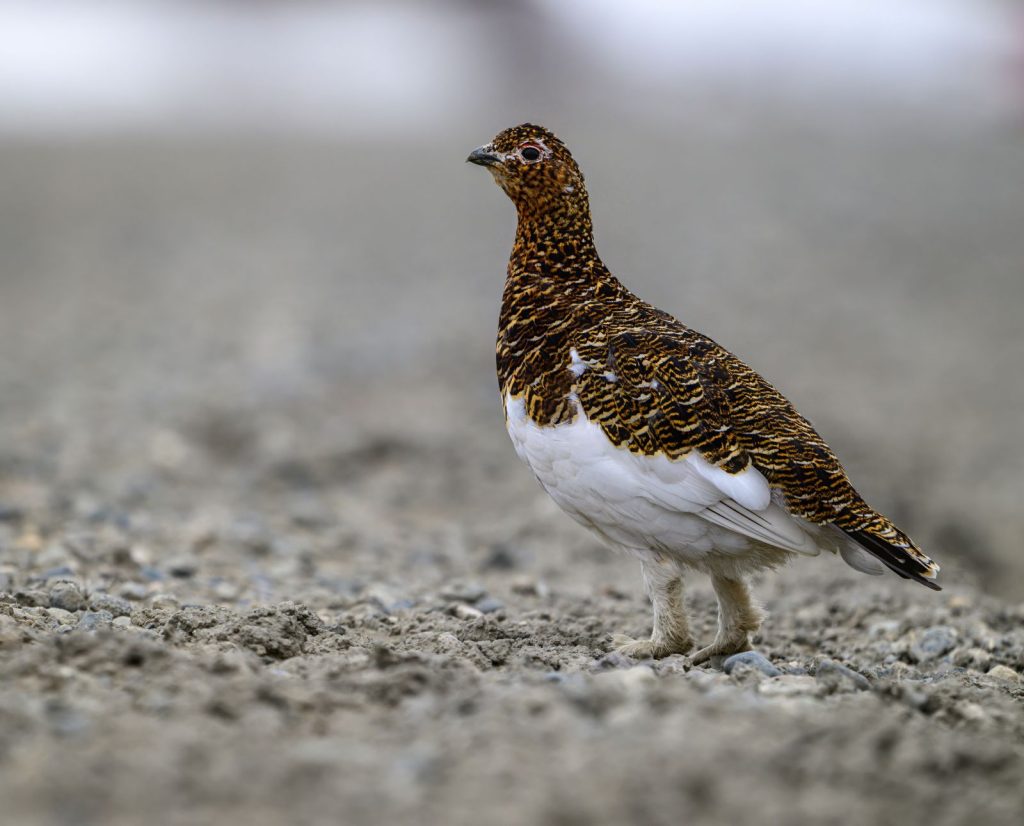
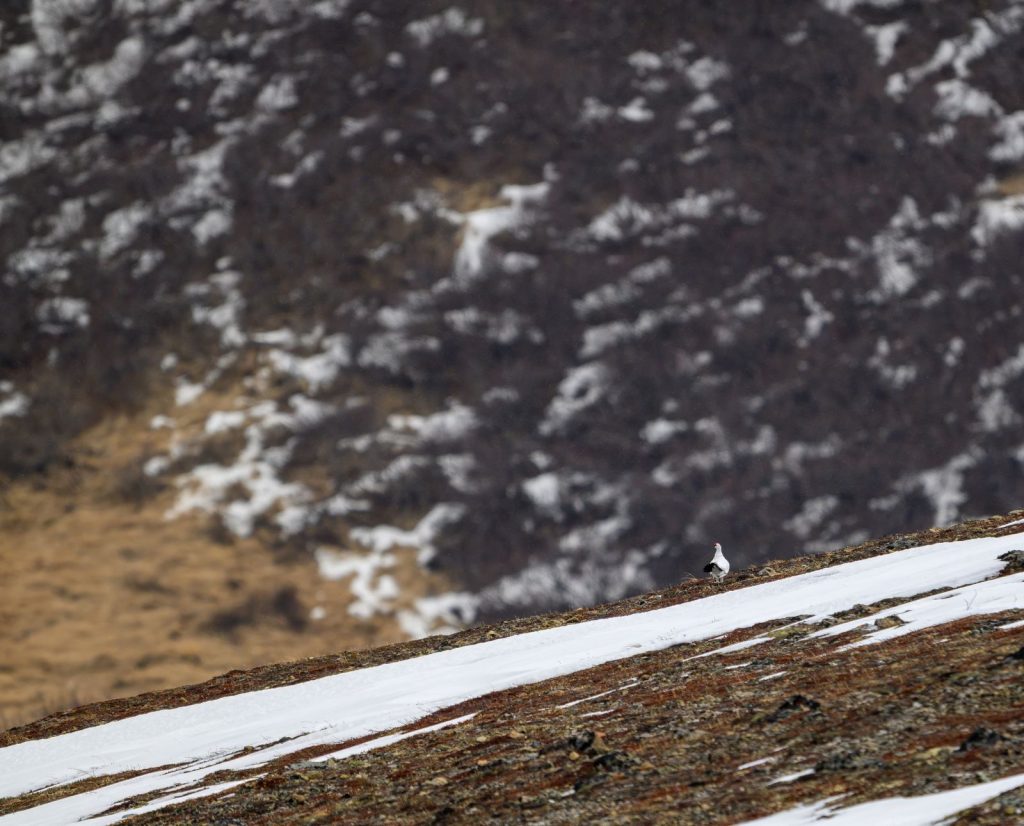
Ptarmigan are also masters of camouflage, being the only group of grouse with seasonal polyphenism, or the ability to change colors seasonally. Seasonal polyphenism is incredibly helpful in climates like the tundra where one consistent color plumage would be ineffective during one or multiple seasons.
In the fall, rock ptarmigan begin to transition to their white coats. They remain nearly entirely white, with males having a black stripe of eyeliner and their red comb being present. This white plumage reaches its peak in the courtship and territory-building season. As day length grows through the winter and into the spring, this change in photoperiod drives the next molt. Both males and females will transition from white to a variety of browns, grays, blacks, and buffs, usually sorted in distinct barring. However, they never lose their feathered feet, even in the summer.
This species is extremely polytypic, having as many as 24 to 30 subspecies depending on who you ask. Winter white plumage is almost entirely consistent across all subspecies, but the summer camouflage is highly variable between groups. Subspecies in Lapland (Norway, Finland, and Sweden) fall under the subspecies Lagopus muta muta; this group is the nominate subspecies, or the subspecies that was first scientifically described. L. m. muta has a stony gray plumage in the summer, highly useful for blending into the stony terrain it lives in. In Japan, L. m. japonica has a summer plumage that leans more towards a bronze-brown. Its white feathers in summer are limited to spots on the wings, the legs, and a small patch on the belly. Alaska has an incredible diversity of rock ptarmigan, with at least two occurring on the Alaskan mainland and at least 7 different subspecies in each group of the Aleutian Islands.
There is growing evidence suggesting that the rock ptarmigan species should be split into several distinct species. There are at least eight groups with significant DNA differences, but some subspecies like L. m. evermanni (Aleutian Islands Adak and Aggatu), L. m welchi (Newfoundland), and L. m. dixoni (much of continental Alaska) are candidates for full specieshood. In the late 1800s, evermanni and welchi were first described as distinct species from rock ptarmigan, but have since been lumped back in with Lagopus muta.
I, for one, am all in favor of more species of grouse to hunt someday.
Rock Ptarmigan Breeding and Display Behaviors
Male rock ptarmigan are extremely territorial during the courtship, breeding, and nesting seasons. Males will create boundaries between them and their competition, and disputes are settled with ritualized behaviors and displays. Very rarely do disputes turn to physical attacks, but when they do, wings and beaks form weapons that target the heads of their opponent. Damage and injuries to the brilliant eye combs are very common. Males will chase neighboring intruders in the air and on the ground.
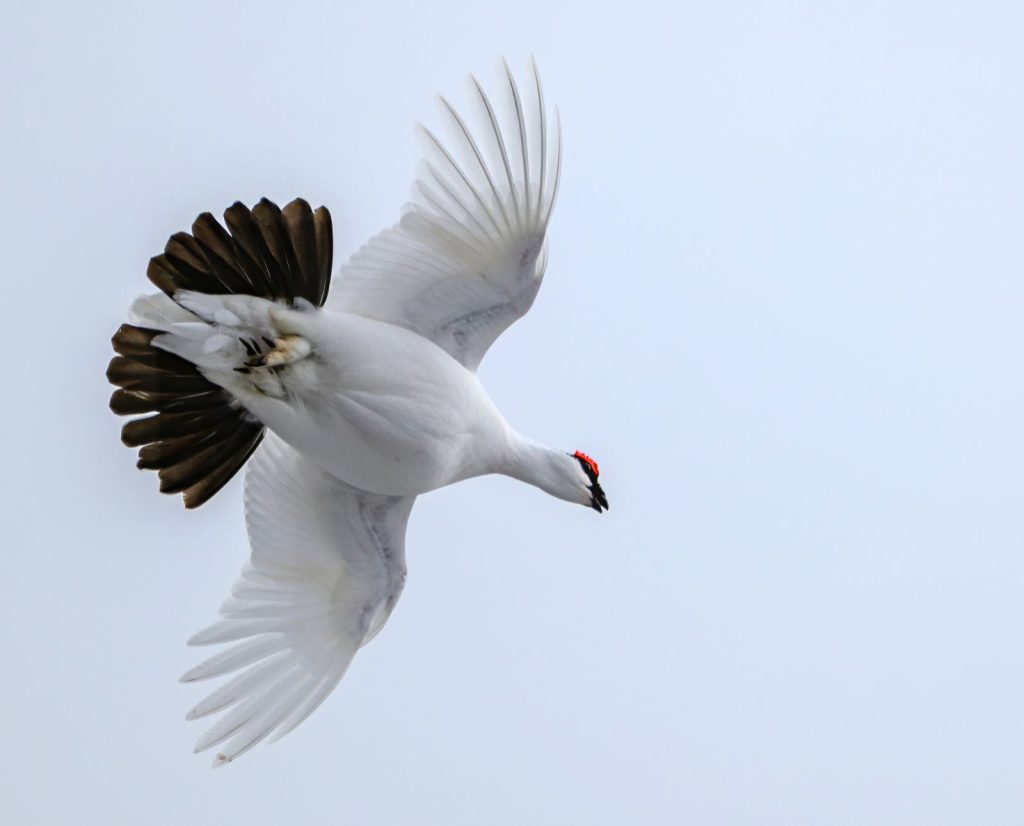
All of the Lagopus species have an intricate flight display, and the rock ptarmigan is no exception. Males will fly steeply into the air, flying as high as 250 feet. They will parachute down with wings held low, combs erected, and tails held stiffly fanned behind them. On the descent, males will let out a guttural croaking sound, not dissimilar to the sound of a frog.
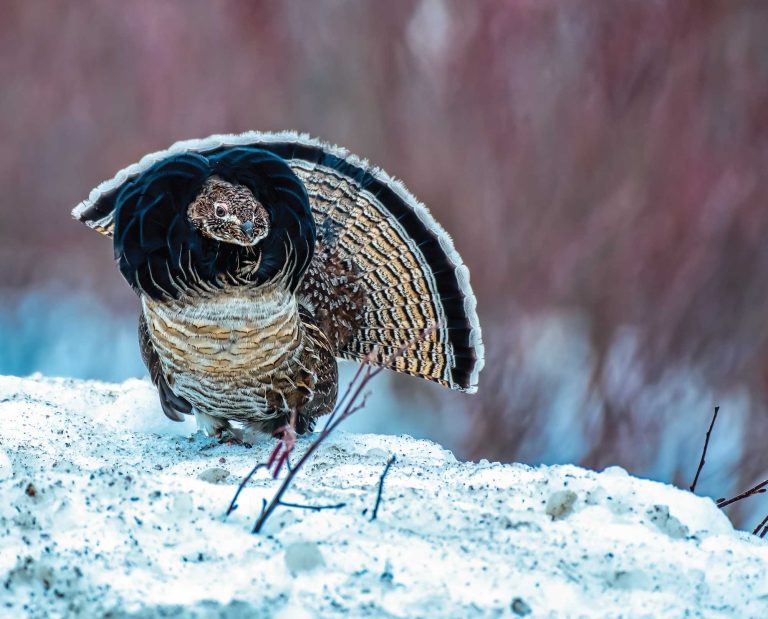
Flight display, quality of plumage, and the combs are likely what female rock ptarmigan look for in a mate. The size and condition of those ruby-red combs seem to be heavily sought after, with larger combs being more appealing to a mate. After attracting a mate visually, males will perform a variety of on-ground displays and dancing. Often involving fanning their tails, wagging their heads, bowing, and dancing. A female may visit the territories of several different males, so there is tough competition on the tundra. Luckily, once a pair bond is established, females very rarely leave their mate, and as long as the male is present, there is little to no extra-pair mating.
Rock Ptarmigan Nesting and Brood Rearing
After copulation, a female will create a small scrape nest on the ground in a small depression. It is very rare for most nests to be built with any overhead cover and they are often found in dry and rocky habitats. White-tailed ptarmigan (Lagopus leucura) nest similarly, with little to no overhead cover, but willow ptarmigan (Lagopus lagopus) tend to have some vegetation around the nest and typically nest in slightly wetter habitats.
Hens will typically lay between six and nine buff-colored eggs with dark splotches. There is some variation among ptarmigan subspecies in typical clutch size and egg color. They will typically lay one egg per day and will begin incubation after the last egg is laid. Like clutch size, the incubation period is also slightly variable across different populations, but downy chicks covered in golden and dark markings will hatch after 20 to 26 days.
These chicks grow fast and get right to it! They are precocial, meaning they are ready to wander and feed on their own shortly after hatching. Short bursts of flight are possible within about a week of hatching. They tend to double their mass every week for the first four to five weeks, and will stay very close to their hen when foraging on the tundra. After about 10 to 12 weeks, they are independent. Broods will begin to group up in late August, sometimes forming flocks of over 300 individuals from different family groups. They stay grouped through the winter, but disband slowly over time.
Rock Ptarmigan Range, Habitat, and Diet
Rock ptarmigan can be found nearly anywhere there is stark tundra and low tree density. In North America, they cover many of the Alaskan Islands, almost all of Alaska and the Canadian tundra, through the Arctic Circle and on the coasts of Greenland and Iceland. In Eurasia, they are found in large swaths of Arctic Siberia and Lapland. They also have island populations in the mountains of Central Asia like the Altai and Sayan between Mongolia, China, Kazakhstan, and Russia. They’re found in the Pyrenees and the Alps mountain ranges. There are even disjunct populations in the Scottish Highlands and the Japanese Alps. These alpine islands were likely colonized during the last glacial maximum, but as ice retreated and the climate warmed, the mountains still held refuge for these isolated populations.
Rock ptarmigan survive in a variety of habitats. In the lower elevation areas like the far north, they live on the arctic and alpine tundras. Habitats include very few trees, dwarf vegetation, lichens, mosses, and low-growing berries. In the more southerly Alpine Islands, they can be found in zones above the tree line, scree and boulder slopes, high-mountain deserts, and boulder ridges. In short, if there is cold, rugged, rock-infested landscape in the Northern Hemisphere, you can probably find rock ptarmigan. Many of these alpine islands are entirely geographically isolated, and these subpopulations are on distinct evolutionary tracks. Who knows what the next million years will bring for them.
Rock Ptarmigan Conservation Concerns
With an incredibly massive range across often dangerous habitats, rock ptarmigan are not globally threatened. They are relatively tolerant of human presence, and their remote habitats often save them from heavy development. Ski resorts have the potential to damage habitat, but they also attract nest predators. In Scotland, carrion crows boomed near new ski resorts, leading to increased nest predation. Human presence and construction do tend to create opportunities for mesopredator expansion like foxes, mustelids, and corvids; this can lead to increased nest predation, too.
Rock ptarmigan have been an important food source for native communities for thousands of years, especially in the winter and early spring. Luckily, data tends to show that hunting has little to no effect on breeding density in following years.
Directly, there are very few threats currently to most rock ptarmigan populations, but the Japanese rock ptarmigan (L. m. japonica), called the Raichō, is listed as endangered. Their main threats are loss of alpine habitats and predation from non-native and expanding predator species.
There is one looming threat that could affect all populations of rock ptarmigan, though: a changing climate.
A warming climate in the arctic regions is expected to diminish and reduce arctic and alpine tundra habitats across much of the world. This warming allows for the expansion northward and in elevation of woody species. Woody encroachment is a double-edged sword, however. Many of the species expanding are species like birches that make up a large proportion of their diet. Through ptarmigan droppings dispersed across the landscape, they will likely aid the expansion of woody plants. Woody encroachment can help increase wintering habitat, but will likely harm the treeless breeding and nesting habitat that these species rely on.
More time and research are needed to understand how the rock ptarmigan may respond to the changing future. The vast range of the species and numerous isolated populations can be good for long-term survival, but some of those subspecies are at risk of local extinction. Continuing to monitor and learn about this species is crucial to protecting it worldwide across its vast range.