

Developing a Grouse Dog: The Importance of Ranging, Tracking, Pointing, Retrieving, and Patience
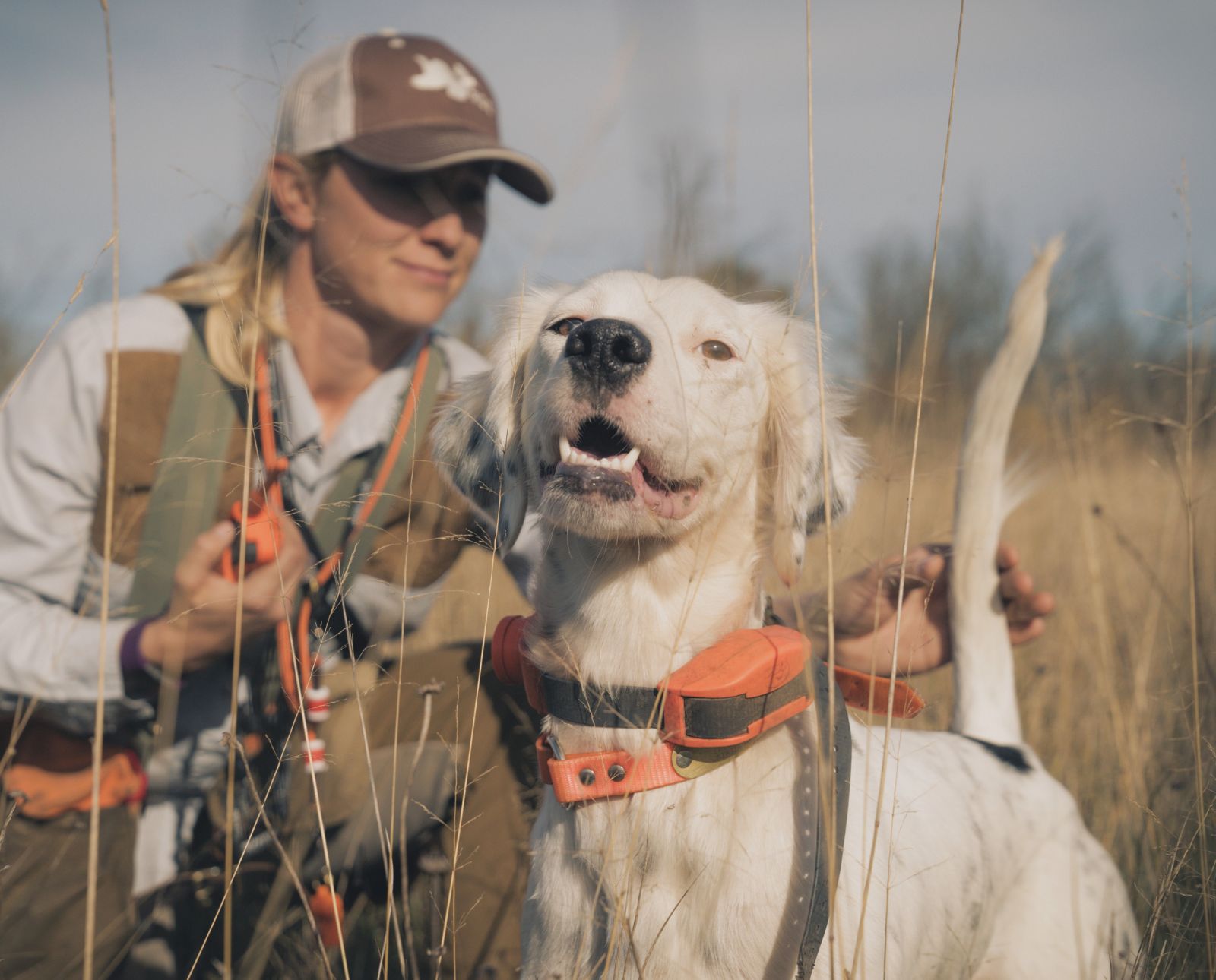
Accelerate your bird dog’s education by teaching it a few crucial lessons before heading into the grouse woods
This article originally appeared in the fall 2024 issue of Project Upland Magazine.
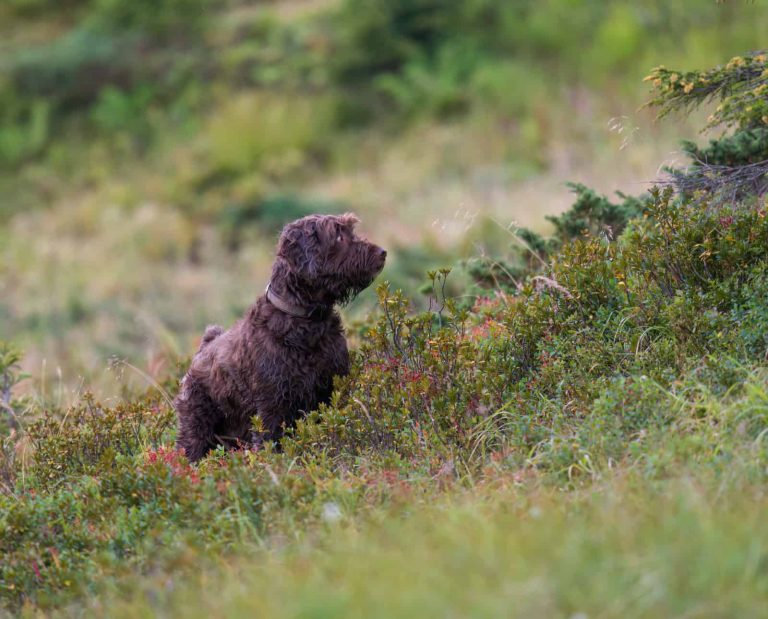
The allure of the ruffed grouse prompts many to breed and train dogs specifically designed to hunt these remarkable birds. Those who consistently find success in the field study the best dog breeds and breeders for grouse hunting and learn to train their own grouse dogs. Come fall, hunters who went the extra mile will find themselves truly prepared to chase grouse. All this hard work will be worth every ounce of tribulation once you and your dog stand among the briars, admiring a grouse in hand.
A grouse dog needs to be fast, but not too fast, as it might run over birds before scenting them. Its innate intelligence should guide its proximity and tracking speed, allowing it to keep up with the bird without bumping it into flight. Nose work should be done with diligence, and the dog must listen when its nose tells it to creep forward or point. During exciting scenarios, exhibiting patience and self-control is a must, and when the time comes, it should complete a successful retrieve.
Much of what a dog needs in the grouse woods comes from its genetics and exposure to wild birds. However, you can accelerate your dog’s learning by teaching it a few lessons before grouse season.
Ranging
The natural hunting range of a bird dog varies depending on its independence and drive. Ideally, young dogs should work within 50 yards when hunting dense cover, allowing you to assist in their development. As the pup matures, allow it to push out to its natural range.
A dog that either runs for the hills or stays underfoot is of little use to a grouse hunter. In the grouse woods, a big-ranging dog typically plays in the bird’s favor. By the time you locate your faraway dog, the grouse has identified escape corridors, providing you with a limited shot opportunity. A closer-working dog allows you to get around the grouse and deny its escape while maintaining the dog’s steadiness. However, an extremely close-working pointing dog must learn to push out.
Dogs that work far too closely can be encouraged to push out with increased bird contacts, bolstering their purpose and drive. Verbal encouragement tells the dog it is okay to separate and push out. Additionally, hunting with two dogs encourages the dog to separate from its handler. After a good afternoon of grouse hunting, the pup will realize there are greater things out there to find than you, and a light bulb in its brain flicks on.
To develop your dog’s range, quarter back and forth like a windshield wiper. Attempt to gain distance and an effective hunting pattern from the dog. That way, it will learn to feel comfortable hunting from a greater distance and in a manner that ensures no game is left behind. Additionally, planting birds upwind where the dog can easily scent them will encourage the dog to push out and follow its nose, expanding its search. A dog that checks in but spends the lion’s share of its efforts finding game is more productive, overruns fewer birds, and is more enjoyable to hunt over.
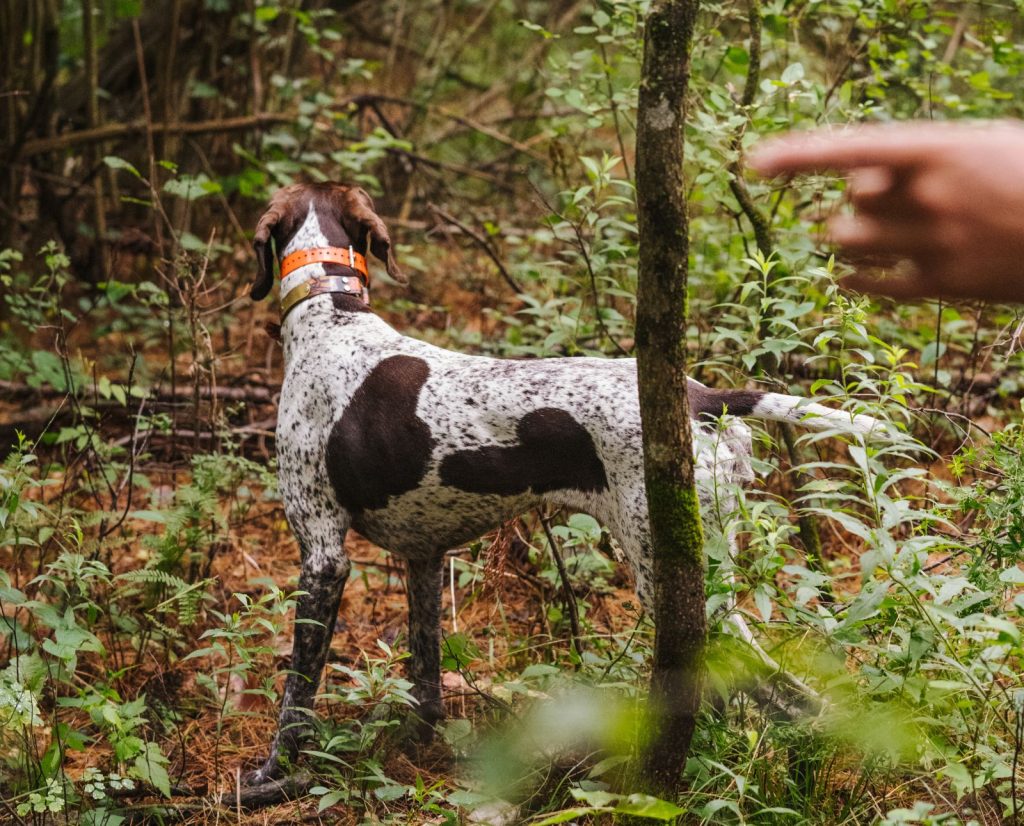
Tracking
Dogs experience the world with their noses, much like we experience the world with our eyes. Every dog hones its nose over its lifetime through exposure and training. However, certain breeds have genetic advantages that we exploit when hunting. For example, Labradors are bred for marking or visual accuracy for retrieving purposes. Hounds are bred for their ability to track, trail, and stick to ground scent. Bird dogs are bred to search out game via airborne scent.
Veteran dogs have learned to deep-nose track scent while remaining on the fringes of the bird’s body scent cone. These dogs know when to leave a hot track to find the downwind side of the bird. They also know that if they try to close the distance, the bird will take flight. Alternatively, if the bird walks away, the dog can self-release and follow its prey while remaining on the scent cone fringe.
Only experienced grouse dogs can perform this dance. Most of this dance is developed on the job; we can only train the extended focus and nose work portion.
Training bird dogs to focus exclusively on ground scent can require effort. Some dogs may need help overcoming their natural tendency to search for body scent in the air. This can be seen when inexperienced grouse dogs break off a grouse track to locate the nearby bird’s body scent. “Ghosting” is when a dog leaves a track and runs concentric circles until it locates the bird’s body scent, often bumping the bird in the process. A balanced, experienced dog knows if it sticks with the track, it will eventually encounter the bird. However, the dog must multitask while working the track, constantly checking the air currents to gauge its proximity to the bird.
Growing up with Deutsch Kurzhaars, blood tracking was part of our training regimen. Although most grouse hunters may not train their dogs to track blood specifically, this training method teaches dogs to focus on ground scent.
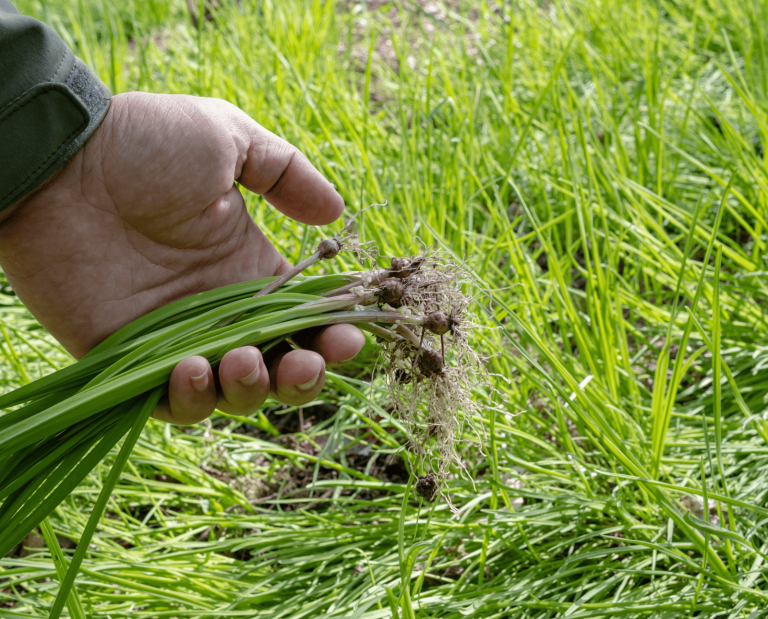
Teaching dogs to track ground scent is an in-depth process that uses food to show pups that if they hold their focus, they will be rewarded, be it game or dinner. When learning to track, the pup is asked to stick to ground scent and is denied the opportunity to search out its reward in the air. Utilizing its daily meals helps when training tracking, as it is very natural for a dog to work for its food.
Initially, the food portions are large, and the tracking distance is short. Food is placed under every step, starting with only ten steps or less. Over a few weeks, extend out to thirty or more steps, depending on your dog’s success. The pup should be denied the ability to skip any steps, keeping its nose deep in the short grass while you finger-point at each piece of kibble. Place the lead under its leg so that when you apply pressure to the lead, it directs the pup’s head toward the ground. Over the weeks, the command to put its nose on the ground switches to solely the leash pop. As your dog finds success, move further back from it on the lead. Increase the complexity and hide food in taller vegetation.
Once the dog masters how to investigate every step without trying to search or skip steps, it’s time to make the dog work a little harder by aging the track, adding voids in the food trail, and incorporating small bends into the track.
Read: Why Strong Leadership Is the Secret to Successful Dog Training
Eventually, real game scent will replace the food. The idea is that the dog discriminates against any other scent besides what it is being asked to follow. It must focus and stick with the scent to the track’s completion. When proofing the track, drags can be run across the trail. Though the dog will acknowledge the drag, it should quickly return to its job. If the dog decides to follow the drag, the pop of the lead should redirect it back to the trail it should be following. The dog must learn to disregard all other scents and trust its nose and ability to find the end. In time, the dog develops the focus and drive to methodically finish the job.
Tracking is a great mental exercise for any dog. After a tracking session, your dog will be mentally drained.
From my experience, most bird dogs learn to track during hunting season, but training a bird dog and hunting simultaneously can be a trial by fire. Set yourselves up for success and practice tracking before opening day. After your dog completes your tracking program, simulate a common hunting season occurrence by allowing a training bird to run from the field into cover, and then asking your dog to track and point it. This simple exercise will help better prepare your dog for what it will undoubtedly experience in the grouse woods.
Insist the dog follow the foot trail, denying it the ability to search. It’s important the dog remains glued to the track. Unlike blood tracking, the track should be as long as possible and into the wind so the dog has an opportunity to point and retrieve at the end. Training bird tracking initially requires a long lead. Eventually, you’ll replace the long lead with an e-collar.
We use the command “easy” to tell the dog to slow down. If the dog charges down the track, say “whoa,” then let the dog try again. If necessary, let it try a hundred times. The dog must realize that to move ahead, it must move slowly. This drill teaches your dog to track and relocate moving birds, a skill you will depend heavily upon in the grouse woods.
Tracking creates teamwork because the dog realizes it is hunting for the gun, not for itself. With enough practice, the dog realizes a diligent, methodical track always leads to a pointing opportunity with the possibility of a retrieve.
Pointing
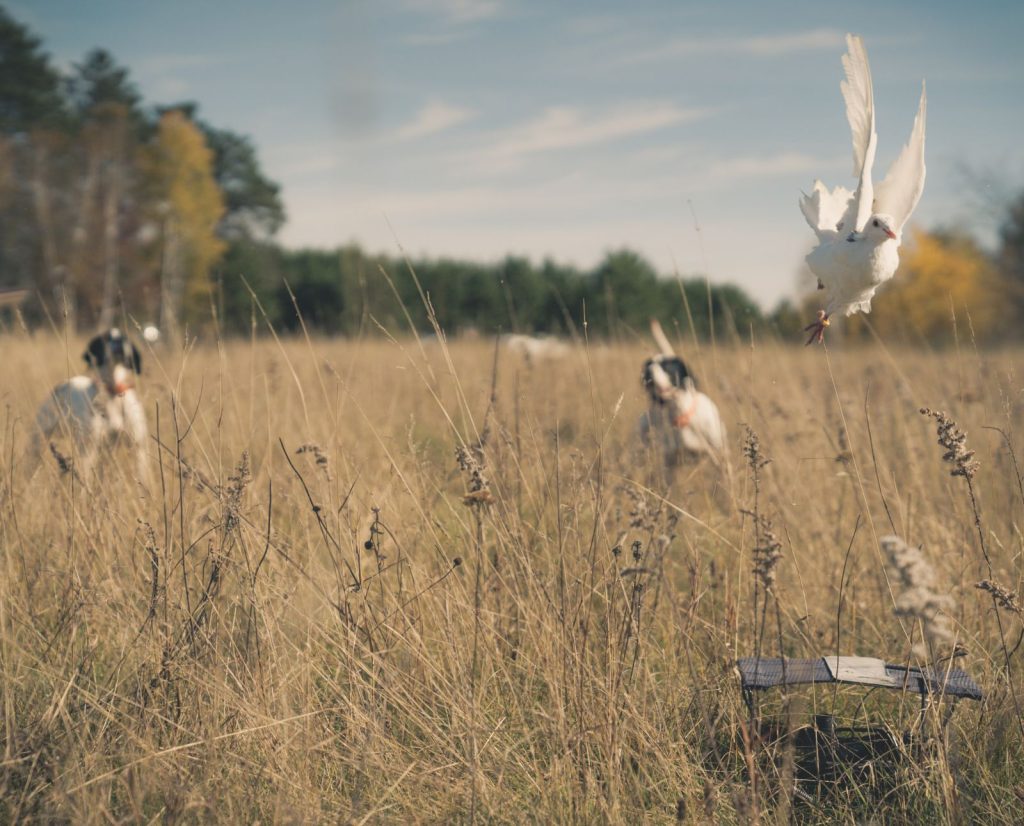
Ruffed grouse are difficult for dogs to pin because they are very intolerant of encroaching hunters and dogs. Too often, pen-raised birds teach dogs to crowd, or get too deep into the scent cone, a situation wild birds would not allow. For this reason, the use of pop traps or launchers is crucial in preventing creeping or crowding on planted birds. Launchers teach pups to point at greater distances and allow us to flush birds, which is essential when hunting wary grouse.
When hunting in thick cover, the dog will feel alone with its quarry. To mimic this predator versus prey situation, we, as trainers, should step back and remove ourselves. Let the dog play out the game without whoaing or influencing it. The moment your dog tries to get too close, launch the bird. Use good, strong-flying birds that head for the hills, far away from your dog.
By allowing the dog to learn the consequences of getting too close on its own, it will learn to maintain the correct distance. Remember, it’s always better to pop the bird early and treat it like a wild flush than to allow a dog to get too close. A missed opportunity is a far more meaningful consequence to a dog than your correction.
If allowed, there is nothing better than training on wild grouse before the season begins. This practice will prepare your dog for the real hunting scenarios it will encounter while exposing holes in its training that can be addressed before opening day.
Adding ourselves to the dog-bird equation only muddies the waters. Take your time, allow the dog to hold point, and play out any wayward thoughts it might be having. Once you feel the dog has anchored itself to the ground, then start working on steadiness.
Retrieving
Leaving dead or crippled birds in the field can ruin a hunt; it doesn’t feel good and should be avoided at all costs. For the ethical treatment of game, it’s important that bird dogs are finished retrievers who ensure we get birds to the frying pan. Reliable retrievers provide you with the best opportunities to recover lost birds.
My dogs have retrieved birds underneath deep brush piles and across rivers. They’ve dug them out of holes, tracked them into nasty bogs, and even plucked them out of trees. We put in too many miles to fail to recover game. This reliability begins with developing a finished retriever.
The most commonly used training process is the trained retrieve. It provides your dog with the tools required to retrieve reliably. It starts with fun retrieving, advances to an extensive, conditioned hold process, and finishes with the force-trained retrieve. Some dogs have natural retrieving instincts, but for many, the trained retrieve is required for reliability in the field.
Patience
A versatile hunting dog is expected to exhibit self-control and patience, which can be challenging for many dogs. Remaining steady in dense cover, on distant points on the prairie, or in the duck blind is a big ask. Thankfully, there are numerous opportunities to train patience when raising a bird dog.
Asking your dog to wait before feeding, leaving the house, exiting its kennel, and greeting a visitor helps develop its patience and self-control. A grouse dog will need to steady itself while watching a nearby grouse strut about. While watching a grouse run from sight, it must exhibit restraint while every predatory instinct tells it to break. These scenarios must be handled appropriately and thoughtfully by the dog.
Learning patience is a lot for a developing dog to manage. By slowing down your steadiness process and incorporating patience and self-control into everyday life, your dog will learn to stay composed in the grouse woods. Patient dogs provide a safer, more productive grouse hunt.
An essential part of instilling patience and control is the “whoa” command, a cornerstone of many bird dog training systems. “Whoa” helps calm the dog, resets its brain for learning, and allows you to work as a team to bag the king.
Often, we become irrelevant to overly excited dogs pursuing game, causing them to become dysregulated and unbalanced. An over-exuberant dog driving down a grouse track can be whoa’d, helping it focus and become a more methodical team player. A well-timed whoa mentally resets the dog, giving you an opportunity to become relevant in the bird-finding process again. This command reminds the dog of your expectations and bridges its training into the field.
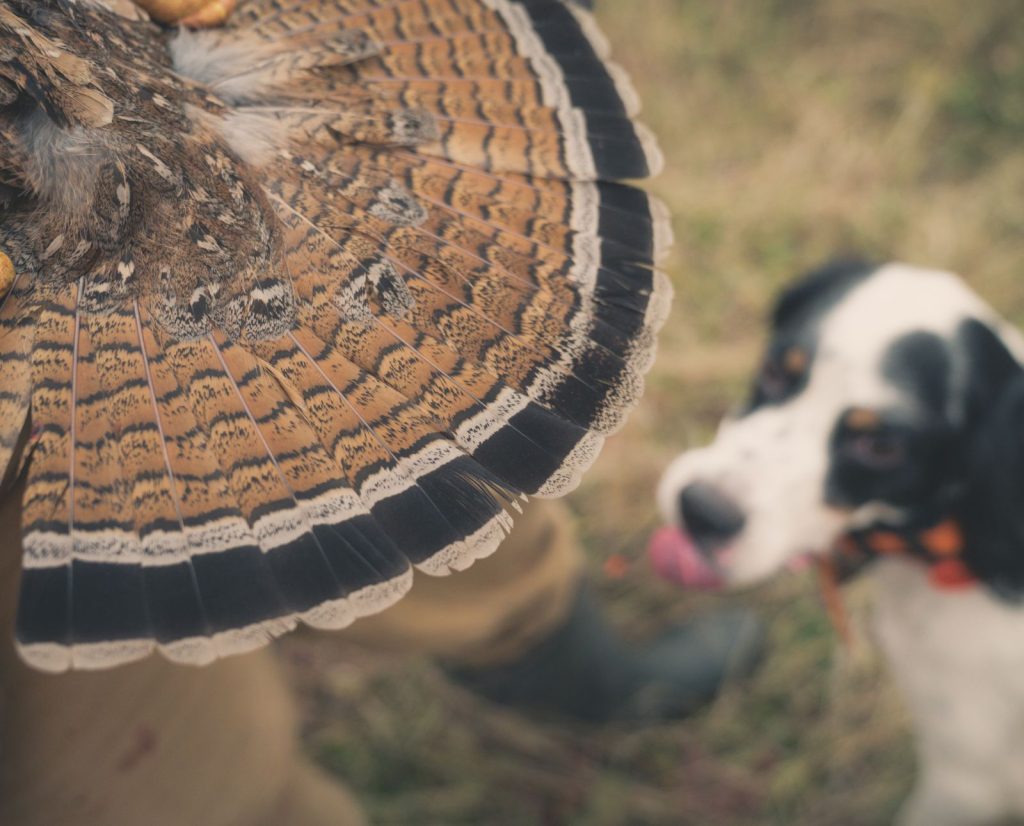
Expose Your Hunting Dog to Wild Birds
With strong obedience training and a solid grouse hunting foundation, you and your dog will develop the teamwork required to shoot grouse on the wing together. Wild bird contacts are the best way to develop this foundation. It takes at least two hundred encounters to instill the necessary bird-handling skills in your dog. But remember: the dog is only as good as the ground you put it on.
The development of a true grouse dog requires exposing the dog to as many grouse as possible. The survival instincts of these amazing birds are so legendary that many novels have been written about them. Give your dog the tools it needs to handle evasive ruffed grouse, and the two of you will undoubtedly find success in the field.