

The Disconnect Between Hunting and Political Reality
This Isn’t the Party of Teddy Roosevelt (and It Never Was)
This week, it’s the proposed changes to wetland easements—the “Duck Factory.” Hopefully, this is not the first time most folks have read about pushing back against the proposed U.S. Fish and Wildlife Service rule change surrounding wetland easements. But this article is not so much about the specifics of that rule change. There has already been excellent coverage of the issue from outlets like Outdoor Life and American Hunters & Anglers. Instead, this is about a profound need for accountability in how we got here.
Hunters need to know their history, and the older generations—mine included—have failed to tell the full story. So let me begin with a little history of the Duck Stamp Act, because it is directly connected to the current debate.
The Duck Stamp Act was passed in 1934. The stamp itself is something many of us hunters are familiar with; its impact on waterfowl populations is almost immeasurable. Species that were once on the brink of collapse now thrive, providing countless hunting opportunities across North America. This is all common knowledge to us hunters.
In 1958, the Act was amended to create the Small Wetlands Acquisition Program—the very program called into question by the Trump administration’s proposed rule change in 2026. The Heritage Foundation’s Project 2025 blueprint explicitly called for eliminating the U.S. Fish and Wildlife Service’s authority to purchase conservation easements under this program, arguing that the federal government should no longer acquire such interests in private land.
But that is not the most surprising part of this story. The more troubling reality is the cultural illusion that hunters have clung to for decades: the belief that Republicans have always been the party of hunting and conservation.
Here are the parts of the story that have been left out. The Duck Stamp Act was enacted in 1934 during Franklin D. Roosevelt’s New Deal era—the era of some of the most ambitious social and conservation policies in our country’s history. It was championed and sponsored by progressive Democrats who were hunters themselves and who believed they had a profound responsibility to expand and preserve hunting opportunities for future generations.
When the Small Wetlands Acquisition Program was proposed in 1958, its two primary sponsors were Senator Clinton P. Anderson (D–New Mexico) and Representative Wayne N. Aspinall (D–Colorado). After all, many of us were taught that Republicans—and especially President Theodore Roosevelt—were the ones who carried hunting and conservation into the twentieth century and beyond. (More on that later.)
Then there’s Pittman-Robertson, or the “PR Fund,” one of the largest and most important federal funding sources for state wildlife agencies. It is the program so many of us have pointed to as proof that hunters are the primary funders of wildlife conservation—another claim that is far more complicated than we were led to believe, even if Pittman-Robertson remains an enormously important source of conservation funding.
That law was also born during the New Deal. It was sponsored by Democrats, championed by the progressive Democratic coalition, and its impact on wildlife conservation and hunting opportunities is immeasurable, even in 2026.
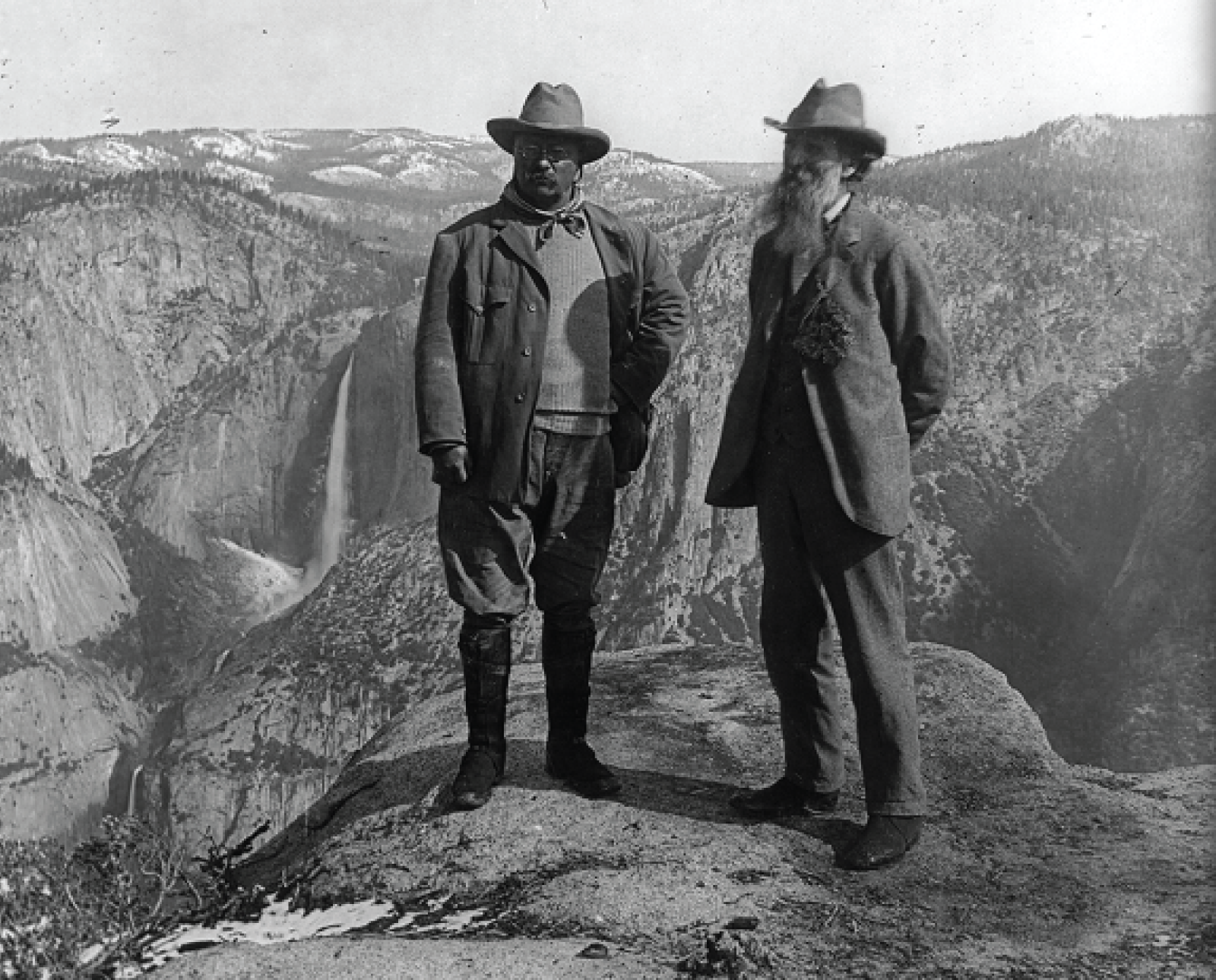
But in our hunting culture, we would never think of Democrats—and especially not New Deal progressives—as the architects of our hunting legacy. After all, President Theodore Roosevelt has long been held up as the poster child of the Republican Party and its conservation legacy.
It’s an interesting legacy, especially the part where Roosevelt was effectively driven from his own party and went on to be a founding member of the Progressive Party, a movement whose ideas helped shape the foundation of the New Deal progressives who came after him.
We’re rarely told that many Republicans of his era fiercely opposed him for breaking up monopolies, aggressively regulating big business, pushing wealth taxation, advocating limits on corporate money in politics, and using expansive executive authority to create national forests, monuments, wildlife refuges, and other public lands.
And here’s my favorite: Theodore Roosevelt became the first major presidential candidate to campaign for a national system of health insurance.
Now, try not to spit out your coffee, but aside from his views on military power, Theodore Roosevelt’s domestic agenda shares a remarkable number of themes (as in almost all of them) with modern progressives. Whether you agree with them or not, the through-line from Roosevelt’s “New Nationalism” to politicians such as Senator Bernie Sanders and Representative Alexandria Ocasio-Cortez is far stronger than any other form of modern political affiliation; conversely, the MAGA movement and its Project 2025 agenda are in direct opposition to these domestic-policy principles.
Furthermore, we should be skeptical of the people and organizations that have perpetuated this narrative. Many modern conservation organizations celebrate models such as South Africa’s, where everyday people like you and me are divorced from meaningful access to hunting through an almost entirely privatized system. Look at the disparity in hunting opportunity in places like Texas, where hunting access is heavily dependent on private land ownership and the ability to pay for access.
This year, I watched the Republican Party in New Hampshire celebrate legislation that, in my view, ran directly contrary to the Public Trust Doctrine by making wildlife mitigation compliance voluntary. That represented a departure from more than 150 years of legal tradition that recognizes wildlife as a public resource held in trust for all citizens rather than the property of private landowners.
I see countless social media posts this week tagging Donald Trump Jr. as “one of us” and urging him to “do the right thing.”
One of us?
I don’t know about you, but I am not a multimillionaire who hires guides and hunts private ranches. I live paycheck to paycheck. I hunt publicly accessible land, and I do the work myself. That is the reality for most hunters I know. Yet the fact that so many people view a man whose experience is so fundamentally different from our own as representative of us only underscores how deep this cultural illusion has become.
Even more concerning is the way the phrase “conservation should be bipartisan” has been weaponized. I wholeheartedly agree that conservation should transcend party politics. But for decades, the political dynamic has been one-sided.
State, federal, nonprofit, and academic wildlife professionals have naively tried to keep wildlife management above partisan politics. Yet while they avoided political messaging, the political right spent years promoting the narrative that it alone was the champion of hunters and conservation. Democrats, for their part, rarely challenged that narrative in an effective way, allowing their own party to become disconnected from much of its conservation legacy in the public imagination.
Many hunting conservation organizations have become so hollow in the name of being “bipartisan” that they are no longer willing or able to say anything meaningful when the future of hunting is genuinely at stake—ironically making them incredibly partisan. That silence is made worse by the reality that many of these organizations rely heavily on private donors whose political leanings inevitably shape boardroom priorities and institutional agendas.
As a result, many of us have carried forward a familiar political narrative around hunting: that Republicans are the party of hunters and Democrats are a threat to it. I grew up with that understanding myself. As a young hunter reading the NRA’s American Hunter in the 1980s, I found plenty that inspired my lifelong love of hunting—but I also came away with a clear sense of which political party I was supposed to trust and which one I was supposed to fear.
For a long time, I never really questioned that assumption. Like many things we learn when we are young, it simply became part of how I understood hunting, conservation, and politics. It wasn’t until I was much older that I began looking more closely at the history and asking whether the record was really as simple as I had been led to believe.
That is where things become particularly interesting: what happens when that familiar narrative is actually put to the test?
As policies emerge that, in my view, threaten pillars of the North American Model of Wildlife Conservation, many of these same organizations become hesitant to speak with the moral clarity the moment demands. If hunting as we know it can be dismantled in plain sight while those entrusted to defend it remain largely silent, then we have to ask whether “bipartisanship” has become a principle—or simply an excuse.
It is no wonder that, in 2026, many people on both the left and the right believe Democrats have little claim to America’s hunting heritage, despite the central role that progressive lawmakers played in building many of the institutions and funding mechanisms that hunters still rely on today.
Our failure as hunters has not simply been believing the narrative. It has been allowing it to go unchallenged. We failed to do the difficult work of influencing the political institutions that will determine whether our conservation legacy survives.
And I know many people are reading this with rage, asking, “What about the guns?”
First of all, Democrats have supposedly been coming to take my guns for all 45 years of my life. I still have my guns.
Second, I no longer believe that the modern Republican Party—one that has increasingly embraced George Orwell’s surveillance state, executive overreach, and a stronger centralized federal governement—is how I best preserve my rights as an American. John McCain was the last Republican I voted for.
In fact, the modern political narrative has become so contradictory that, following the fatal shooting of Alex Pretti by federal agents in Minneapolis, President Donald Trump suggested that exercising one constitutional right could justify limiting another. Asked about the incident, Trump responded, “You can’t have guns. You can’t walk in with guns. You just can’t.”
I find that deeply ironic. I spent decades being told that Democrats were coming for my Second Amendment rights because an overreaching federal government could never be trusted. Yet here we are, watching a Republican president argue that a citizen exercising one constitutional right can forfeit another.
That sounds remarkably similar to the kind of government the NRA spent decades warning us to fear.
I have no illusions that today’s Democratic Party is some perfect guardian of my way of life. It isn’t. In many ways, it has drifted from the hunting and conservation vision it once embraced. But I do believe that legacy is worth reclaiming, that those values are worth fighting to restore, and that it can be restored. I also find that anyone who believes 100% political alignment is either realistic or desirable is incredibly vulnerable to becoming part of a cult.
Whether hunters realize it or not, conservation in this country faces more threats than ever, and I am not just talking about the policies of the Trump administration. I am talking about the actual environmental challenges wildlife faces today. Some of those challenges are scientific, habitat-related, and climate-driven, but they all share one underlying problem: a lack of funding in a modern world to address a growing number of conservation issues.
So let’s talk about some modern Republican hunting policy. The Republican-backed solution was R3—Recruitment, Retention, and Reactivation. As someone who was a guest speaker at the very first National R3 Symposium and thought, “Maybe this can work,” let me say plainly: I believe it was a mistake.
Beginning in 2016, Senator James Risch (R–Idaho) introduced legislation to expand the use of Pittman-Robertson funds for hunter recruitment and recreational-shooting promotion, an approach subsequently advanced through Republican-sponsored House legislation.
As a result, Pittman-Robertson funds—which had traditionally been reserved for wildlife restoration, habitat management, hunter education, and other direct conservation purposes—could also be used for recruitment and marketing initiatives. Eventually, funding flowed to marketing campaigns, influencers, and hunting organizations whose messaging often reinforced an increasingly partisan political identity within hunting culture.
We stopped asking how to strengthen the public institutions and policies that made hunting possible in the first place, and instead we created an aggressively forward-facing influencer culture riddled with unvetted information, illegal activity, and the worst possible representatives of our culture at the forefront. It was a profound misstep.
At roughly the same time, we saw public support for hunting begin to decline, and I believe those trends are connected. As hunting became increasingly associated with one political ideology, extreme behavior, and inappropriate content—rather than a shared public trust and conservation ethic—we alienated many Americans who otherwise could have been allies.
The problem was never simply that we needed more hunters. We needed hunters who were willing to advocate for the kinds of public policies that had built our conservation system for nearly a century. We needed to return to the Aldo Leopolds of the world and move away from the Ted Nugents. Instead, we invested our energy in defending a political movement that, in my view, is the very threat to the future of conservation. This is the type of solution to our modern conservation challenges that the modern Republican Party has given us: you can thank them for R3.
On the flip side, meaningful conservation policies that benefit hunters and anglers have consistently been championed by Democratic lawmakers. These include: the Sport Fish Restoration Act, the Multiple-Use Sustained-Yield Act, the Land and Water Conservation Fund, the Wilderness Act, the Wild and Scenic Rivers Act, the Clean Water Act, the Coastal Zone Management Act, the Magnuson-Stevens Fishery Conservation and Management Act, the Alaska National Interest Lands Conservation Act, the Conservation Reserve Program, and the North American Wetlands Conservation Act.
Many of these laws ultimately received enough Republican support to pass, and that is a bipartisan world I wish to live in for conservation. But despite what we have been told, it was Democratic lawmakers that were at the center of creating, sponsoring, and advancing much of the conservation framework that still protects our wildlife, fisheries, habitat, and public access today.
In today’s world of partisan identity politics, I know this argument isn’t going to land well with every reader. Some will dismiss it outright and others will avoid engaging with the facts. My challenge to those who have: don’t take my word for it.
Vet the information. Do your own research. Learn your own hunting history, and come to your own informed conclusions.
I am willing to bet on the facts.
Don’t outsource your thinking to influencers, political talking points, and nonprofit slogans. If we are honest with ourselves, those narratives helped get us here.
Our hunting heritage belongs to all of us. Take it back.

AJ, it sure as hell lands well with me. Thank you for this, and please keep it up. We are getting our asses kicked, and it may be impossible for hunters to get back what they had only recently.
Started donating to Project Upland after reading this article. We have waited years for a writer in the community to stand up along side men like Hal Herring and let everyone know there’s an elephant sitting in the middle of the kitchen. Ethical, moral, critical thinking hunters have been drown out by high-volume low-character influencers, politicians and grifters seeking to secure a voting bloc or ad revenue. Both sides are very much not the same. Conservation, climate change mitigation, science based wildlife management, public lands protection and ethical fair pursuit have been openly rejected by one side and clinging to life support thru the efforts of a small group on the other side. Mewling about the reality of it helps no one. Take a stand, and if that costs you a few hunting buddies you win twice. We need to pour some bleach in the hunting community pool.
Very excellent article! Thank you for the reality check. It’s about time someone starts to take back the narrative and help us correct course! It’s a breath of fresh air in the world today.
I would never trust a person my dog didn’t like. And a person that doesn’t like dogs? There’s something very wrong with them, IMO. The current resident of the White House has nothing to offer to true traditional sportspersons. He takes us for granted, or for suckers, and if we’re buying what he’s selling…we are. Excellent article, A J.
Thank you AJ, very well written and thought provoking. Blind adherence to a political party or political view point is the beginning of a path that leads to an Orwellian future. We must fight for those creatures who can’t fight for themselves, the birds we all love to hunt. Habit is the key.
What a pleasure to read. Thank you
As a wildlife biologist, all my schooling and training taught me what was best for wildlife and habitats. Then I went to work out west for an agency, and the idealogy was nuts to me. The hunters were nuts to me. All voting against what they said they valued. My husband was a conservation officer. He stopped supporting NRA when he read into their hunting and public lands stances.
Generally I find the biologists lean left, and enforcement leans right.
Now I teach so the next generation can think better about it
Outstanding piece! Thank you AJ.
However, we can certainly all get on board with the rhetoric, but we must create some real action(vote) to alter the course that our federal leadership(?) has taken. As a Texan and registered Republican I will NOT BE VOTING for any of the current ‘boot lickers’ and grifters come November. Hopefully, all having read your summation, will vote to change the national bureaucratic course.
Wow! Very insightful and powerful article. I am worried about our hunting future unless there is some bi-partisan efforts
Interesting read, and you make some valid points. But you were also very wrong about some things. Mainly the weaponization of climate change by the left and secondly firearms ownership. The Democratic Party, as an institution is hostile to private firearm ownership, and they do want to take your guns away. And I also see a thread of Trump derangement syndrome (TDS) running through this anrticle. American liberals are no friend to hunters and sportsman.The current administration may not be getting everything right, and I say this as one who voted for them. I will disagree with them where I need to, and if they’re wrong about fish and wildlife management and maintaining access for average people for hunting and fishing opportunities, I will say so. but don’t let TDS blind you to the things that they are getting right in terms of protecting private land ownership.
Roger, I’ll probably regret asking this question but what exactly do you mean by “weaponization of climate change by the left?”
Hunter and multi gun owner here. Christian who sees our world as God’s gift to us and our responsibility to handle with respect and care. Call it “derangement”, but I see nothing the current administration has to share with my values. Lip service doesn’t cut it. What do I have in common with billionaires whose idea of being outdoors is driving a golf cart on a manicured course? Maybe skiing at a resort? Not only the wild public lands, but our national parks are being left to erode for the sake of wasteful and unwanted vanity projects in DC.
Do as the author suggested and research outside of your usual sources. Then vote like you mean it.
Just when you thought there was a media outlet that DIDN’T require acquiescence to a party as a condition of readership… some of us are old enough to remember when “totalitarianism” was defined by one party’s politics being necessarily present in EVERY FACET of daily life….
Pathetic.
You earned yourself a cancellation. So we are clear- that’s for bringing party politics into my inbox.
Consider perhaps that their larger goal isn’t part politics but truly the conservations of our beautiful land-the current political system doesn’t not agree with that goal. Focus on the mission of protecting the hat we love
The logical incoherence of turning the Alex Pretti situation into a “democrats are pro-gun and republicans aren’t” talking point insults the intelligence of this entire readership. This is the point where this article ceases to inform, and instead becomes nothing more than an attempt to persuade. Anyone with a pulse should recognize we are now reading propaganda, not journalism.
Some of us thought we were paying to read about upland hunting, not badly spun endorsements of one party over the other.
You’ll note this article takes no ownership for the stated goal of the DSA, now running vanguard for the democratic party, to limit every American to single shot firearms. Good luck with your evil assault SxS or O/U. Doesn’t touch the Brady campaign, moms demand action, everytown, or any of the MYRIAD OTHER deocrat aligned disarmament campaigns.
AJ can write whatever he wants in his magazine, he’s not entitled to everyone’s money to do so.
Anyone with a pulse should know that Republicans – or rather, MAGA – aren’t 2A friendly anymore unless its for themselves and their voters. Republicans have passed more gun control on a federal level than Democrats have.
For what its worth I read this article for free.
Can you some examples of MAGA republicans denying gun rights to those other than themselves please? You keep making this statement here.
As a big game hunter, I am cautiously impressed with what they seem to be doing for suppressors TODAY.
On behalf of those of us who paid for you to do so, congrats.
Nothing you have said here has done anything OTHER than make my point.
1. Everything MUST be politicized
2. Because (1.) is “true” you must accept the only true answer which is (party)
3. Enjoy your free politicized content subsidized by us paying subscribers
God bless
I 100% agree with Jay above. Consider me cancelled as well.
Sorry Jay, but hunting is inherently political. Gun, hunting, wildlife, and land rights are all political.
Conservation laws? Political. Conservation Gencies? Political. Conservation funding? Political. Conservation enforcement? Political.
No acquiescence to any party is required. Acquiscence to loving the natural world more than a party is, though.
Noah,
And yet, somehow the author endorses just one party across the board with at best, a sprinkling of dubious arguments, and at worst, disingenuous presentation of badly cherry picked talking points, rather than making reasoned arguments for each of the issues on their merits.
A reasoned article might point out that democrats often align better with public land ideals and use (there’s little denying that), but also have worked tirelessly to restrict gun rights (every legislation attempt in at least my lifetime) and hunting as a whole (see Oregon just this year; there are almost unlimited examples however).
The author doesn’t do that. The author chooses to fit the entire narrative into a predetermined conclusion. This is called propaganda.
This is supposed to be a magazine about hunting, not maybe being allowed to walk your dogs on public land. That’s what I thought I was paying for.
You can continue to enjoy this, and to pay for it. I won’t.
Frankly – I want all the money back that I have ever paid into this organization (not insignificant) based on AJ’s decision to renege on our presumed business arrangement (my money in exchange for quality content), but I am done with this.
End of the day, there is unlimited room for argument for the facts and merits of left vs right, republican vs democrat vs libertarian vs anarcho-capitalism vs constitutional monarchy. I don’t knowingly pay for political content because I got my fill of that years ago doing regime change work in two foreign wars, and I’m done.
May our chains rest lightly, etc.
If we should meet in the field, beers on me.
Cheers
Thank for speaking up for those of us who don’t blindly follow.
“The party told you to reject the evidence of your eyes and ears. It was their final, most essential command.”
Well said. Thank you for following your compass and not some political agenda. We need to come together to protect our land now more than ever.
This essay needs to be shared far and wide. Everything written rings true with my former career in the conservation field. Democrats have allowed themselves to be misaligned for a generation at least and instead of promoting their policies for the public good spent all their time and energy responding to false narratives. Thank you so much for writing this very thought provoking essay. It needed to be said.
Good stuff. Thank you. And it’s encouraging to read some of the comments. While there are always going to be folks who cry, and pout, and tell you that they’re taking their ball and going home, it’s nice to see that the majority of folks in the comment section are willing to consider the possibility that the GOP has been lying to them for decades now.
Exceptional narrative! Thank you for the major investment in drafting the article and getting it circulated. Facts always trump intent! Hopefully we can start gravitating the “public’s attention” to the threat on their wildlife/wildlands best long-term interest. President, Idaho Chukar Foundation “Benefiting Wildlife Habitat!”
An outstanding article AJ. It needed to be said. One of my concerns is the “Administration’s” desire to utilize and privatize publiclands. States, mining corporations and billianairs that can afford to lease or purchase our our lands are not likely to allow us free access. I hunt public land and appreciate the freedom.
AJ, great choise of guns and WPG dogs!
The democratic party you speak of no longer ger exists. Most of their new people would ha e no idea who you were even taking about. Republican party is far from perfect but I’ll take my chances. And I’ll fight them on stupid decisions.
You still have your guns because of the NRA.
The NRA helped pass the NFA, Lynn. And MAGA is no 2A ally.
I suppose losing public access to land and thrashing our natural resources is worth a 5th place swimmer still being a 5th place swimmer to you.
I dont think most people believe that the Republican party has always been the party of hunting and conservation. I think that reputation firmly ended with the Reagan era. That was nearly 5 decades ago. Can you point to some individual congressmen and women in the party who champion specific conservation measures. Sure! But as a party, Republicans have been waging war against any form of government intervention or regulation on our natural resources. They try to offer hunters access gains to asswage them from becoming concerned about conservation. To some extent, this strategy has largely worked. The real story is the hunting community itself. A huge proportion have and will continue to support the deregulation of industry and support weakening our environmental safety net, and many other scorched earth policies of this administration. .
I agree with Lynn, The Democratic party is definitely not the same party it was even when I was growing up. And remember that all those conservation initiatives would not be in existence without bipartisan cooperation. The author admits that he does not vote Republican ever so what does that tell you about the bias he exhibits. The future is looking bleak for us hunters – look at the recent attempt to ban all hunting in Oregon. Those kind of ideas are not Republican ideas.
Look at Oregon! Exactly!!
Great article but please know, it takes us all to achieve balance and to manage the Human Destruction of Nature. It takes both parties and all rational people to offset us destructive humans.
Here is my two cents: American conservation relies on a delicate balance between public stewardship and private enterprise. While progressive legislation and federal public-trust management have historically secured vast public lands, habitat protections, and open access for everyday hunters, conservative principles emphasizing private property rights, local economic flexibility, and strong Second Amendment defenses ensure the active participation of working landscapes and gun-rights advocates. Achieving healthy wildlife populations and enduring hunting traditions ultimately depends not on single-party loyalty, but on integrating robust federal conservation funding with respect for private land stewardship.
AJ, this is exactly why I support Project Upland. I have been making the same evolution. Thoughtful, articulate and will hopefully open some eyes. Before we are all watching upland hunting become confined to a private enterprise for a select few.
Don’t blame me I voted Kanye; wait wrong election…….
Sportsmen and women who pay attention know that since 2000 it’s been a choice between pave the earthers and folks who hold council with HSUS. I would point out that prior to 2000 this was not the case and Nixon and HW Bush were involved in some major environmental legislation so Republicans weren’t always bad. Right now the only party really moving the ball is the Tech Bros who will gladly destroy this planet in their rush to space and mars. They are the real architects behind project 2025 and they control the modern media that keeps most voters head spinning over gay marriage and Sophie Cunningham. These guys HATE all forms of public ownership of anything because they want to suppress the memory that the US government was able to usher in both the atomic age and the space age with the leftovers from building a decent quality of life, civil rights and some form of safety net for its citizens. Whereas the space X and Besos phalus missiles just blow up a lot, and run into the moon at tax payer expense. We are now at the mercy of the ultimate hucksters who ever existed and I’m not optimistic that either party will serve our interests going forward. In Louisiana essentially everyone in state government has signed multiple Tech Bros NDAs and passed a raft of environmental waivers and litigation waivers to allow them to destroy whatever the oil companies and loggers have left of our state. And most of the public isn’t paying enough attention to be mad………..seems more Germaine than who fouled who in the WNBA but people prefer rage bait and clicks to thinking!
I had some doubts about Project Upland but your fine essay put me clearly on your side. Keep up the good work and many of us will support you.
The NRA is designed to protect the 2nd Amendment of the Constitution of the United States and, while certainly not perfect in all of it’s actions and activities, I know I can’t worry about anything related to conservation of land for hunting if the value of the hunter is lost because of our inability to carry arms to do it! Not to mention to protect ourselves from individuals or governments that would like to see us disarmed for whatever their agendas might be! There are Democrats and Republicans that support conservation and habitat conservation but, I fear your views on this topic are misguided. I should also note that I was raised in Alaska, so I’m not speaking from a position of a backseat hunter who has ever been on a guided hunt in my life! Everything I hunt is on public land or us on private land I acquired permission from personally with eye contact, politeness, and a firm handshake! My background is a major in biology and based on my education and experiences in Alaska and hunting upland game throughout the “Lower 48” I’m bummed to see a magazine I so enjoyed put a label of Republicans as hunters that tend to follow the European model of hunting as a “rich man’s game” as you suggest. I hunt the majority of my time on public land. I truly enjoyed your magazine until I read this piece. I’ll get rid of my shirt I purchased from you and will be canceling my subscription. I vote Republican not because I’m rich. I live paycheck to paycheck. But I can’t hunt without the 2nd Amendment to allow me to carry arms to protect myself. And it’s more important now than ever to protect it. As Europeans how disarming a population works out!
Too bad you lost another passionate reader. I’ll spend my money supporting people who support the recognition of the importance of the 2nd amendment and value hunting without drawing party lines!
Bad move Bro! Sloppy, misleading and propaganda. Republicans aren’t the enemy. The solution is bipartisan solutions to habitat loss and recruitment of young people. Not pissing people off by division!
Did you not know that class struggle is at the heart of shooting upland game, like everything else, comrade?
Hard to shoot birds when they no longer exist, or there isn’t public land to do so. The future of hunting is under threat and it’s not because your guns are at being taken away. I’d rather walk my dogs through the woods in 20 years and see birds without a gun in my hand than shoot sporting clays because birds and habitat are gone.
Choosing between guns and the environment is a false dichotomy when on a federal level Republicans have passed more gun restrictions in the last few years, yet continue to treat out natural world as expendable. These days Republicans push the idea that only certain people (aka themselves) should be allowed to own and carry guns – and by extension hunt. They’re coming after public land daily. How is that not pushing a European model?
I don’t agree with many Democrat politicians on gun regulation and restrictions, but plainly put neither party has an interest in preserving 2A rights for all Americans, but one does express the desire to preserve ecosystems and their services.
How can you have bipartisan legislation when one party would rather block off and sell loads of public land, then put pipelines, mines, and clear cut the rest for a few extra dollars?
Please cite some sources here for you gun ownership claims here, like maybe even one.
Last time I checked (this week – read up on NFA deregulation of suppressors…) the “republican” courts (how disgusting we now have THAT distinction… thanks politicization of everything!) and DOJ were actively engaged in expanding gun rights.
Read this from pheasants forever and which party supported this…. A.J… check your facts…
https://www.pheasantsforever.org/BlogLanding/Blogs/Pheasants-Forever/Policy-Update-House-Ag-Committee-Advances-2026-Farm-Bill-Proposal.aspx
While the bill included funding for CRP (paying farmers to not use portions of land for growing) on private land, it also heavily favors big ag. Good luck getting permission to hunt on THEIR land. It also doesn’t reverse the SNAP cuts and allowed states to use private entities for SNAP administration.
EQIP funding was cut too…
Maybe the bill isn’t as straighforward as “Republicans want you to be able to hunt pheasants and Democrats don’t!”
Interesting article that misses the point and, unfortunately, sows division among us. We are aligned as conservationist hunters, and don’t need to be aligned as democrats or republicans. Look at the reaction to Sen. Mike Lee (R-Utah) proposal to sell up to 3.3 million acres of BLM and USFS managed land. That dangerous bill received intense blowback from environmental groups, outdoor recreation organizations and hunters alike with hunters and anglers making up the most significant bloc of opposition. In fact, Lee paused his efforts after Hunter Nation, a conservative advocacy group whose board includes Donald Trump, Jr., applied pressure. The point of this example is that we hunters should advocate for legislation that supports conservation and hunting, regardless of which party is the offender – and when we advocate as a group we can be successful. So AJ, don’t advocate for a party and sow division amongst us, advocate that we stick together and fight adverse legislation. Focus on legislation, not party!
Hear! Hear!
I share the disgust with much of what goes on today. What bothers me more is that what we’re up against is worse than all that. A Democrat or Republican in history didn’t vote or sign anything because of today’s politics and whatever the deal was then doesn’t tell us anything about today. If we need an issue handled we need to work with whomever we can get to care. Parties today are harder to split or branch off from today. We, however, seem to split and branch like kudzu: public-land hunters vs private-land hunters, resident vs non-resident, long-range vs. old school… name it. Seems like we need to figure out what unites us before complaining about Politics in which we’re spectators even if we get involved. The tile drain setback was supported 359-degrees (I wouldn’t be surprised if Ted Nugent’s group Hunter Nation got on board like some Trumpies did on the public land scare last summer).