

The Governing Body with the Greatest Impact on Hunting – Civics of Conservation
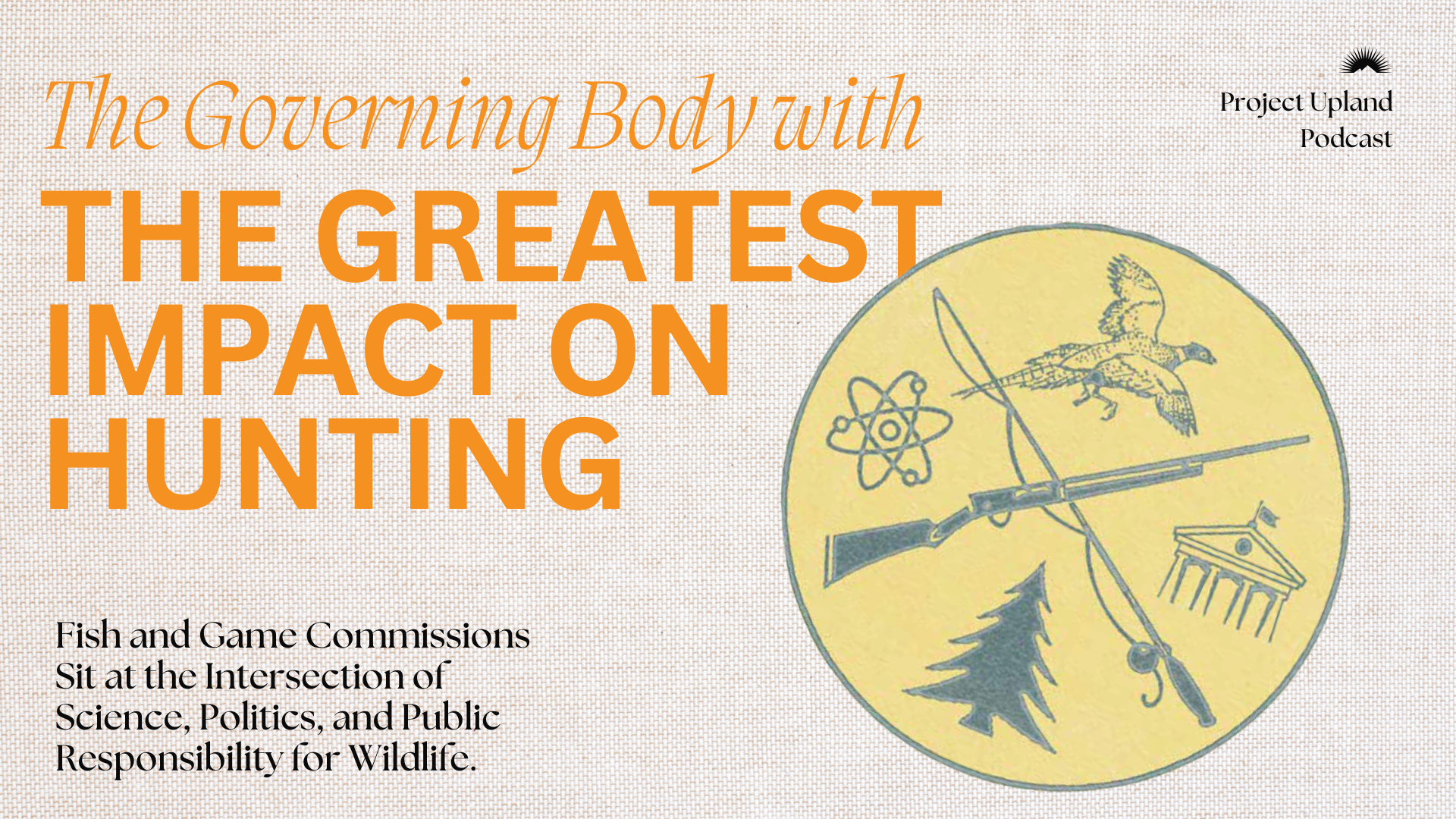
Fish and Game Commissions Sit at the Intersection of Science, Politics, and Public Responsibility for Wildlife
In this “Civics of Conservation” episode of the Project Upland Podcast, AJ and Gabby are joined by veteran journalist and former Montana Fish and Wildlife commissioner Andrew McKean to explore the often misunderstood world of fish and game commissions and the powerful role they play in shaping wildlife policy across the United States.
Together, they examine how commissions function at the intersection of science, politics, and public accountability, overseeing everything from hunting seasons and regulations to agency budgets, conservation priorities, and long-term strategic planning. The conversation breaks down how commissions operate, how the public can engage with them, and why their influence reaches far beyond hunting and fishing.
AJ, Gabby, and McKean also discuss the growing pressures facing wildlife commissions as debates intensify over predator management, non-game species, scientific research, funding, and the public trust in wildlife management. Along the way, they explore how commissions increasingly serve as the front lines of both conservation and conflict, where science, public opinion, and political realities often collide.
Throughout the episode, they argue that understanding how fish and game commissions operate is essential for anyone hoping to engage meaningfully in the future of wildlife conservation, hunting, and public policy in North America.
Get access to behind-the-scenes content and full, unedited guest interviews while supporting independent storytelling.
Podcast Episode Transcript
AJ: Today, we are going to talk about one of the most influential government bodies for everyday hunters and anglers. These bodies exist at the state level, where their authority is derived from the idea of the public trust.
Gabby: We are talking about Fish and Wildlife Commissions, which can go by various names—sometimes not even including the word “commission.” They are ultimately governing bodies that oversee different parts of a state agency’s fish and wildlife management. And AJ, you are in a unique position for this episode, I must say.
AJ: Yes. When I’m not wearing my Project Upland hat, I currently serve as the chair of the New Hampshire Fish & Game Commission. I have held the Strafford County seat for five years, and my most recent appointment expires in June 2029. I will say it has been an incredibly humbling experience in the civics of wildlife management. In most of the country, these positions are voluntary, meaning they are not paid, including New Hampshire.
Gabby: I know that most commissioners are governor-appointed. As a Colorado resident, I also know that these commissions can have a significant impact on everyday hunters.
AJ: Rulemaking, or setting hunting seasons and dates, is certainly the most forward-facing role commissions can play. But in this episode, we are going to explore how widely commission authorities can vary. They can range from strategic plans to setting legislative positions for a department, and many other functions.
Gabby: In this episode of the project upland podcast, we will cover everything from how someone becomes a commissioner to how we, as the public, engage with our commissions—which is probably the most important part of the episode. And we brought an old friend on for this episode who is a former Montana Fish and Wildlife Commissioner, Andrew McKean, who many of us know from his work with Outdoor Life.
“As wildlife populations increased and more people began to engage in recreational hunting and fishing, competing interests turned to elected officials in governor’s offices and state legislatures to influence the allocation of wildlife benefits. This resulted in decision-making that was often dominated by powerful special interests. In the early 1930s, the International Association of Game, Fish, and Conservation Commissioners (the forerunner to the Association of Fish and Wildlife Agencies), developed the Model Game Law as a way to moderate the influence of partisan politics on wildlife policy and allow for more deliberative decision-making related to complex fish and wildlife management issues. The model law called for creation of citizen Commissions with power over wildlife agency policies and regulations, budgets, and selection of a chief administrator who would be responsible for carrying out the policies and programs of the agency. These Commissions, composed of dedicated citizens, would serve as trustees for fish and wildlife resources.” – The Association of Fish and Wildlife Agencies, Commission Guidebook—2022, Edition 7
AJ: Now, these numbers have been hard to pin down and may not be perfect, because as we will learn, the authorities and functions of commissions or boards involved in governing fish and game vary widely from state to state.
Gabby: Thirty-five states have commissions or boards that at least have direct authority over season settings. Another eight states have natural resource commissions or boards whose authority extends into areas completely unrelated to Fish & Wildlife, but they still hold authority over those functions.
AJ: And lastly, seven states have advisory boards that have no statutory authority over Fish & Game functions. Those states are Alabama, Connecticut, Maine, New York, North Dakota, and Rhode Island.
Gabby: Before we go deeper, let’s bring in Andrew McKean.
Andrew: I am Andrew McKean. I am a freelance journalist covering, generally, the hunting, fishing, conservation, and, I would say, resource public policy beats, to get a little nerdy on you.
I’ve been a sort of consumer of Fish and Game Commission actions my whole life—my whole adult life—especially around the West. And I suppose that made me a relevant candidate for consideration for the commission. I was appointed to Montana’s Fish and Wildlife Commission—oh, the years are gonna get away from me.
We were still in COVID, but it was by a Democratic governor in the last year of his administration. And I happily accepted. It was, in some ways, sort of the pinnacle recognition of my interest in this space in general. And then, uh, I served for a number of months, almost a year, until the legislature reconvened, at which time I had to stand for confirmation, and I was not confirmed.
And so I had to hand in all of my paperwork and all my badges and really this… You can tell I’m not bitter about it. And actually, I’m not. It was just the way it works. It’s the process. I went into it knowing that it was a political process, and I would say I was a casualty of the political process, but it didn’t dim my enthusiasm for the topic or for the work.
AJ: So Fish and Game agencies are usually led by an executive director or some form of high-level position. When I say that, I mean daily operations and the management of personnel, in fact that would be a whole different episode. Commissions usually work at the 30,000-foot view more like a board of directors. So let’s get some basics out of the way: what is a Fish and Game Commission, and why do they exist?
Andrew: t is a citizen group that essentially—and appointed, politically appointed typically, uh, we can kinda get into some of the nuances there in a little bit—but typically it’s a citizen board that oversees and directs the policies of the wildlife agency.
It’s funny, it’s not… It’s such a simple question, but in some cases it’s not a simple answer because there are lots of variations on that theme. The neat thing about it to me is this is a state-level authority or jurisdictional body because, by our traditions and sort of legal precedent, fish and wildlife resources are managed by the state.
But the cool thing about it is every state kind of approaches it a little bit differently. So I gave you kind of the bland vanilla version, but there are lots of variations on that theme. I mean, some have the authorities of a commission, but not the name. I mean, this kinda gets into the, I think, sorta nettlesome nature of it, is sometimes it’s a secretary within the agency that has the oversight ability, and sometimes that’s an elected position instead of an appointed position.
So it does widely vary. But I would say, in general—let me talk about the intention of it before we kinda get into the practical application of it—it should be, when it works best, a layer between the political parties of the governor or the legislature and the bureaucrats, the people who are actually delivering fish and wildlife management in a state.
And within that layer, there is so much room for direction and interpretation and prioritization. And to me, that’s actually what’s so interesting about it. But to put a point on that, I would say it’s an important component of this thing that we call, this squishy idea we call, the public trust, which is that fish and wildlife resources should be managed for the entirety of the citizens of a state.
And if a commission’s doing its job correctly, it’s both looking in the rearview mirror and looking ahead, and it’s got situational awareness with that as its main focus. We expect commissioners to do their best for the public, just as we expect our elected officials to do their best for the public.
Gabby: Alright, so what are the requirements, and how do they get selected? Furthermore, I see states with different numbers of commissioners—so many questions.
AJ: These are great questions. And unfortunately, we would never have enough time or resources to go over each state because they are all unique. In New Hampshire, there are 11 commissioners—one for each of the 10 counties and one seacoast commissioner. Yes, New Hampshire has an oceanfront. So in this case, it’s a combination of geographical representation and specialty representation.
Andrew: So Montana actually just, through a legislative mandate, enlarged the commission from five to seven, actually just as I was going off.
In fact, that same legislative session where I was not confirmed, the legislature expanded it. So Montana has seven Fish, Wildlife and Parks administrative regions. And in the past, with five commissioners representing seven districts, you had some sort of strange math. But now there’s a commissioner from each of the administrative regions of the state agency.
There are sub-qualifications in that, that at least one commissioner has to represent the sportsmen’s interests of the state. At least one has to be an active stock grower. And I think there might be one or two other sort of sub-qualifications for commissioners.
Interestingly, Washington has been in the news. There’s, I would say, a sort of coarser cut. You’ve got three commissioners, I think it’s three from Western Washington, three from Eastern Washington, and then two that are at large. So I would say that arrangement is pretty common, at least among the Western commissions that I’m familiar with. You’ve got some sort of loose representation either of a constituency or a geographic region.
So some states require at least one or two commissioners to have a degree in fish and wildlife management. I don’t think that’s a bad thing. I think—I’ll opinionate here just a little bit—to be a commissioner is a crash course in fish and wildlife management. And so somebody who comes into it with a grounding in just the terminology, let alone the science and the consequences of the science, has a head start.
We get commissioners who really, in my experience in Montana, had little engagement with the department or with the commission before they became… It was essentially a political appointment, you know, kind of a little… It was cronyism. And some of the commissioners actually did really well once they got their feet under them, but it took a year or two.
And typically these are three-year terms with the opportunity for renewal. But they’re at a disadvantage to start if you don’t already have some sort of conversant familiarity with the issues that you’re gonna be talking about.
I know Mississippi’s commission has actually been in the news quite a bit lately because the legislature just—I can’t remember, I’ll get some of the details wrong—but either approved or mandated that the agency manage captive deer operations. And so now you’ve got a commercial enterprise that a lot of the sports folks of Mississippi think is a direct threat to the free-ranging wildlife populations in Mississippi that the commission is now responsible for managing.
So as a result of that, one of the commissioners was required to have experience in captive animal husbandry, which is a little bit weird for a commission.
So each state kind of has some variation in terms of those codified requirements of the commission. And I would say the livestock interest or agricultural interest is probably one of the more common ones. That’s an artifact of a time when I believe there was much more interest with fish and wildlife management—think about our hatchery example—being more like aquaculture or the idea of raising wildlife like a crop, like an annual crop.
There was much more focus on that, where I think the idea of agriculture and a background in agriculture were much closer to wildlife management than they are today, where I think now we see wildlife more in conflict with agriculture than we do as a partner of agriculture.
Gabby: Okay, let’s put the brakes on here. Since this is a bit of a civics adventure, let’s establish where we are in the governmental landscape.
AJ: Okay. We are broadly talking about the Executive Branch of state government when it comes to a Fish and Game agency, this refers to the part of the state government responsible for enforcing the laws and policies of the entire government. This includes everything from the Department of Safety to the Department of Transportation, to name a few. The head of that branch is the governor. Governors usually appoint commissioners.
Andrew: The commission is an extension of the executive branch, right? It is essentially a cabinet-level agency that is operating under the influence, whether direct or implied, of the governor and the executive branch.
I think the reason it’s such an interesting question is the places where this relationship gets messy are where the legislature either enforces policy on the commission or where the commission starts to legislate rather than administer executive actions.
And it’s a natural tension because I think most commissioners, if they’re expressing the fullness of their job, want to legislate, right? That’s the tension here. It’s partly legislative. It’s setting policies and priorities, not just implementing the policies and priorities that are handed down.
Those are two really different poles.
AJ: The legislators also play a role here, so that’s the State House of Representatives and Senate. While the Public Trust Doctrine establishes the need for state-level management of natural resources, the legislature makes the statutes that give commissions specific authoritative powers. In some cases, the legislative branch must also approve the governor’s nominated commissioners. In New Hampshire, that authority lies with the Executive Council, which is actually part of the Executive Branch of government. The New Hampshire Executive Council is incredibly unique to New Hampshire, but that only highlights the nuances of this conversation—civics can be complicated and incredibly unique from state to state.
Gabby: The Judicial Branch of government has its influence on this process. For example, the public trust of wildlife is part of common law. Common law is based on judicial decisions, custom, and precedent rather than statutes enacted by legislatures. Definitely check out our past episode on the Public Trust Doctrine.
Andrew: That’s the caveat here. The commission structure is by far the most effective, and I think compliant with the expectations of this North American model that we manage wildlife in the public trust.
The reason being this: commissioners, whether they represent a region of a state or a constituency of a state, I think are at their best when they truly are representing that constituency while also kind of keeping this almost judicial fiduciary duty highest in mind.
So you’ve got two tensions there, right? You’ve got the tension from your constituency that may be hotheaded about a certain issue, and there may be the knowledge or the realization that that might not be best for the resource or the agency.
That’s the role of a commissioner, right, to me, is to balance those competing interests as a collective.
And there you also have the dynamics of commissions that don’t agree on things.
“It is perhaps accurate to say that the ownership of the sovereign authority is in trust for all the people of the state, and hence, by implication, it is the duty of the legislature to enact such laws as will best preserve the subject of the trust and secure its beneficial use in the future to the people of the state. But, in any view, the question of individual enjoyment is one of public policy, and not of private right.” – Edward Douglass White, Associate Justice of the Supreme Court of the United States, 1896
AJ: So now many of us are probably wondering what authorities a Fish and Game Commission actually has and ultimately how does it affect us as hunters?
Gabby: Okay, I’m starting to sense a trend here—I am guessing these things vary widely from state to state.
Andrew: Some commissions establish and approve the budgets for the agencies. Some commissions hire the agency’s director. Other agencies have nothing to do with the fiscal management of the agency or with the director or the management of the agency, and are just there to advise on policy issues.
So it can be kind of everything and anything.
AJ: Other examples of authority include setting legislative positions on proposed laws—for example, when an agency testifies for or against a bill. They may also establish strategic plans and approve land purchases or disposals. Frankly, I know I am missing some here, but probably the most forward-facing authority is rulemaking.
Andrew: In the limited context of Montana, because I’m trying to be guarded a little bit because that’s where I’m most familiar, but I’m gonna guess the experience between those is the same everywhere it exists.
And so rulemaking—and we can use bag limits or season setting as a good example of that—that’s probably the most common sort of familiar part of rulemaking for commissions.
So a rule has a public process, where typically a rule package is presented by the department, and it’s the result of, let’s just say deer season, just to keep things kind of focused.
So you’ve not only got historical precedent, how this has been done in the past, but you also have wildlife inventories. Like, we know how many deer are on the landscape roughly, and we know what the harvestable surplus should be, which sort of goes into how we’re gonna fashion our season structure.
That goes out for public comment. People have the ability to weigh in on it. There’s typically a hyper-public process where commissioners or the agency go to communities and solicit input in person.
That then comes back to the commission, and here’s where I think this is the best evidence that it’s a wonky and messy, deliberately messy public rulemaking process.
Usually those are digested into a final rule that then goes back out for public comment and comes back in for the commission to adopt that final rule. So there are so many touchpoints along the way.
That rule that the commission approves has the authority of law, right? That’s why if I violate the bag limit of my state, I can get a ticket that is meaningful in terms of its legal consequences.
Lawmaking has its basis in the statutes of the state. And so you think about judicial precedent, everything kind of comes into what we call in Montana the ARM rules, the Associated Rules of Montana. They’re part of legislative precedent, and the fish and game part of that is a subset of the legislature’s rules.
Laws have an even higher bar in terms of not only legal consequences for violation of them, but in terms of the public process. There is not the same sort of annual review and approval of this. Once it’s set by the legislature, it takes an act of the legislature to change it.
So I think that’s maybe the most interesting and, I think, underutilized power of a commission, is to establish prioritization of the agency’s work.
So many agency constituents and listeners are going to be familiar with those very overt public processes, the annual bag limit discussion and season-setting process, where there’s an established public input part of it. There’s a quasi-judicial process that results in these legal documents.
The commission in Montana has the ability to have time-constrained rules. What it doesn’t have is the ability to have rules into perpetuity. In other words, they have to be revisited on some sort of periodic basis, which I think is actually fascinating when I think it through. I haven’t thought about it until now.
The legislature has the power of permanence.
Gabby: So I have to say, rulemaking feels like the most important process that hunters should be aware of and provide input on. And maybe we need a whole future episode on the rule making process. I feel like this is really where the rubber meets the road for hunters—and maybe a great starting point for getting familiar with your state’s commission.
Andrew: It’s hunting and fishing, and for somebody who is into hunting and fishing, this is where it all happens—at a commission meeting, in the commission dialogues.
But I’m gonna maybe extend that out a little bit because I feel like we have lost touch with local politics. Like, I can’t really tell you right now what my county commission is talking about. And it affects me directly in terms of road management and funding and… But I know exactly what’s happening in Washington, DC.
And so I look at the sort of powerlessness, relatively speaking, of people to know about and influence the people whose decisions make the most impact on their lives, their cities and their counties and their states.
One of the things I think that’s really interesting with fish and wildlife is because of its very defined mandate and sort of purview, people know exactly what a fish and wildlife commission is going to be talking about. It’s gonna be fish and wildlife. And if you’re a hunter and angler, that’s where you go with your passions and your concerns and your suggestions.
And so I think, in some ways, it’s the last vestige of accessible policymakers and decision-makers for constituents. Even more so than the legislature, even though there are many, many more state legislators than there are commissioners, we don’t really know what state legislators do. It’s just a little bit vague and amorphous.
We know exactly what fish and wildlife commissioners do.
AJ: So to Andrew’s point, there are certainly federal-level processes that impact us as hunters, and luckily (or not) they’re kind of in our faces all the time. But since state-to-state politics are unique, not only do they have the potential for a serious impact on us as citizens of those states, we also have to do our own homework. I’ll tell you, there is no faster way to tell someone is not from New Hampshire than when you read an article on state politics written by someone who is not a Granite Stater.
Gabby: I’ll have my editor-in-chief moment to point out that this is exactly why we largely avoid writing about state-level hunting issues these days. It’s just impossible for us to capture all those nuances and properly vet that information. It takes local experience—that means you, the listener.
“We started seven years ago to build up a fish and game department. Before that it was nothing but politics, but I am glad to say that we have not had to play politics very much of late years. Politics and fish and game commissions; do not mix, and that is a great trouble with a lot of our states. Fortunately we have not been obliged to pay very much attention to politicians; once every two years they raise a lot of trouble with us, but we have managed to get through all right, although some day they will probably get us. – Roland Parvin, Colorado Fish and Game Commissioner – Convention of the International Association of Fish and Wildlife Agencies, 1926
AJ: According to the Commissioners Guidebook, commissioners, as representatives of the public, have to make decisions by weighing five key sources: biological and ecological factors, legal mandates and constraints, economic feasibility, technical feasibility, and social values. As you can imagine, this leaves things very open to interpretation.
Andrew: So Missouri is the best example of a well-funded state. They have a portion of their sales tax that supplies a consistent and sizable—I’ll forget the percentage—portion of the state’s wildlife management budget, agency budget, that comes from that, but it’s a lot.
They also have a huge amount of Pittman-Robertson dollars coming into the state and Land and Water Conservation Fund dollars coming into the state, all of which means their ability to build and maintain a conservation infrastructure is almost separate from the day-to-day policy-level perspectives they bring.
So they’ve got the building blocks, the foundation of wildlife management, sort of covered with petty cash—not to say it’s petty and it’s not cash—but they don’t have to worry about it. So then what the commission is really doing is making fairly small adjustments to this pretty sustainable engine.
That’s the best example I can think of. There’s just not a lot of drama there.
Underfunded states—Wisconsin comes to mind. Wisconsin comes to mind where you’ve got a whitetail population that is riddled with CWD. You’ve got an aging hunting population. You’ve got all of these mandates of federal wolf management in the Upper Peninsula. You’ve got some federal fisheries stuff going on there.
Anyway, it seems to me—I think I’d need to research it to confirm it—but it’s a relatively underfunded state. And because people are sort of… The image I have is people fighting for scraps. It tends to be a lot of cultural identity that comes to the fore.
I’m a meat hunter versus I’m a trophy hunter. There’s just division within the sportsmen’s community and over resource allocation. And so what you have is all of these sort of naked identities coming to the fore and sharpening over resource management.
That may not be the best example, but I think it’s not a bad example that when you have resources that are struggling, when you have funding that is uncertain, you start to kind of bring out the worst in people, and they’re really fighting desperately for their share of things.
And you’re seeing it certainly in states that are underfunded. You tend to have well-funded political interests having disproportionate influence. So I’m thinking about the oil and gas industry in the Dakotas. So much of what happens in North Dakota is determined and defined by the oil and gas industry.
Whether that’s deer management or water management—I mean, resource and certainly habitat management—if you had a well-funded agency that didn’t have to rely on partnerships with the industry, you might not have that sort of tension.
Gabby: When I went to school for my degree in Wildlife Ecology, a theme that many professors, scientists, and people working within government agencies involved in our wild spaces emphasized was that conservation is bipartisan. Unfortunately, that is no longer the case.
Andrew: I would say this kind of is an extension of what we were talking about, about the hyper-partisanship and our ability to hear what we want to hear when it comes to political discussions. And so we’re in these silos, these echo chambers of social media or whatever.
Fish and game politics is probably ultimately partisan, but as we’ve been discussing here, it doesn’t have to be, and it shouldn’t be. And one of the things I would like to sustain is the nonpartisan nature of resource management because, when it works at its best, it’s not partisan.
And if it does get sucked into this tribalism that is affecting every other jurisdiction, we’re probably screwed.
And so if you care about keeping this as a truly nonpartisan—I don’t want to say meritocracy so much—but management that’s based on the merits of the resource and not political paybacks, this is the time to get involved because we could easily lose fish and wildlife management to partisan politics like we’ve lost every other jurisdiction to it.
AJ: Some states do have forms of safeguards in place to try to prevent partisan commissions. In New Hampshire, no more than six members of the commission can be from the same political party, a rule established by legislation. Commissioner terms are also staggered, which prevents a loss of experience all at once. This can also help spread appointments across multiple governors to build a more diverse commission.
Andrew: That is highly unusual. In my experience, there are no safeguards. The fact that it is largely a nonpartisan body in most states is really a function of, like I talked about a little bit before, a tradition of politeness and, I think, focus on the resource rather than the partisan management of the resource on commissions.
That’s a gross generalization, but I think it’s worked in a lot of cases. But it worries me greatly that there isn’t a fail-safe on that.
I’m going to give you one example of that here in Montana. So I would say I was a casualty of a political process. I went into it, as I said, with my eyes open, knowing that that was a possibility.
What was interesting, though, is the commissioners that the Republican governor, who is still in office, appointed were either political donors or political fellow travelers or represented constituencies that were politically aligned with the Republican governor.
So we had a very vocal commercial outfitter on the board. We had a very active oil man on the board. We had a stock grower, a very active stock grower, on the board. We had somebody who was very active in Republican politics and also from Simms Fishing, so there was a resource part of it. But I would say more of an executive level of the outdoor industry on the board.
Not very many of what I would say were kind of the grubby sportsmen on the board, which was a constituency I happily and proudly represented, were the work-a-day hunters and anglers of Montana.
I don’t think there’s a partisan representation to that constituency, but it was important that I voiced that.
And when I left the board, I think there was only one commissioner who would even talk about maybe somebody who might like to bait fish, or that doe harvest is important in terms of not only wildlife management but putting meat in freezers.
AJ: Fish and game, or wildlife—really any variation of these agencies’ titles—does not negate the fact that non-game management responsibilities are also part of their work. The idea of overpopulating game animals without regard to the consequences of overpopulation is now antiquated.
Gabby: Habitat-level management, which is ultimately an ecological approach, has proven to be beneficial not only for non-game animals but also for game species.
Andrew: So every agency has abundant authority for non-game wildlife species. And one of the happy, I think, outcomes of the last 10 years or so has been a recognition that because there’s not that discrete funding source through license dollars to support non-game species, there needs to be other funding mechanisms.
So that’s where you see some of the federal money that’s coming to states to manage those species and those ecosystems. So there’s more money than ever, but there’s still not enough. And I think it’s the commission’s sort of blind side to not be paying attention to not only those resources but those constituencies that advocate for them.
And that’s what we’re seeing in Washington with this ecosystem management. Finally, there was a critical mass of commissioners who said, “Enough. We need to pay attention to the larger tapestry of fish and wildlife in the state, and not just the ones that licensed hunters and anglers are paying for.”
I feel pretty strongly about it. This is not going away. This is only going to get more intense. And I think it is not only good politics, but also good for the resource, including the resources that we hunt and fish for, to pay attention to this and make sure that we’ve got functional ecosystems for animals that we don’t hunt and fish for.
And for a couple reasons. One, I can look at it from a punitive and negative side, and that is those are the candidates for endangered species listing, where the feds can easily come in and override state jurisdiction. So that’s always the boogeyman.
But I think from the other side of it, these are indicator species, right? And in a lot of cases, the better we do for the animals that we don’t hunt and fish, the better the animals that we do hunt and fish will do as a result.
And so I think there’s a broadening of that perspective over time, but it’s been slow to build and a slow realization for a lot of at least the Western commissions to come to terms with.
Because they don’t have to, right? It’s a choice, if not a mandate.
Washington State has been in the news because their commission has become, I think very intentionally, pretty activist in terms of representing what we in the hunting world would call a non-traditionally represented constituency on these fish and wildlife commissions, which is the non-game, non-hunting consumers of the wildlife resource.
So wildlife viewers, hikers, people who really care about endangered species management. In a lot of cases, these people are left out of the very narrow definitions of fish and game commissions.
And what the Washington Wildlife Commission directed the agency to do is rethink how it manages wildlife with more of an ecosystem approach instead of really using hunting and hunting seasons to control recreational opportunities with ungulate populations.
Maybe let’s think about how we can use predators to manage ungulate populations would be one example. Another example is there’s a huge reliance on hatcheries to sustain recreational fishing opportunities. Well, hatcheries, especially for anadromous rivers, can influence native species.
And so one of the things that this ecosystem management approach in Washington was trying to do is say, “Let’s de-emphasize these recreational opportunities that have been built up over the years by the constituency,” right, that says, “Hey, we want more fishing and hunting opportunity,” and instead say, “Hey, our obligation is to the full spectrum of Washington’s wildlife.
And in order to achieve that, we’re going to have to reduce some of the recreational influence on the commission.”
I think that’s a good example of a commission really redefining the priorities of the agency.
So I think when you do lose the diversity of perspectives, regardless of that partisan overture, I think it’s a loss to the entire commission.
AJ: A theme in all these civics episodes is that the work of preserving our wildlife and fisheries, or the North American Model of Conservation, is fluid. California claims they established the first wildlife conservation agency in the country in 1870 called the California Board of Fish Commissioners which would become Fish and Game Commission in 1909.
Andrew: I’m in a really funny place because I look across to Washington, and I actually kinda cheer what’s happening in some ways. Having people who don’t come from our hunting and fishing culture, who care enough about wildlife to be involved at a commission level and make decisions—I applaud that.
But it scares the hell out of me because I feel like there are people in the non-hunting and fishing community who are active and involved because they would like to end hunting and fishing. And involvement in commissions is a damn good way to do that, is to be influential in the process like we were just talking about.
I don’t love that.
If I look at the bulwark against that, it’s that if you are a hunter and a fisher who is worried about losing what we have, the time is now. We could lose it not only from deliberate actions from people who actively wanna take it away, but also from inattention to people who want the resources that wildlife requires.
I’m thinking of industrial agriculture. I’m thinking about winter-range subdividers. I’m thinking about urban zoning that is putting nitrates in our rivers, in cold-water rivers. I’m thinking about climate change that’s changing all of the habitat that wildlife requires and doesn’t have the runway to evolve fast enough or the mechanisms to migrate to habitats where species can sustain themselves.
So all of these pressures are happening.
So yeah, on the one hand, I think the pro-rights, pro-hunting-rights people are quick to point to the anti-hunters who are after us. I think that’s real. It’s worth paying attention to.
But I think equal to that are all of these other pressures on our resources that are, through sort of chiseling away at either opportunity or habitat, taking just as much.
And it’s the commissions, it’s the people who are involved in these day-to-day decisions, that can influence our ability to keep doing this in the future.
Gabby: So I looked up the federal timeline for this, and in 1871 the United States Commission of Fish and Fisheries was formed. That eventually became the U.S. Fish and Wildlife Service.
AJ: Now I need to set the record straight here. In 1865, New Hampshire established the Commission on Fisheries—for context, that’s the same year the Civil War ended—making it the first state in the country to do so. It had two commissioners, appointed by the governor and council, just like today. Tasked with a unique crisis of sea fish decline in New Hampshire riverways.
Andrew: The responsibilities to the public, I think first are… Here’s why I’m struggling with it and thinking it through. There’s the current situation where I think it’s a really narrowly defined expectation of what a commissioner’s responsibility is to the public, right?
They hear from hunters, they hear from anglers, they hear from landowners who have wildlife impacts, they hear from maybe industries, and they hear from NGOs, collections of all of those subsets.
And so I think there’s a real tendency to be responsive to those pressure points and those vocal constituencies.
I think when a commission is really firing on all cylinders, they’re looking ahead. They’re looking at things like urban growth patterns and, certainly in the West, probably the biggest threat to wildlife we have right now is development of winter range and big-game migration corridors—not only for charismatic species, but for other things that we don’t have GPS collars on.
And so fragmented habitats are really problematic, and they’re expressing themselves in sportsmen’s access and the bag limits and the way that we very granularly manage fish and wildlife.
So to me, a commission is doing its job best when it’s looking ahead at these bigger threats that are coming. And that doesn’t just involve hunters and anglers. That involves county commissions and planning boards and chambers of commerce and this bigger constituency of people who have to live in and work around wildlife, which gets, I think, to the bigger picture of a commission representing wildlife resources.
Again, you can look at it narrowly. The legislative authority is pretty clear. It’s fish and wildlife and animals that are on the list, and these are legislatively codified lists of game species. They’re legally defined.
Animals that fall off that list, it’s really a sort of elective management and elective prioritization.
I think commissions that are doing their job best for wildlife are really taking a look at threats to ecosystem health, whether that’s water here in the West, like in-stream flows. Conservation pools in either reservoirs or rivers are a huge hot topic.
We are gonna see rivers this summer go dry, and all of the resources that have been put in for generations and years to develop a sustainable fishery are gonna be lost because we didn’t have the foresight and the strength of our convictions to keep water in waterways.
I think that’s the job of a commission, is to look out for those longer-term resources.
Yeah, there’s a lot of noise around those annual bag limits and the rulemaking, but a commission that’s really doing its job is looking at those bigger, I’d say, threats, but also opportunities.
What do we have for non-traditional funding sources? Who are constituencies that we can align with?
To me, that’s the best part of being a commissioner, is thinking of those bigger pictures and adjusting to the benefit of the resource.
“Every Commission member is a trustee of the state’s wildlife resources. In that role, each Commission member has an obligation to make decisions that are in the best interest of the people of the state, including both current and future generations.” – The Association of Fish and Wildlife Agencies, Commission Guidebook—2022, Edition 7
AJ: If there is one thing I hope listeners take from this episode, it’s to go on Google and look up your state’s commission and learn who represents you, reach out to them. Maybe attend a meeting, review their agendas, and begin to learn the process. Because it is going to be unique to your state.
Andrew: In commissions where the commission is the regulatory body, is the decision-maker, in my experience there’s an interesting dynamic with that because there is less appetite and, I would say, less acceptance and solicitation of that grassroots sort of opinion and perspective, which is a little disappointing because I think that’s a really, really important role.
Everybody should know who their wildlife commissioners are. And I bet if you polled your audience, I don’t know what the number might be—10%, maybe it’s less than that—know who their wildlife commissioner is, and a far lower percentage has a relationship with them or can contact them.
So I think this is a lost opportunity. But I think part of the reason for it is regulators are generally, great generalization, loath to hear from their constituents.
Gabby: So I looked up the Colorado Parks and Wildlife Commission, which has eleven voting members: three hunters/anglers (one outfitter required), three agricultural producers, three recreation/parks users (one conservation nonprofit representative), and two at-large public members. I now have all of their emails.
Andrew: I feel like for so many hunters and anglers in this country, there’s this invisible hand. You don’t even think about the management side of it. Like, how are opportunities allocated, and how are resources managed, and how do we ensure that these pretty fragile populations of wildlife are perpetuated—and not only perpetuated, but in enough abundance that we can hunt and fish for them?
That’s the biggest issue to me. This didn’t happen by accident. We got here through very deliberate choices and from people who cared enough about the future of wildlife to establish frameworks and commissions and bodies and processes for allocating them.
And to me, that’s the biggest issue. This is a public resource, the same as our air and our water. And somebody is deciding who gets what and how these resources are allocated. We’re all the downstream beneficiaries of it.
But I hope people who are listening to this podcast feel like we’re, in some ways, lifting the covers on the mechanics of all of this. This doesn’t happen by accident. This happens every day through deliberate choices, and some of the choices are benefiting wildlife and benefiting us as consumers of wildlife, and others are not.
So first is awareness, and second, there are avenues for involvement. Get involved. If you care about this as much as I do, find a way to be involved, not just as a consumer.