

The Art of Escutcheon: Engraving Shotgun Stock Ovals
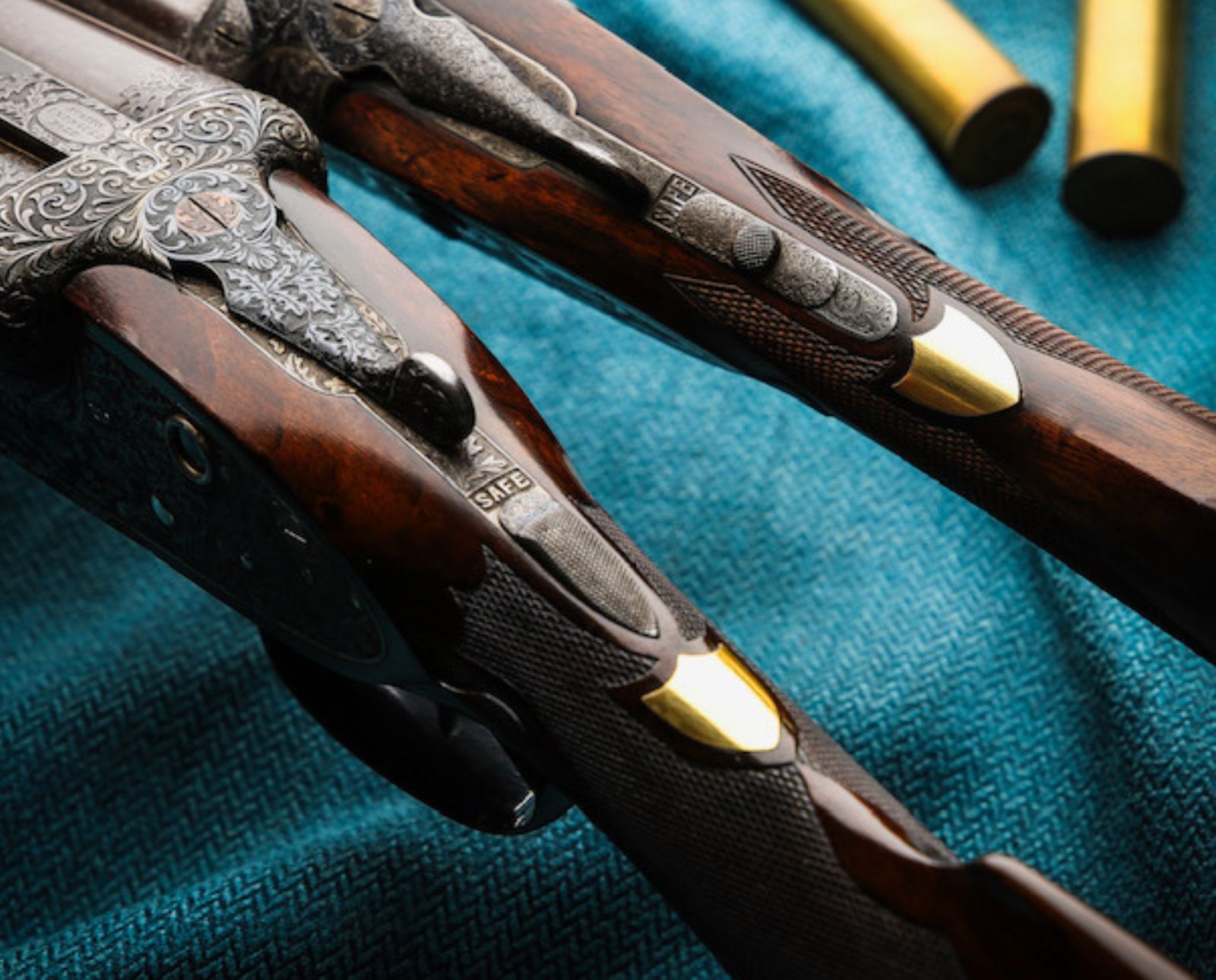
Do engraved stock ovals diminish value or complete a story half-told?
This article was originally published in the spring 2026 issue of Project Upland Magazine. Photos are by LD McCaa.
Escutcheons, or what many gun enthusiasts refer to as stock ovals, have accompanied hand-carried firearms since their earliest forms. Over the centuries, they have evolved in style and purpose, yet their essence—a graceful marriage of art and identity—remains unchanged.
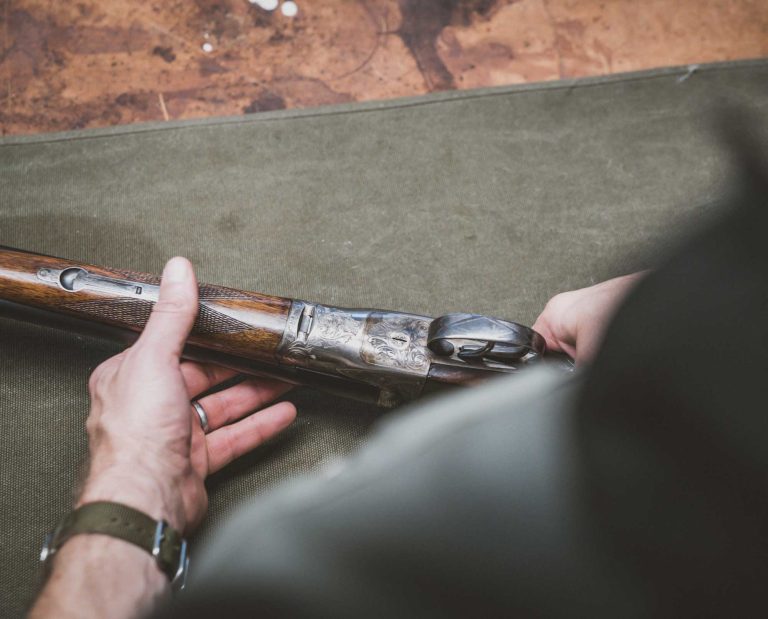
The word escutcheon derives from the Old French escuchon, meaning “shield.” In firearms, it denotes a nonfunctional piece of metal, usually inlaid into the stock of a gun. Though primarily decorative, it carries a symbolic weight that far exceeds its size. Traditionally shaped like a small shield, the escutcheon can range from simple, unadorned ovals to elaborate, hand-engraved works of art, each revealing something of the owner’s character, heritage, or pride.
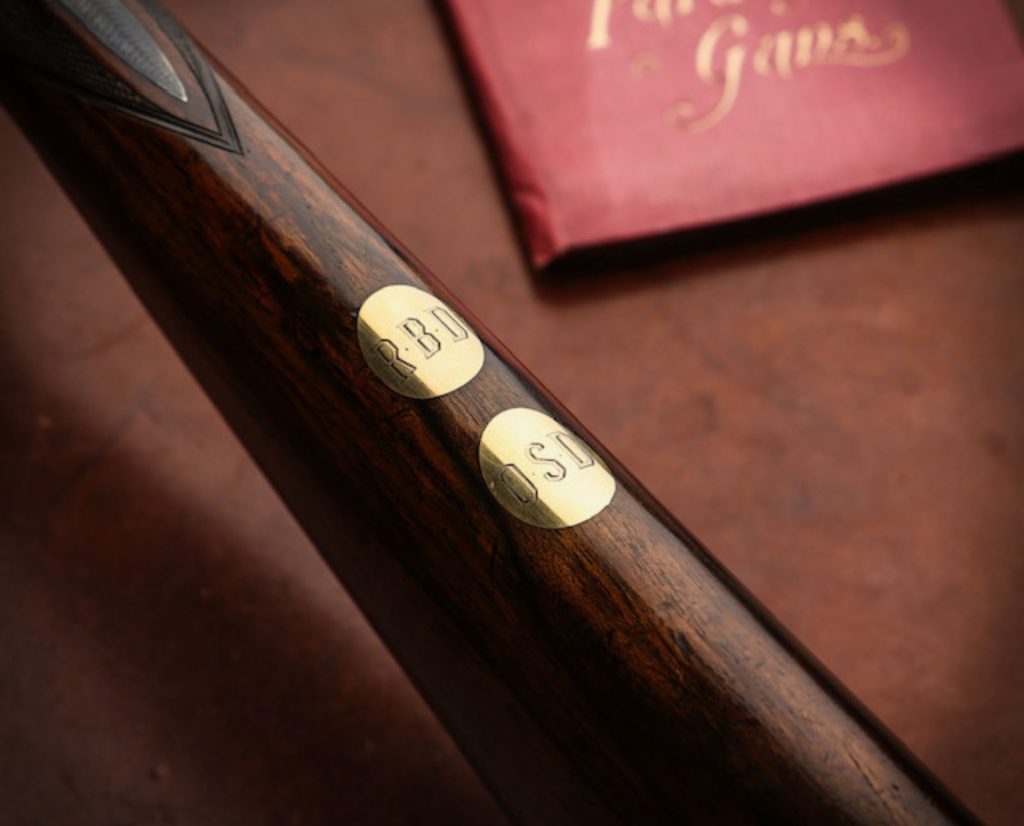
Today, most shooters recognize the escutcheon as the oval of metal inlaid on the toe line of fine guns, often engraved with a monogram, crest, or family emblem. Throughout history, these miniature canvases have borne everything from the coats of arms of European royalty to the initials of humble farmers. The dents and scratches that accumulate on a shotgun over years of use may lend it character, but they speak only in generalities. The escutcheon, however, tells a deliberate story. An ancestor’s initials on the toe line of a well-loved firearm become a tangible bridge to the past, carrying both memory and meaning.
A Personal Beginning
The fascination with these small tokens often begins with a single gun. For me, it was an AYA 20-gauge Model 4/53, a Spanish double gun of striking beauty. Fresh out of college, the cost was considerable, yet the allure of craftsmanship outweighed financial prudence. The gun came with an unengraved oval, a blank page inviting a decision: should it remain untouched, or should it bear the owner’s mark?
Watch: In Our Veins – The Story of AYA Shotguns
Among collectors, this debate has endured for generations. Online forums and club meetings often divide enthusiasts into two camps: those who leave ovals blank to preserve originality, and those who believe that engraving completes the gun’s story. The purists argue that an engraved oval diminishes value, particularly if the piece is collectible. “Who wants another person’s initials?” they reason. Others hold that engraving disrupts the continuity of an untouched firearm, especially if it has survived decades unaltered.
For years, indecision prevailed. Gun after gun entered the cabinet, their ovals left smooth and silent. The argument for restraint seemed reasonable, but something about the emptiness felt incomplete. The absence of initials felt less like preservation and more like omission, a story half-told.
A Shift in Perspective
The turning point came not through sudden impulse but through reflection. Ownership, after all, is part of a firearm’s living history. Each new caretaker becomes another chapter in its narrative. Why should that story remain unwritten?
Seeking professional insight, I contacted Kirby Hoyt, owner of Vintage Doubles in Washington, a respected authority on fine sporting guns. Hoyt’s approach to vintage firearms emphasizes precision and authenticity over exaggeration; a craftsman’s honesty rather than a salesman’s pitch. His view was pragmatic: in most cases, engraving an escutcheon does not meaningfully affect a gun’s market value. “I wouldn’t touch a gun with the Queen’s initials,” he said, “but otherwise, a tasteful monogram won’t hurt it.”
In Europe, replacing or re-engraving ovals when guns change hands is entirely routine. British gunmakers, accustomed to producing bespoke pieces for multiple generations, expect such personalization. In contrast, certain American collectors—especially those devoted to the Parker brand—value absolute originality. Many Parker ovals were custom ordered, and collectors often trace a gun’s provenance down to its factory hang tag. In that niche, any deviation from the original specification can influence value.
Another respected voice, L.D. McCaa, U.S. manager of Westley Richards, echoed similar sentiments. Through his hands pass both heritage pieces and newly commissioned English best guns, and he regularly oversees the replacement of ovals for new owners. Westley Richards includes a stock oval as part of every bespoke order, offering materials from silver and gold to enamel. One New Orleans client, McCaa noted, always requests an enameled oval featuring a fleur-de-lis—a nod to local pride.
McCaa agreed that monogramming or replacing an escutcheon has negligible effect on a gun’s value. Over the years, he has encountered an extraordinary range of designs: engraved cattle brands, depictions of game birds, and even Purdey’s distinctive inlaid initials set directly into the stock rather than on a separate plate.
Both experts reached the same conclusion: personalization, when executed with taste, neither diminishes the firearm’s worth nor disrespects its lineage. The beauty of the escutcheon, they agreed, lies in its balance between tradition and individuality.
The Craft of the Escutcheon
Once the decision to engrave is made, the question becomes one of execution. Monogramming is typically handled by a fine gun shop or an experienced jeweler. Indeed, much of the engraving seen on British firearms can trace its lineage to the jewelry trade. The familiar rose-and-scroll pattern of many English guns is said to have originated from motifs found on the backs of pocket watches crafted in Birmingham and London.
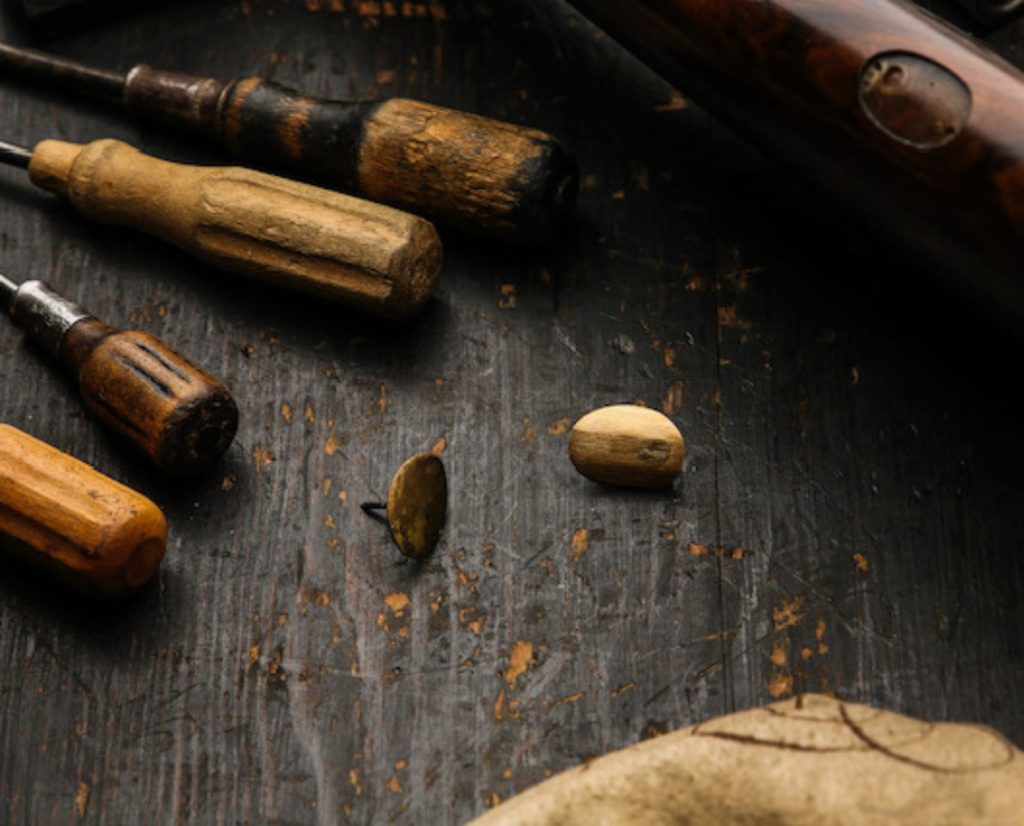
Replacing an escutcheon, however, requires specialized skill. Steve Dazell, a stocker based in Maine and trained by the renowned craftsman David Trevallion, offered perspective on the technical challenges involved. Older firearms often used shellac to secure their ovals—a bond easily reversed without harming the wood. Modern guns, by contrast, typically employ epoxy, which makes removal delicate and time-consuming.
Each escutcheon usually features a small spike on its reverse side to prevent rotation during installation. The edges are beveled to allow a snug yet flexible fit. Dazell cited Parker reproductions as particularly difficult: their unbeveled, thick ovals demand perfect inletting, and the epoxy used during manufacturing leaves little room for adjustment.
Read: The AYA No. 2 Sidelock Shotgun
Dazell also highlighted an overlooked historical evolution. The earliest escutcheons were positioned on the top wrist of the stock rather than the toe line. As driven shooting gained popularity in the late nineteenth century, practicality prompted a change. Guns were often racked muzzle up at shoots, with the toe line visible. Moving the oval to that location allowed shooters to identify their guns quickly—an important convenience in an era before serialized numbering was universal.
Over time, the escutcheon became not only an identifier but also a hallmark of taste. Victorian gunmakers sometimes matched the metal to the furniture of the firearm—silver on rosewood, brass on darker walnut—creating subtle contrasts that caught the eye in sunlight. In certain aristocratic households, guns were even engraved with heraldic devices designed by family artists, merging lineage with craftsmanship in a way that no other object could replicate.
A Window into History
Hoyt, McCaa, and Dazell share an appreciation for the escutcheon as a portal into the past. Each has spent time researching the initials on a gun’s stock, often uncovering remarkable stories about former owners. These small shields become, in effect, genealogical clues cast in metal.
The custom of personalizing fine firearms has deep roots. During the height of the British gun trade, it was almost unthinkable for a bespoke client not to add initials or a crest. The gun was a statement of individuality, and the escutcheon its signature. Today, companies like Upland Gun Company continue this tradition. A large majority of their customers request initials or other identifying marks. For a piece that may cost anywhere between $5,000 and $250,000, leaving the oval blank feels anticlimactic.
Historically, the omission may have served other purposes. Some families may have expected descendants to add their own initials later. Others, particularly the landed gentry, may have left ovals unmarked to allow a gamekeeper to use the gun without the master’s emblem. Whatever the reason, the result is a mystery etched in absence.
The Collector’s Dilemma
Collectors remain divided. The purist’s concern for originality has its logic, because historical integrity is central to the discipline. Yet many experienced appraisers agree that modest, tasteful engraving has little practical impact on resale value unless the gun is a museum-grade artifact. The larger truth lies not in market trends but in the enduring connection between owner and object.
For the modern enthusiast, engraving an escutcheon is an act of participation in a centuries-old tradition. It is less about asserting ownership than about acknowledging continuity. Each engraving becomes a marker of stewardship, not possession.
In an age in which so many products are disposable, the very idea of marking something meant to endure becomes a quiet act of defiance. The engraved oval says, “This mattered enough to last.”
A Story Recovered
The deeper meaning of these little ovals was illustrated powerfully in an unexpected encounter with history. Nearly fifteen years ago, a friend suggested attending a farm auction in North Dakota. It was a time when small family farms were being absorbed by larger agricultural interests, and this sale, like many others, represented the end of a generational way of life.
Among the tractors, implements, and household goods, one lot stood out: three shotguns. Two were well-used Winchester pumps, and one was a beautifully maintained Holland & Holland Royal. The lot attracted little attention from bidders more focused on machinery and land. Acquired for $2,500, the Holland bore the engraved initials O.L.B.
Curiosity led to research. County records identified Oskar Bjerke, whose family had farmed that land for more than a century. Oskar had served abroad during the war and returned home with a French bride of some means. According to family accounts, the Holland was a wedding gift, its escutcheon engraved by his wife as a token of affection. For decades he hunted with it faithfully, cleaning and polishing it by firelight well into his eighties.
When the family finally sold the farm, most descendants had moved away, though one grandson, Craig Bjerke, continued to farm in Iowa. Contacting him revealed a heartfelt connection. Craig remembered sitting beside his grandfather, learning to care for the gun that had sparked his lifelong love of upland hunting.
Returning the Holland to its rightful heir became a natural decision. On a bright autumn day in 2021, the restored firearm was placed once more in the hands of the Bjerke family. The barrels gleamed, the stock had been professionally refreshed, and with it a family story came full circle.
Since then, Craig and his benefactor have hunted together each season, a modest tradition of shared appreciation. Craig carries the Holland proudly and, in doing so, honors both his ancestry and the craftsmanship behind the gun. The episode underscored that the true value of an escutcheon lies not in its material but in its continuity of meaning.
Legacy in Metal and Wood
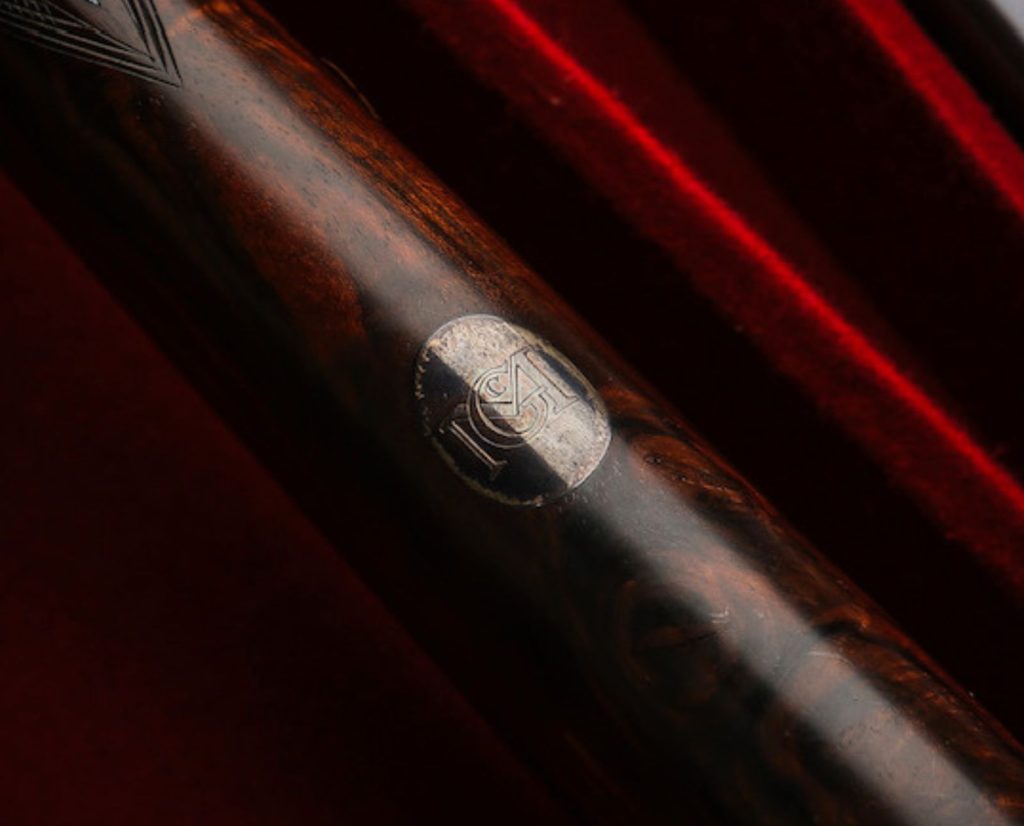
Over time, engraved ovals have appeared on Spanish doubles, English best guns, and American classics alike. Each engraving marks not just ownership but passage, a record of human hands and histories. Somewhere in the future, perhaps, another enthusiast will come across a well-kept gun with the initials E.A.J. on its stock and wonder about the person who once carried it.
This continuity mirrors the broader story of sporting culture itself. Guns, especially fine ones, are not merely tools; they are heirlooms of tradition and craftsmanship. The escutcheon encapsulates that dual nature perfectly, both art and artifact, personal and historical.
Read: Early Shotgun Innovations and Patents By English Gunmakers
Beyond the collector’s cabinet and the shooting field, the escutcheon also reflects the evolution of taste and technology. Early examples were cut by hand from coin silver, chased with chisels, and burnished into stocks of walnut or maple. Later, as gunmaking became industrialized, escutcheons were stamped from nickel or brass and mass-produced. Today, high-end manufacturers once again favor hand engraving, blending time-honored techniques with modern precision. The cycle of craftsmanship has, in a sense, come full circle.
The escutcheon endures because it is more than metal; it is memory made tangible. It records not only who owned the gun, but who valued it, who carried it into field and fog, and who passed it down when their own hands grew unsteady.
The Enduring Appeal
Why does this small embellishment continue to matter in an age of synthetic stocks and digital engraving machines? Perhaps because it connects the mechanical to the human. A shotgun may represent engineering excellence, but an escutcheon reveals emotion: pride, legacy, belonging. It is a reminder that firearms, at their best, are personal expressions of artistry and heritage, not mere instruments of function.
Even in an era when many shooters favor lightweight polymers and modular platforms, the allure of hand-finished walnut and engraved steel endures. The escutcheon stands as a symbol of that endurance, a mark of individuality in a world increasingly defined by uniformity.
Every engraved oval is a sentence in an ongoing narrative. Some are brief footnotes, others entire chapters, but together they form a lineage of craft and memory. Whether left blank or carefully monogrammed, each escutcheon reflects its era and its owner.
To engrave one’s initials on a gun is, in a way, to take part in an unbroken tradition that stretches back centuries. It is an assertion not of ownership but of participation, an acknowledgment that the gun’s story will outlast its current custodian. The next pair of hands that carries it into the field will inherit not just a tool, but a legacy inscribed in metal.
In that light, the debate over engraving versus preservation becomes less about economics and more about philosophy. The escutcheon is not a question of value but of voice. Whether it bears the crest of a duke or the initials of a Dakota farmer, it speaks quietly of care, continuity, and connection.
The art of the escutcheon endures because it captures something elemental about the human relationship with craftsmanship and memory. It is the point at which the mechanical meets the sentimental, where the history of gunmaking intersects with personal heritage. Every polished oval is a mirror reflecting both maker and owner, past and present.
When viewed this way, engraving an escutcheon is not an indulgence but a tribute to tradition, to artistry, and to the generations who have carried fine guns into the uplands before. In every engraved oval lies a reminder that the story of craftsmanship is, at heart, the story of us.