

The Slovakian Rough-Haired Pointer: What Does It Take to Create a New Dog Breed?
Explore the history, development, and unique characteristics of the Slovakian Rough-Haired Pointer, from its origins in Czechoslovakia to its evolution as a versatile hunting dog and the ongoing efforts to refine the breed.
In this episode, host and dog historian Craig Koshyk explores the fascinating history of the Slovakian Rough-Haired Pointer, one of the youngest breeds in the world of continental pointing dogs. Developed in Czechoslovakia during the 1950s, the breed emerged from a combination of Cesky Fouseks, Weimaraners, and German Wirehaired Pointers, with the goal of creating a versatile hunting dog with a distinctive silver-gray, wire-haired coat. Craig traces the breed’s origins, its journey toward international recognition, and the challenges breeders have faced in establishing consistent coat quality, appearance, and hunting performance.
Drawing from his extensive travels and firsthand experiences with the breed in Slovakia, Craig shares stories of remarkable dogs, including an unforgettable hunt behind a young female named Cema. He examines the breed’s strengths in the field, the ongoing efforts to refine its genetics and working abilities, and the dedicated breeders shaping its future. From its unique appearance to its potential as a world-class gun dog, this episode offers an in-depth look at a fascinating breed still finding its place among the established continental pointing dogs.
Episode Transcript
In our last episode, we looked at the Cesky Fousek, a wire-haired breed developed right next door in the Czech Republic. Well, it seems that in the early 1950s, several unusual puppies appeared in litters of Cesky Fouseks, and those litters were all whelped in Slovakia. Uh, let me just make a side note here.
In the 1950s, the period we’re discussing right now, the Czech Republic and Slovakia were actually a single country called Czechoslovakia. They were split up in 1992 and have been independent since then. But in this period, well, we’re talking about Czechoslovakia, so there were a lot of Czech dogs and Slovak dogs bred sort of all over that country, which was united at the time.
Anyway, those pups all had the same rough-haired coat as their Fousek parents, but they were unusual because the color of the coat was that of a Weimaraner. It was silver-gray. The first of those unusual pups, well, it popped up in a litter bred by a guy named Grznarik in Slovakia. How and why a gray puppy ended up in a litter of Cesky Fouseks is, well, it’s open to speculation.
But we do know that Grznarik, well, he was instrumental in the development of the wire-haired Vizsla, the next breed we’re gonna look at. Grznarik worked to form and help those people breed, wirehaired Vizslas by using Cesky Fouseks, German Wirehaired Pointers, and Weimaraners in some of the early efforts.
So that gray wire-haired coat probably occurred in that litter of Fouseks by chance when just the right combination of recessive genes happened to line up because those breeds were used in the background of those dogs. The dog must have been a nice one because Grznarik kept him, and he named him Bobby.
Later on, a fellow named Koloman Slimak used Bobby to breed to an Austrian-born Weimaraner bitch, and a dog from that litter, again, a litter from Bobby and a Weimaraner, was eventually bred to another Weimaraner. But around the same time, two more gray rough-haired pups appeared in a litter of Fouseks whelped in a different town in a different part of the country, and those dogs were eventually crossed with the dogs that Slimak bred.
And early on, well, they developed an experimental stud book for those dogs, and at first, they registered them as wire-haired Weimaraners. At some point, and I don’t know exactly when, the Slovakian Hunters Union asked the Weimaraner Club of Germany to officially recognize their dogs as wire-haired Weimaraners.
But according to Dr. Werner Petri, the former president of the German Weimaraner Club, well, that request was refused in 1964. Other sources state that it wasn’t until 1975 that the official position of the German Weimaraner Club was made public. In any case, by the end of the 1970s, it was clear that the breed would not be recognized as just another variant of the Weimaraner.
It would be recognized as an independent breed, and it needed a new name. So efforts got underway in Slovakia to convince the FCI to recognize the breed as the Slovakian Rough-Haired Pointer. Unfortunately, for a variety of reasons, the first application submitted by the breed club was refused.
Apparently, the FCI requested that the club increase the breed’s population, and they had to widen its genetic base before reapplying. By the early 1980s, well, breeders in Slovakia had registered over 400 Slovakian Rough-Haired Pointers, and they had developed three distinct lines. And then finally, on the 6th of June, 1983, at the general meeting of the FCI held in Madrid, Spain, the Slovakian Rough-Haired Pointer, the most recently created breed in that big extended family of continental pointing dogs, was announced.
And since that time, the Slovakian Rough-Haired Pointer has become a relatively popular gun dog breed in Slovakia, of course, and it’s attracted interest in France, the Netherlands, the UK, and even in America. But the breed is still very much a work in progress, as we will see. A number of important issues still need to be addressed before it can be considered completely, well, stabilized as a breed, as a coat type, and as a hunting dog ready for the field just about anywhere in the world.
Since the very start of the breed back in the 1950s, breeders have always sought to combine the qualities of the Weimaraner, the German Wirehaired Pointer, and the Cesky Fousek into that one breed of Slovak pointing dog. And after nearly 60, 70 years, they have succeeded in producing excellent all-round hunting dogs and a national pointing dog for Slovakia.
But breeders are still trying to stabilize the quality and color of the coat, and they’re struggling with certain health issues. Performance aspects are also undergoing, you know, some modifications as some breeders work towards faster, wider-ranging dogs while trying to maintain the breed’s excellent reputation as a tracking and retrieving breed.
The club has therefore kept an open mind in terms of allowing crosses to the original founding breeds and, and to other breeds. Michal Urban, secretary of the National Breed Club, told me, quote, “It is only in Slovakia that we are allowed to cross to the original breeds. We have very strict rules in our program.
We opened the register because we needed to create a wider base for the breed, but we only keep the best working dogs that look the way they’re supposed to look. We use mainly German Wirehaired Pointers and Weimaraners. We try to avoid too much Cesky Fouseks because of problems with the coat, mainly alopecia.
And we’ve also used German Shorthaired Pointers and Pudelpointers in the past. In 2005, we started to work out a new line for this breed as a combination of the three foundation breeds, like it was way back in the beginning. And all the work is strictly organized by our club, and we keep within the FCI regulations that allow these crosses to be done openly, but only in the country of origin.”
And so work continues with the breed, but as I mentioned before, it is still very much a work in progress, and it is a wire-haired breed, which, like all wire-haired breeds, you know, is that sort of knife edge of good to not-so-great coats. So it’s… Th- they’re really dealing with a difficult, or at least challenging, proposition by creating this wire-haired breed, a new breed, by combining old breeds, and then trying to get this super tricky coat, which is a recessive gray coat, as in the Weimaraner, and also a wire-haired coat.
They are basically walking a tightrope, and so far they’re doing a good job. Now let’s just take a real quick detour into one of the things I love doing with all the breeds that I study and write about. I love looking at the names and figuring out, you know, where they came from, why the breed was named that way, and if I can, try to learn how to pronounce it in the language of the country in which the breed was created.
And I gotta tell you, if there was a contest for the hardest breed name to pronounce, well, the Slovakian Rough-Haired Pointer would be right at the top. But when I was in Slovakia, I discovered that a shot or two of the local whiskey, Slivovica, well, it loosened my tongue just enough to help me get around the rolled Rs of the name.
So you may wanna pour yourself a stiff drink first if you’re trying to pronounce this name, and then you say Slovenský Hrubosrstý Stavač. Slovenský means Slovakian. The literal translation of Hrubosrstý is strong, but in this context, it means wire-haired, and it refers to the breed’s harsh coat. Stavač is the Slovak word for pointing dog.
In some publications, you’ll see the word Ohař, which is the Czech word for pointing dog, instead of Stavač or in brackets after Stavač. And the reason it’s included in the breed name, well, it reflects the fact that until 1992, the Czech Republic and Slovakia were one nation. They were Czechoslovakia, and they had two official languages.
According to the FCI, the official name for the breed in English is Slovakian Wire-Haired Pointing Dog, but breeders and owners in England and the US and elsewhere refer to it as the Slovakian Rough-Haired Pointer, and they usually abbreviate it to SRHP. So what does a Slovakian Rough-Haired Pointer actually look like?
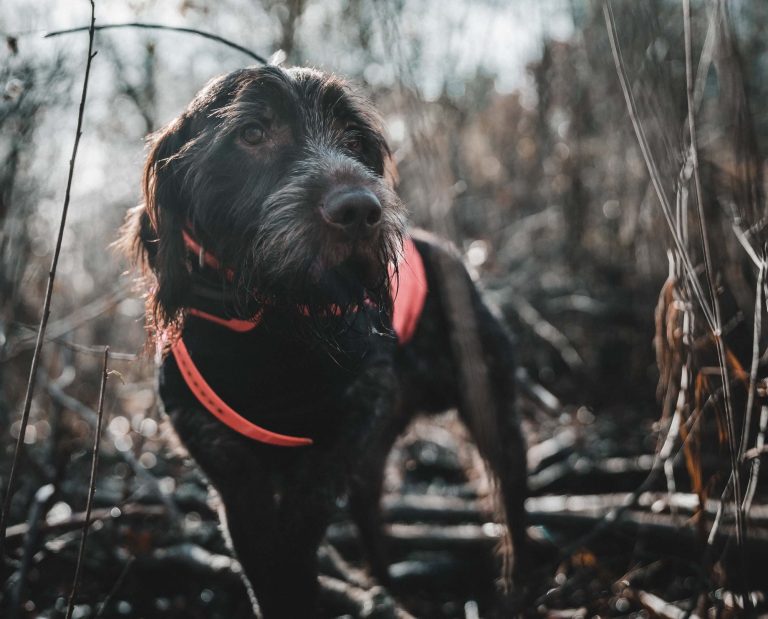
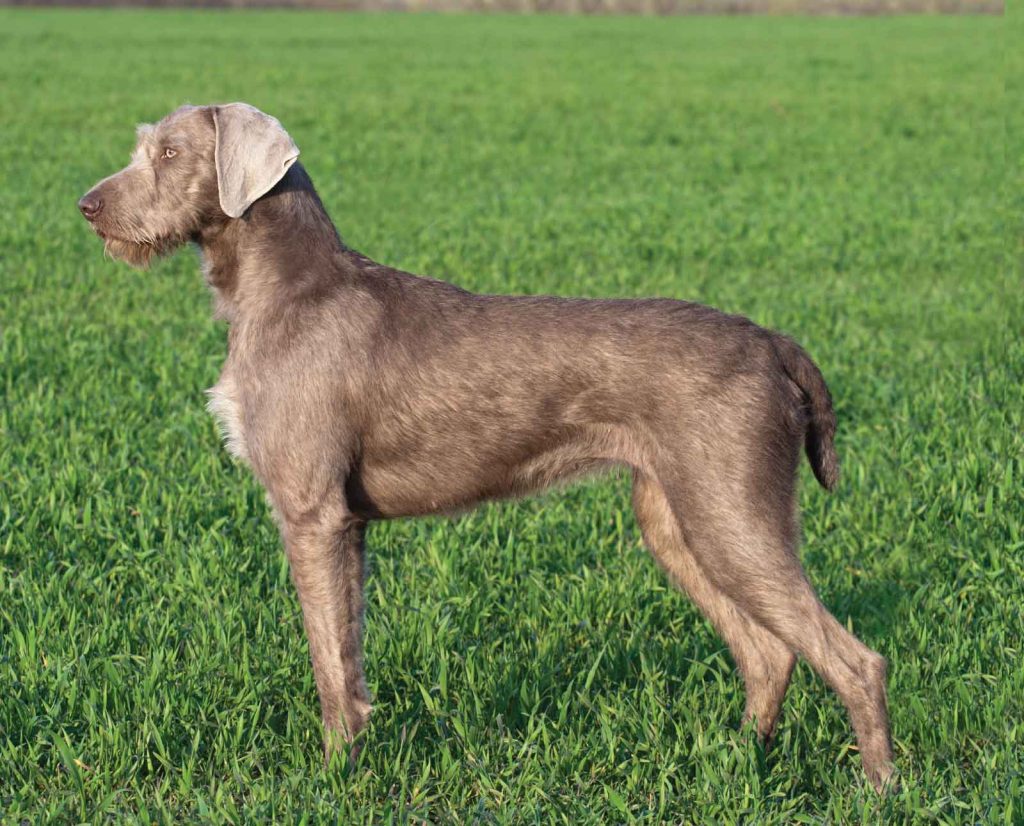
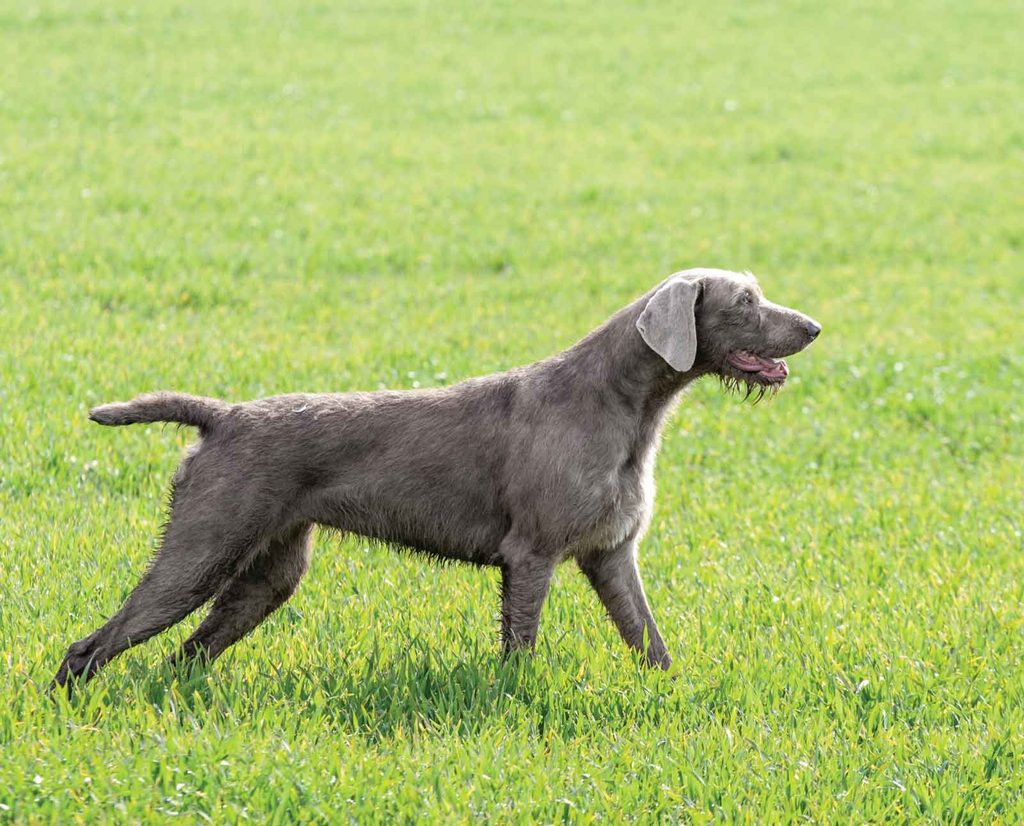
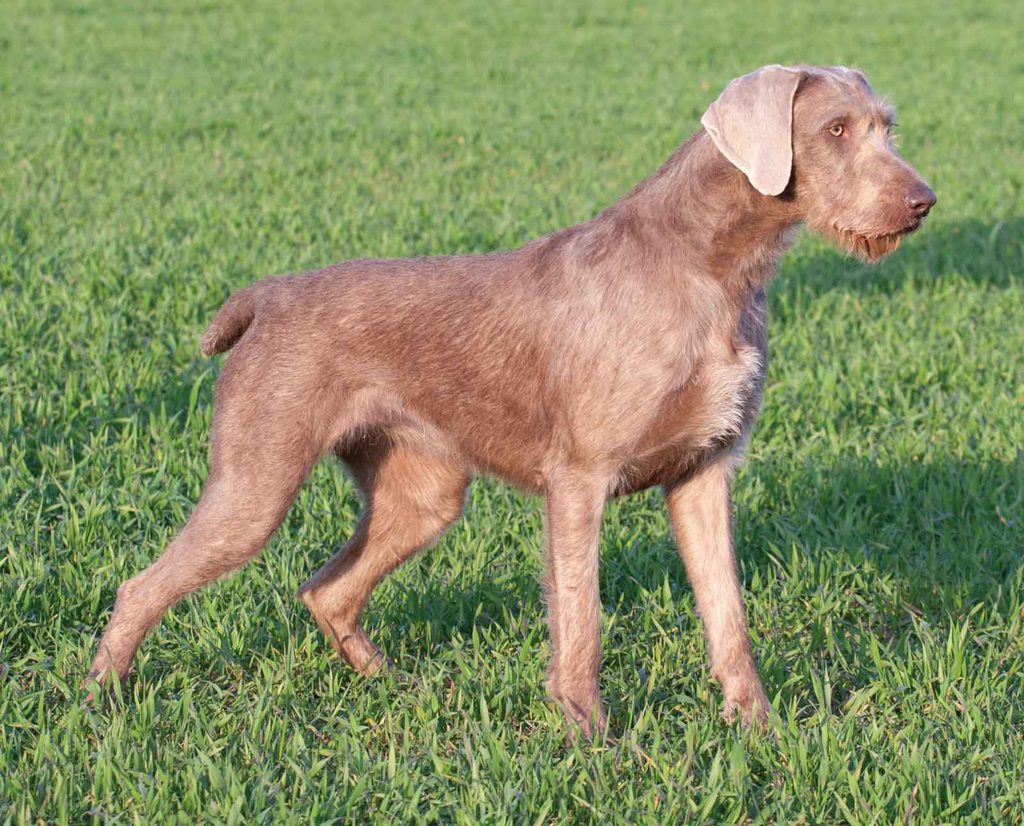
Well, the minute you see one, you realize why the original breeders wanted to call them wire-haired Weimaraners because they look like Weimaraners, well, with a wire-haired coat, beard, and a mustache. I mean, they’re roughly the same size as Weimaraners, and they have the same powerful, athletic build. And Slovak pups are also born with the same stripes on their back as Weimaraners, and they have blue eyes that eventually change to an amber color, just like Weims.
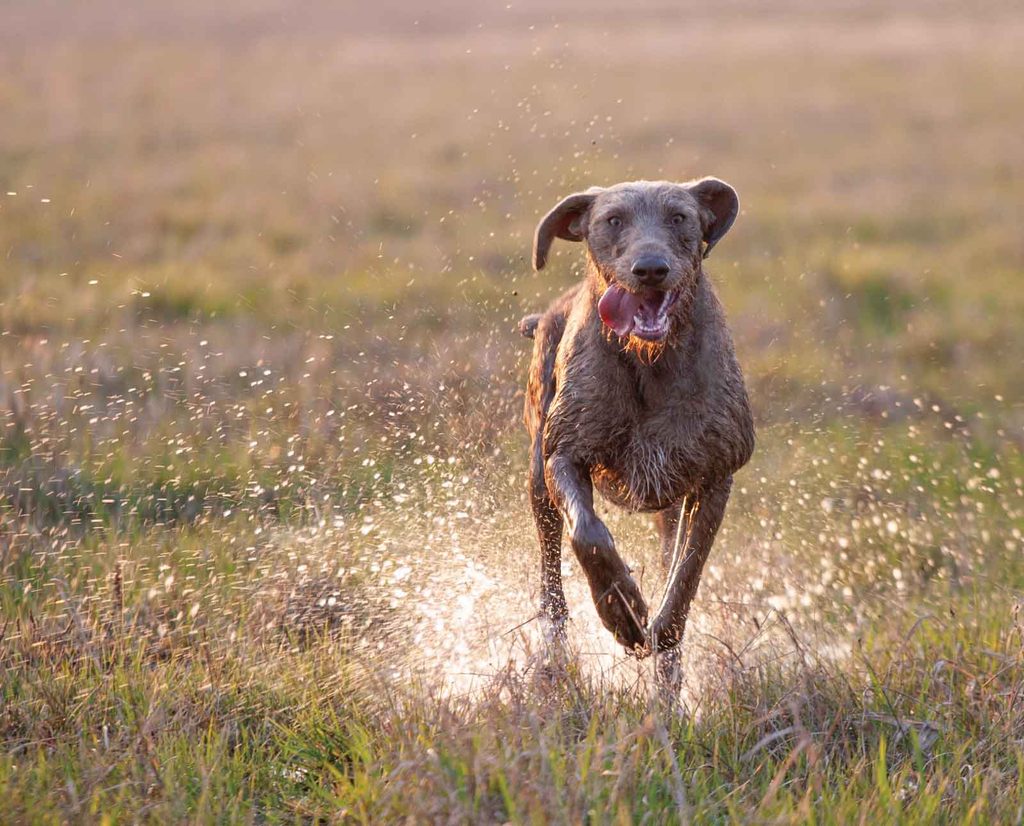
But the ideal Slovak coat is not short like a Weimaraner’s. It consists of a fine undercoat covered by a flat-lying, harsh topcoat of approximately four centimeters or so in length. Facial furnishings include a mustache, a beard, and eyebrows. The hair on the ears is short and soft, and the tail is usually cropped to half length.
And as with all of the wire-haired continental breeds, that ideal coat can be difficult to achieve. And since the Slovak Pointer is really still in the early days, it’s a work in progress, well, the coat quality varies more than in other older, more established breeds like the German Wirehaired Pointer.
Slovak coats range from nearly smooth to very woolly, and colors range from a very light silver-gray to a dark gray-brown shade referred to as sable. In some litters, pups are born with mixed gray and liver roan coats, with or without patches of solid liver on the flanks. So just imagine a Weimaraner with a wire-haired coat, and you get pretty close to an SRHP.
But then again, they do have the tail that’s left a little bit longer than Weimaraners or Wirehaired or Fouseks. So if you want to, imagine basically a gray Pudelpointer, and you’re pretty close to what a Slovakian Rough-Haired Pointer looks like. But as mentioned, this is a young breed. It is still very much a work in progress, and there is an enormous amount of variation between litters and even between pups within litters.
So you have dogs with very flat-lying coats, even slick dogs that have no furnishings whatsoever, to woolly-haired dogs. But the ideal is basically the same type of coat as the ideal coat on a Pudelpointer, uh, but it is the same color as that on a Weimaraner. And how does a Slovakian Rough-Haired Pointer perform in the field?
Well, again, because it is such a young breed and because it is a work in progress, there’s a lot of variation. I mean, there are some dogs that are pretty, well, I’d call them traditional, fairly close-working, fairly methodical dogs, real specialists in, you know, tracking and, and handling big game or even dispatching vermin.
And then there are other dogs that are bred for a little bit more speed, a little bit more range, a more sort of Pudelpointer-y GSP type of performance out of these dogs. But instead of trying to go over, you know, the breed’s working standard or what they’re supposed to do or what breeders have told me about their own dogs, let me just relate to you my experience with one specific dog in Slovakia.
And the reason I want to do this is because, to my mind and that of her breeder, who is probably one of the most prominent breeders of the breed in the world, she kind of represented the absolute peak or the absolute ideal of what the breed should be in the field. Her name was Cema, C-E-M-A, and among all of the dogs that I have seen in my many years of looking at various dogs of all the different breeds, she’s got to be in the top 10, if not in the top five.
That dog was spectacular. And so what I’ll do is I’ll just, you know, read a portion of my book where I describe, uh, seeing her and seeing, uh, a Slovak for the first time really work in the field. I had seen others. I had seen them in other situations in training fields and, and in various situations in France and elsewhere in Europe.
But this was the first time I was with a Slovakian Rough-Haired Pointer in its native country, in Slovakia. Uh, I was armed only with my camera, but Michal Urban was armed with his shotgun. We were out hunting pheasants in this wonderful area not too far from his home. Here’s what I wrote, quote:
“For our first photo session, Michal took us to an area of open fields bordered by some fairly tight cover.
One of his dogs was due to have puppies any day, so he brought Cema, who was only fourteen months old at the time and still in training. As we made our way out into the field, I realized that despite all I had read about the breed and all the conversations I’d had with breeders in the Netherlands and France and all the, the Slovakian Rough-Haired Pointers I had seen till then, I was still not quite sure of what to expect of seeing one in the field on an actual hunt.
Even Hannah, our Czech interpreter, familiar with most of the European gun dog breeds, had never seen a Slovak hunt, and she lived in the Czech Republic right next door. So she too was quite curious to see how that young dog would do. Cema was certainly a good-looking dog. I mean, she was graceful and athletically built.
She had a coat that really did fit the standard to a T. It was harsh, flat-lying, and silver-gray. As she and Michal walked into the field, she remained perfectly at heel with a relaxed, carefree attitude. I asked Michal to pause about halfway across so I could take a few photos, and I distinctly remember snapping away, marveling at just how relaxed the two of them really were together.
I’m used to seeing dogs straining at their leashes, whining, or even barking in anticipation of the hunt as their nervous handlers try to control them long enough for a quick snapshot or two. But there was none of that. Michal and Cema, they just patiently waited as I shot frame after frame.”
The field we were in was well over 100 acres in size.
It was covered with what looked like spring wheat, I would guess. Narrow hedgerows lined each side, and at the far end there was a low spot choked with willows and dried cattails. Well, to my eye, it looked like ideal pheasant cover. As I worked with my cameras trying to get just the right shot, I began to wonder if Cema would actually have that same calm, cool attitude when she was let off leash.
Would she work at a leisurely pace a few yards in front of the handler, or would she cover the field at a gallop? And what about that low spot way down there at the end? Were there even pheasants in Slovakia? I had no idea, but I soon found out.
From the moment that Cema was let off her leash, she absolutely blazed through that field, and for the next hour and a half, Lisa and I were treated to one of the finest demonstrations of dog work we’d seen in a long time.
At one point, I glanced over at Hannah, our interpreter. The expression on her face was priceless. It was one of those awestruck looks you get when you see something way beyond your expectations. And you know what? I probably had the same look on my face because as we exchanged glances, we both laughed and said, “Wow.”
Cema covered a beat of about 150 meters on either side. She kept up a furious pace. In the tightest cover of the sloughs, she worked closer in, plowing through the cattails. Her tremendous desire was obvious to anyone watching. She ran with a powerful, athletic stride. Her head was held high, but she would lower it if she came across the trail of a running pheasant.
Her points were solid, her retrieves snappy and to hand, and at the end of her run, I concluded that if all Slovak Pointers were like Cema, then whatever the creators of the breed used to develop it, well, they must have used all of the best high-quality ingredients.
Next day, we traveled to another area to observe a few other Slovak Pointers hunt small game in a vast series of winter wheat fields.
Cema was there, along with several other dogs from other breeders. And once again, we were impressed with what we saw. All of the dogs hunted well and showed a great deal of desire, but there were obvious differences among them in terms of appearance and in working style. Their coats varied from flat-lying and wire-haired to much longer, softer, and woolly coats.
There was also at least one dog there that was showing clear signs of alopecia, a genetic condition that causes bald patches on the flanks. There were even two very handsome, uh, Slovakian Rough-Haired Pointers with roan coats, a mix of gray and darker sable or brownish plates on the flanks. And the running and hunting style of the dogs varied as well.
To my eye, Cema was by far the best dog there. She continued to impress me with a dynamic run and super stylish points. The running and hunting style of the dogs varied as well. To my eye, Cema was clearly the best dog there. She continued to impress me with a super dynamic run and stylish points. Man, that was a nice dog. The other dogs ranged from very good to, yeah, okay.
At the end of the day, I was left with the impression that the best Slovaks are world-class gun dogs. But overall, the breed is still in the development stages. It’s at that crucial stage where they really need to stabilize the look and the performance of the breed. Fortunately, since I wrote those lines in my first book, Pointing Dogs, Volume One, progress has continued.
Michal and others continue to do crosses to the original breeds as well as to others, like Pudelpointers, and consistency seems to be improving on both sides in terms of look. The coat is getting better and a little bit more consistent, and in terms of performance, we are seeing a better and more consistent breed style, uh, become more and more apparent.
Now, there are other breeders outside of Slovakia that are breeding those dogs, and many of them are working under the guidance of breeders in Slovakia. Some are a little bit more independent, going their own way. There are one or two in North America, but no kennel or line has been developed here with more than a generation or two of experience in the breed.
So, so over on this side of the ocean, again, it is still something that is in the development stage. But it is something that, for anyone interested in working with a breed that is still at that stage, a stage that most of the continental breeds went through 100 or 150 or even 200 years ago, you know, if someone is interested in this really cool sort of, uh, cauldron of mixing and matching and, and, and working through some of the issues, well, this is a great breed to jump into.
Um, it’s not easy going, that’s for sure, and there’s gotta be some ups and downs in anything you do with a breed like this, but at the end of the day, it’s a pretty darn cool breed from a cool idea from a cool part of the world. So anybody who’s interested in this particular breed, I would suggest that they check it out in depth.
You can read more about it in my first book. You can take a look at the articles I’ve published on my blog and elsewhere and, and really sort of dig deeper into this breed. I think it’s worth it, and I think it would be worth it for any hunter who wants a solid gun dog and is willing to take the time and effort to help a breed, you know, work through that growing stage, work through that developmental sort of planning stage of the breed.
Because if it gets the help that it really deserves, and if the Slovaks stay the course, this breed will rise to the same level as all of the other successful, stabilized wire-haired breeds out there. The Slovak Rough-Haired Pointer really deserves to be on the worldwide stage with all of the other breeds at the same level.
And my fingers are crossed that eventually it’ll find that place. Well, there you have it, folks. That is our episode on the Slovakian Rough-Haired Pointer. I hope you enjoyed it. If you want to learn more about that breed or just about any other breed of continental pointing dog, check out my book, Pointing Dogs, Volume One: The Continentals.
And if you want to learn about the British and Irish breeds and take a really deep dive into the development and the history of all pointing breeds, yeah, check out Volume Two. It’s called Volume Two: The British and Irish Breeds, but boy, oh boy, it goes into depth, uh, in the history of all of them. You can check it out at, uh, Project Upland or at my own website, dogwilling.ca.
Happy hunting, everybody, and give that dog a biscuit for me.