

How Versatile Hunting Dogs Are Used Around the World
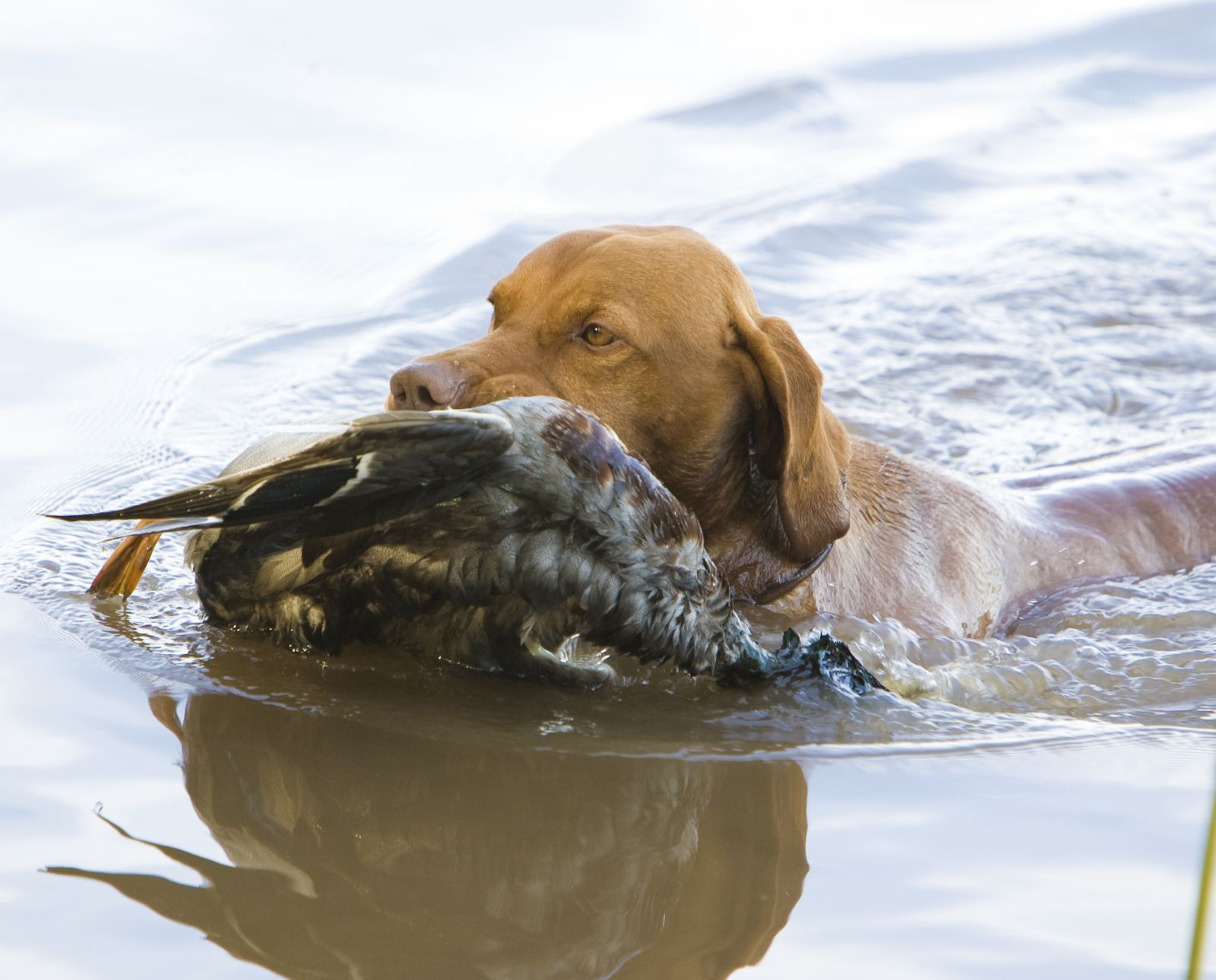
Reporting, stalking, dead game baying, dead game guiding, and boar hunting are all behaviors versatile hunting dogs can exhibit
Around the world, versatile hunting dogs perform tasks most North American hunters have never seen, from leading handlers back to pointed birds in Scandinavian forests to confronting wild boar in Germany. These behaviors reveal how differently hunters define versatility across cultures and how closely hunting dogs have adapted to the landscapes and game they pursue.
What is a Versatile Hunting Dog?
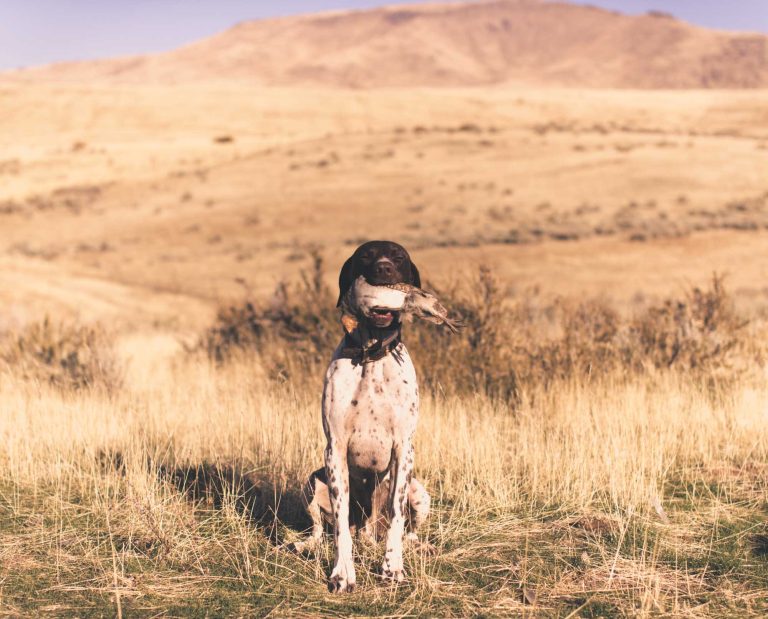
In the gundog world, the term “versatile” is pretty versatile. In the United Kingdom, France, Italy, and other western European countries, “versatile” means a dog that hunts, points, and retrieves. In North America, according to the North American Versatile Hunting Dog Association (NAVHDA), the term means a dog that hunts, points, retrieves, and tracks on land and water. In Germany and other eastern European countries, it means a dog that hunts, points, tracks, drives, bays, flushes, kills vermin, and protects the house and home.
As broad as those definitions of versatility are, they still don’t cover the full spectrum of how hunters in each region actually use versatile dogs. In this article, we will look at some of the more interesting and unusual ways that versatile dogs are used in different parts of the world today and how they were used in the past.
Reporting Dogs in Scandinavia and Finland
Imagine a dog searching for game in a large field or forest beyond the handler’s sight. Suddenly, it points. Then, after a while, it leaves the point, runs back to find its handler, and leads the handler back to the place where the original point occurred. Once there, it points again.
The dog has just done what hunters in Scandinavia and Russia call “reporting,” and it is actually required in some high-level “winners class” field trials in Finland. Here is a more detailed description of how reporting works: the dog, while hunting out of sight of the hunter, sticks a point. If the hunter doesn’t show up after a few minutes, the dog leaves the point and heads back to him, or if the hunter hasn’t seen the dog in a while and assumes it must be on point, he can whistle for the dog to come back. Once back with the hunter, the dog will remain very close to the hunter and cautiously lead him back to the scene of the point. Once they arrive, the dog will point again, and the hunter will hopefully get a shot.
Reporting is not only done in the hunting field; it is actually a requirement of certain types of field trials in Finland. It is done the same way as on a hunt, but the handler must tell the judge that their dog is reporting. He or she cannot say, “I think the dog might be reporting,” or “I think I should whistle him to see if he will report.” It has to be a solid declaration. The handler must say something like, “Judge, my dog is reporting,” or, “I will whistle to make my dog report.” Once the reporting is “declared,” the judge starts evaluating how well the dog cooperates with the handler, specifically how well the dog keeps contact with the handler while returning to the point.
So there you have it. Reporting is a pretty cool hunting technique if you ask me. But one has to wonder how and why folks in that part of the world came up with it. Personally, I have a hunch that it may have been developed because they hunt capercaillie, huge black grouse that often sit in trees and hold well for points in the forest since they are highly territorial and tend to stand their ground even when facing a dog or a man.
The traditional way of hunting capercaillie in Scandinavia is with Spitz-type dogs that tree the bird and then sit at the base of the tree barking to alert the hunter, who then approaches and shoots the grouse with a rifle.
Could “reporting” be a modern, versatile dog adaptation of that technique? If so, how do they train for it? And can breeders actually select for dogs that do it naturally? According to Jani Rajaniemi, a Finnish hunter to whom I posed these questions, the answer to both of them is yes.
“Reporting is mainly something that some dogs do naturally,” he said. “Of course, you can encourage it through training, but it is almost impossible to teach it to a dog that does not want to do it naturally. Some breeds and lines within those breeds have a lot of natural ability for it, especially German Shorthairs from Finnish and German lines.”
Stalking Birds with Pointers, Livestock, and Nets
Anyone who has hunted birds knows that getting close enough to a flock to take a shot, even with a powerful gun, is not easy. So, over the centuries, hunters have devised many ways to close the distance. On the water, low-profile punt boats or sinkboxes proved highly effective at getting within shooting range of ducks and geese. But what about on land? How could a hunter get close enough to a covey of partridge without flushing them?
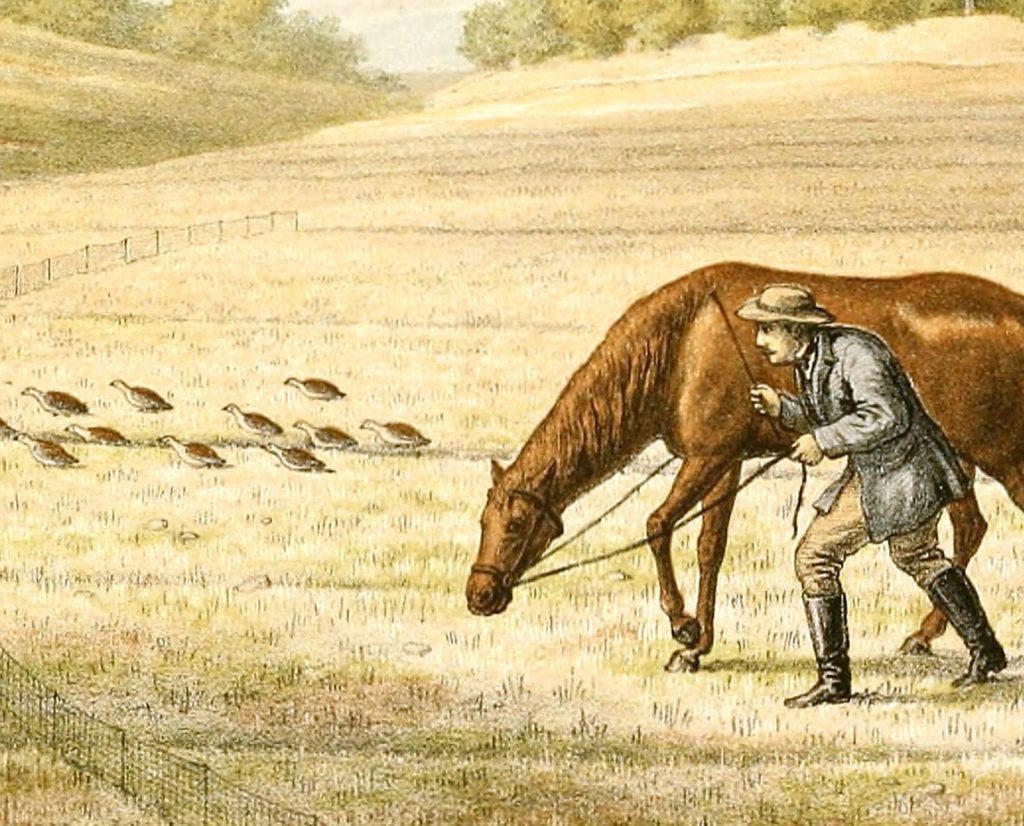
One solution was to hide behind a horse as it slowly moved toward the birds. And it didn’t even have to be a live horse. Some hunters would simply build a canvas screen in the shape of a horse, ox, cow, or even a bush or shrub, and then hold it in front of them as they closed the distance. Sometimes, they would use a dog to seek out and point coveys of birds, which were then stalked by the hunter and his horse.
Read: Hunting Ducks Over Cattle: The Trained Waterfowling Steers of Texas
The practice of stalking birds is probably ancient. Even the earliest treatises on hunting mention it, but hunters continued to use stalking horses and similar techniques well into the 19th century. In 1828, for example, Lewellin Lloyd, a well-to-do English sportsman who often hunted in Scandinavia, described how some Swedish hunters used Pointers to find coveys of partridge and then used a stalking horse to herd them into a basket:
As soon as the harvest is completed, shooting commences with the pointer. To discover them, the surest way is to attend muster, as it is called, in the afternoon or morning, when they always call each other together. They are taken easily with a pointer, either with nets, wicker-baskets, or tirass (purse net). When the covey is scattered, and is again found, nets are the most serviceable, and in particular if you happen to place it between the covey when it is spread, when they of themselves run into the net as soon as they begin to call. Tirass can be used both on the plain and in bushes. The tirass is made of green yam, five to six ells (ten to twelve feet) square; to each corner is fastened a line of sixteen or eighteen feet; when the dog points, and you have discovered with certainty where the hen lies, the net is drawn by the lines by two persons, who drop the net over where the covey is supposed to be; if you are not sure that your dog is perfectly steady, you call him off, and frighten up the hen, when they entangle themselves in the net. When you wish to catch partridges and other birds, you should have a cage, made of sail-cloth, with a wooden bottom, to secure them in.
The third and safest way to catch at once the whole covey is by a horse trained for shooting, and wicker-baskets, but these are only suitable for an open country. The baskets are made nearly like the common basket for catching fish, with two arms or wings. When the pointer has discovered the covey, the basket is set so that the opening lies in the furrow of a corn-field, if possible. The sportsman draws off the dog, and at the side of the horse advances nearer and nearer to the covey, until he gets the hen to run; and when they come to the opening of the basket, he claps his hands so that they may rush in and not stop short. The art consists most in going with the horse, so that the hen does not take wing, and that they continue running, after you have got them within the arms which lead to the basket.

German Dead Game Bayer and Dead Game Guide Dogs
One of the most fascinating things to see in a German versatile dog test is an event designed to evaluate a dog as either a Dead Game Bayer (Totverbeller) or a Dead Game Guide (Totverweiser). To be marked totverbeller, the dog follows a blood track away from the handler, off-lead. When he finds the dead game at the end of the trail, he barks to call the handler to recover the game. A dog marked totverweiser also follows a blood track, off leash. The difference is that when the dog locates the game, instead of staying next to it and barking, he flips a bringsel—a leather fob or piece of antler hung from its collar—into his mouth, returns to the handler, and leads him to the kill.
The first time I watched a dog do this was in Germany, and I was blown away by what I had witnessed. To me, it represented the very essence of Germanic hunting traditions: highly trained dogs performing amazingly complicated feats in a Teutonic forest straight out of Hansel and Gretel. So imagine my surprise when I came across an account written over a hundred years ago about a dead game bayer dog in Kansas. And it wasn’t a German dog handled by a German hunter. It was a Pointer, on a hunt with an American military officer and his buddies from England!
Excerpt About a Dead Game Bayer from The Hunting Grounds of the Great West
In the late summer of 1872, Lieutenant Colonel Richard Irving Dodge and three Englishmen went on an epic three-week hunt southeast of Fort Dodge, Kansas. He wrote about it in his book The Hunting Grounds of the Great West: A Description of the Plains, Game, and Indians of the Great North American Desert.
Dodge and his hunting partners bagged huge numbers of animals, everything from bison to badgers, pigeons, antelope, turkeys, and quail. To accompany the party on the hunt, Dodge chose Pointers because he considered them to have the most required attributes of speed, stamina, and biddability:
A well-trained dog is most invaluable to the sportsman, for, whatever his skill as a marksman or a trailer, he will lose more or less game unless he has the assistance of man’s best friend. All plains animals have extraordinary vitality, and nothing but the breaking of the backbone, or a shot through the brain, will certainly bring one down in his tracks. Any one of these animals is liable to run for a quarter of a mile, though his heart be split as with a knife.
…In many cases, the trail of the wounded animals through such thickets defies the skill of any but an Indian, and the animal is likely to be lost, though he expends his strength and latest breath in going but a hundred yards. It is on such occasions as these that the value of a good dog is best appreciated. To be of value, however, he must be thoroughly under control. He must be trained to remain at heel until sent forward, then to find and take the trail of the wounded animal. Should he run after one unhurt, he expends his strength and is liable to be lost. He should be taught, when he has found or pulled down the wounded game, to bark loudly and continuously until his master comes to him.
Listen: The Rise of the English Pointer in America
This training is very simple and easy to give. For such work I very greatly prefer the pointer. His nose is as good as the best; he has sufficient speed, strength, and endurance, and is more easily taught. Greyhounds, bloodhounds, foxhounds, setters, and even the common cur, are used as above indicated. The first two lack intelligence; the third and last are difficult to train; while the setter, though otherwise a fine animal for such hunting, cannot stand the heat and aridity of the dry plains.
In nearly all my elk hunting I have had the advantage of good dogs; and how inestimable that advantage is may be judged from the following experience — I had succeeded in crawling up to within forty yards of the nearest of a herd of about thirty elk. My dog, a fine large pointer, was flat on the ground behind me. After some waiting my chosen buck gave me a fair shot; but, whether from buck fever or from allowing too much for his movement in walking, I put the bullet too far forward. I had time to see this when the herd rushed together, looking in all directions for the danger. Slipping another cartridge into my gun, I took most careful aim at a splendid doe that was nearest me, and fired. To my intense disgust the doe did not fall, and the whole herd pitched over a bank and disappeared. Reloading, I ran to the edge of the bank, and found the herd again huddled together, about 125 yards off. Again I fired after a most careful aim, and at the report the whole herd went away at a great rate towards some high bluffs about a mile off. I now sent the dog after them and yelled frantically to my servant to bring up my horse. Mounting in all haste, I dashed furiously after the retreating game, which, however, reached and climbed the bluffs far ahead of me.
When, with great difficulty, I succeeded in gaining the top, I found the herd again crowded together about 600 yards off, and my dog just entering the compact mass. Again they started. I had great fears for the dog, but presently saw him bounding pertinaciously against apparently one animal, which after some moments turned out of the herd and came to bay. Galloping up I recognised my wounded buck. A bullet dropped him, and, sending the dog on, I followed at my best speed. The herd was by this time out of sight. The dog, too, soon disappeared, and I followed only by the dust which was kicked up by the retreating herd. I was riding a well-built and most powerful Canadian pony, and never before or since have I ridden at such speed over such rough ground. True to their instinct the elk had taken the worst ground they could find. It was the soil of the ‘bad lands’ through which water cuts its way in ravines with perpendicular sides. These were small, only a foot or two in depth and from six to twelve inches wide; but the ground was thickly scored by them, and, to make matters worse, was covered with sage bush from one to two feet high, completely concealing them from the view of either myself or horse. One moment the pony’s fore feet would go down, the next his hind feet. I rode him from his ears to his tail, sometimes in front, sometimes in the rear of the saddle. How I stuck on I do not know, but after a mile of such riding (if it could be called riding) I was rewarded by seeing my dog holding one elk at bay while another was lying down a few yards off. I got them both. All three elk had been mortally wounded, yet I should have bagged neither had it not been for the dog.
Not only did a Pointer, in Kansas, in 1872 perform the duties of a Dead Game Bayer (Totverbeller), but he held an elk at bay by standing his ground and barking (baying) at it, another thing that Germans train their dogs to do. In fact, boar hunting is so popular in Germany now that the versatile hunting dog clubs have created a brand new test to evaluate their dogs for their abilities to keep boar at bay.

Using Versatile Hunting Dogs to Hunt Wild Boar in Germany
Did you know that the average German owner of a German Wirehaired Pointer or Weimaraner shoots more fox in a season than pheasants in their lifetime? Did you know that German owners of Small Munsterlanders and Large Munsterlanders hunt more deer than ducks? And did you know that for most German hunters, the main quarry nowadays, no matter what breed they own, is wild boar?
German hunters have always focused more on big game than on upland birds and waterfowl. But over the last 30 years, there has been an explosion in the number of boar in their country. Since the German dog breeding system is, above all, practical, when conditions change, the system adapts. This adaptive strategy is now being implemented by most of the versatile dog clubs in Germany as they develop new training and testing methods to assist handlers and breeders with selecting dogs for hunting das Schwarzwild, the wild boar.
In North America, there are German “Landesgruppe” (club chapters) for various hunting dog breeds. They run the same tests under the same rules as the clubs in Germany, but I am not aware of any plans to develop similar tests on this side of the ocean. Of course, that is not to say we will never see Schwarzwildgatter tests conducted on this side of the Atlantic, but if the numbers of feral pigs and wild boar continue to rise throughout the US and parts of Canada, we just might.

An Interview with Tanja Breu-Knaup
Recently, I spoke to Tanja Breu-Knaup, a breeder of Longhaired Weimaraners in Germany, about the new test that the Weimaraner club is setting up to verify a dog’s willingness and ability to confront boars.
Tanja, why is a new test and award now being developed?
Because we are being overrun by boars! Last year, for example, German hunters killed over a half-million of them. So we realized that we needed to come up with a test to certify that a dog is able to hunt boars. And it is something that has been done for other kinds of dogs like hounds and terriers for many years, especially in the former East Germany.
Can you describe the test for me?
The test is conducted in an enclosure not much bigger than a horse corral called a Schwarzwildgatter (schwarzwild = boar, gatter = gate, i.e.: a fenced enclosure) in which a boar weighing at least 60 kilos is located. Two judges from the club observe dogs sent into the enclosure one at a time, while the handler remains outside. The dog searches within the enclosure and must find the boar within five minutes. Once it has located the boar, it should bark at it, harry it, and try to get it to move without endangering itself and without any help from the handler. It must continue to harry the boar for at least five minutes.
The judges look at a number of things and make notes during the test. For example, they note the boar’s approximate weight and whether it stood its ground or charged at the dog. They note how intensely the dog goes about harassing the boar, how close it gets to the boar, how long it barks, and so on.
If all goes well, the dog receives a passing grade, a notation of Schwarzwildgatter [S] is made on its record, and a certificate is issued. A dog that is too reckless, however, will not pass. Nor will a dog that is too nervous or refuses to confront the boar.
Does a dog have to pass this test to be allowed to breed?
No. The Schwarzwildgatter test is something that a lot of breeders want their dogs to do, and it helps us make breeding decisions, but it is not something that the club requires in order for a dog to be bred.
How is the test being received by members of the club and by hunters in general?
I think that they are generally happy with it, and it is a good thing that this sort of test is now available. But that is not to say that the test is perfect. It is, after all, an artificial situation, and that can lead to some problems. For example, some dogs realize that the whole thing is a “set-up” and they don’t react in the same way as they would if they were really hunting. It’s like some dogs and planted birds; they don’t react the same to them as they do to wild birds. So you can have a dog that hunts boars all the time and is really good at it, go into the pen and not really do much since it knows that the whole thing is fake.
Or you could have a situation where the test is used to inflate the credentials of a dog that never actually hunts boars. The only boar it may ever see in its life may be the one in the enclosure. But if it passes the test, some may see it as all the proof they need to declare that they have a fantastic boar dog.
Personally, I think the certificate should be awarded to dogs who demonstrate their willingness and ability to hunt boar under actual hunting conditions in real-life hunting situations, perhaps something similar to an HN(Hartenachweis) award for predator sharpness. But the club has determined that the current way of testing is sufficient.
Versatility Beyond Pointing and Retrieving
The history of versatile hunting dogs is ultimately a history of adaptation. From Scandinavian reporting dogs to German dead game guides, hunters around the world have shaped dogs to meet the challenges of their landscape, quarry, and traditions. While many of these practices remain unfamiliar outside their regions of origin, they demonstrate just how broad the concept of “versatility” can truly be.