

The Canine-Equine Connection: How Hunting Dogs and Horses Aided in the Pursuit of Game Through History
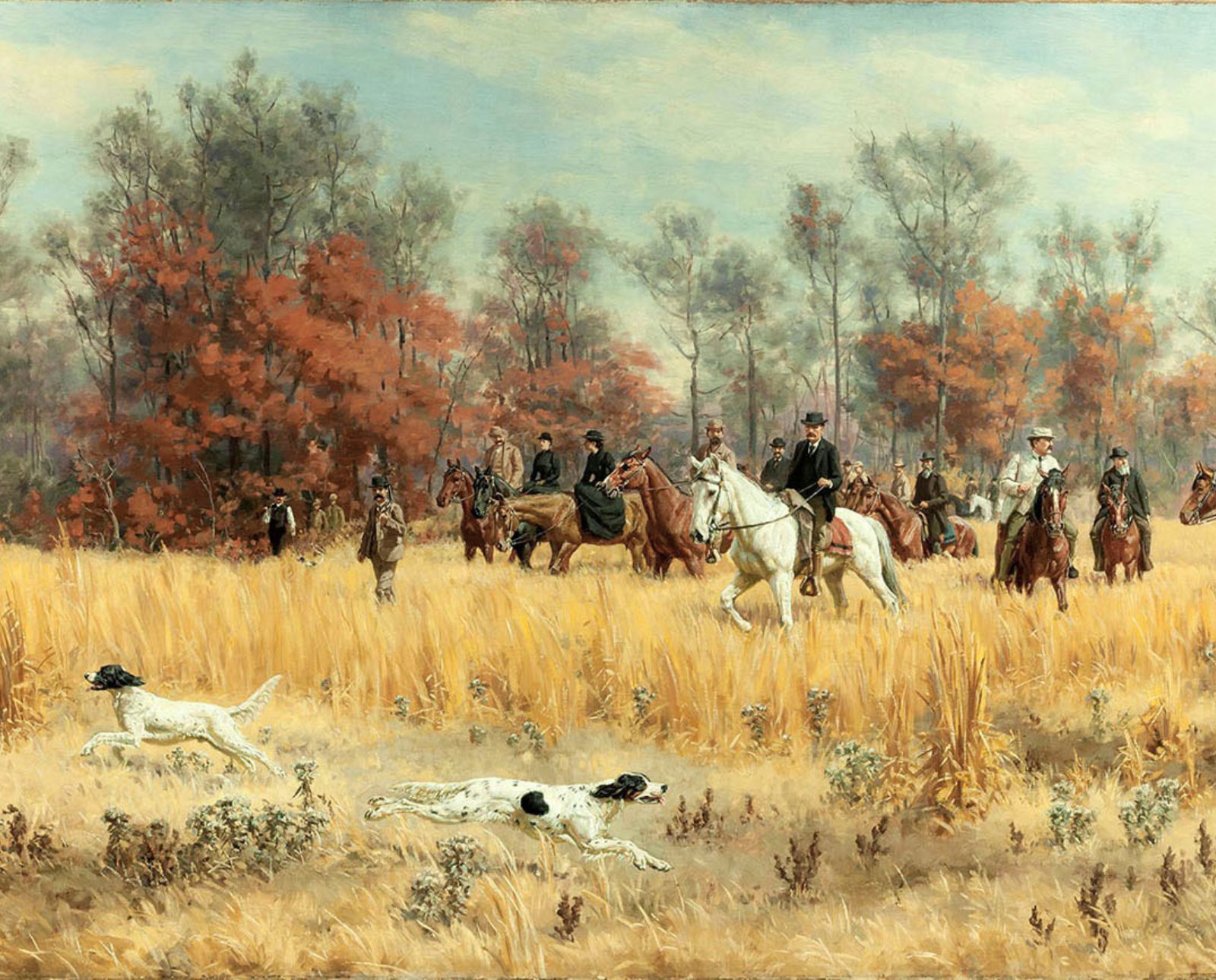
From medieval hunting traditions to modern field trials, horses and hunting dogs have worked together for centuries.
This story originally appeared in the fall 2025 issue of Project Upland Magazine.
Hunters on horseback following packs of hounds is as old as the hills, right? And American field trials have always been about handlers and judges on horseback following the best bird dogs in the land, right? Well, not exactly. Sure, dogs have been helping hunters put meat on the table for over 15,000 years, but for the first 10,000 of those years, horses were among the hunter’s favorite quarries.
Fortunately, about 5,000 years later, soon after we figured out how to domesticate horses, the tables turned. The hunted became a key ally to the hunter.
The earliest depictions of hunters on horseback date to about 2,500 years ago. Ancient stone carvings from the Middle East depict Assyrian King Ashurbanipal spearing a lion from the back of a horse. Interestingly, the same carving shows hunters and mastiff-like dogs killing wild horses. The transformation from hunted to hunter took thousands of years, but once it started, it eventually developed into a relationship second only to the bond between man and dog.
In all cultures where it was performed, hunting on horseback was considered an effective and enjoyable way to take game. Military leaders also understood that the lessons hunters learned while chasing game on horseback could be applied directly to the battlefield.
Hunting Dogs and Horses In Europe
By the Middle Ages, the use of dogs and horses in the pursuit of game had been perfected across much of Europe as well as parts of Asia. Many of the best-known illustrations from that era show mounted hunters accompanied by various types of dogs as they pursue hare, deer, boar, and other animals with bows, crossbows, hawks, and falcons.
This type of hunting, known as la vénerie (Fun fact: The French word vènerie is where we get our word “venison” for deer meat) or chasse à courre, is still practiced in some parts of the world, most notably in France, where it is considered by many to be an important part of French culture and heritage. Currently, over 100,000 French hunters participate in the sport, assisted by nearly 400 packs of hounds (approximately 30,000 individual dogs) and 7,000 horses, many of which are rescues from the horse racing industry.
Read: Why French Pointing Dog Breeds Are Uncommon in North America
By the 1700s, foxhunting had become such a popular sport among the British aristocracy that its influence began to transform vast parts of the English countryside. In their book Game and the English Landscape, published in 1980, authors Anthony Vandervell and Charles Coles stated that, “Extensive areas of the [English] countryside today owe their present form as much to our long sporting history in its widest sense, as to the evolution of agriculture, forestry, and social development over the centuries and, in particular, that of the last 300 years or so. This spirit of the Chase, in the medieval forest, was kindled under the Norman kings, and impressed itself on the history of the countryside.”
Around the same time, we find some of the earliest depictions of setters and Pointers, and most of them include horses in the scene. And this makes sense. Breeders of bird dogs at the time would have, at a minimum, owned horses for work on their lands and for transportation. But many would have also bred horses and were probably active in the horse racing and mounted hunting world. So it was only natural that hunters using nets, bow and arrow, or other arms would also have horses helping them in some manner.
Well-known dog trainer G. T. Teasdale-Buckell wrote:
…the shooting pony in conjunction with pointers and setters is not often seen now in England, but it certainly was very common when the ridable portions of the country were mostly shot by the assistance of those dogs. It is probable, therefore, that this American form of shooting, brought to perfection there by means of field trials, is really more like English shooting at the dawn of the nineteenth century than our own shooting over dogs is like it.
In Tennessee the author was by their kindness introduced to the old English fashion of shooting by the use of shooting ponies. The mounted guns, whether one or three, had three handlers of dogs, each mounted also, and each working a brace of speedy dogs, and by that means covering three-quarters to a mile of country at a beat. The horn is used to sound “a point,” and then the six miles an hour “foxtrot” is increased to hunting speed, until the point is reached when the shooters slide off and shoot….This sport is a sort of cross between hunting and shooting, as also was that of ancient England, if all accounts are true.
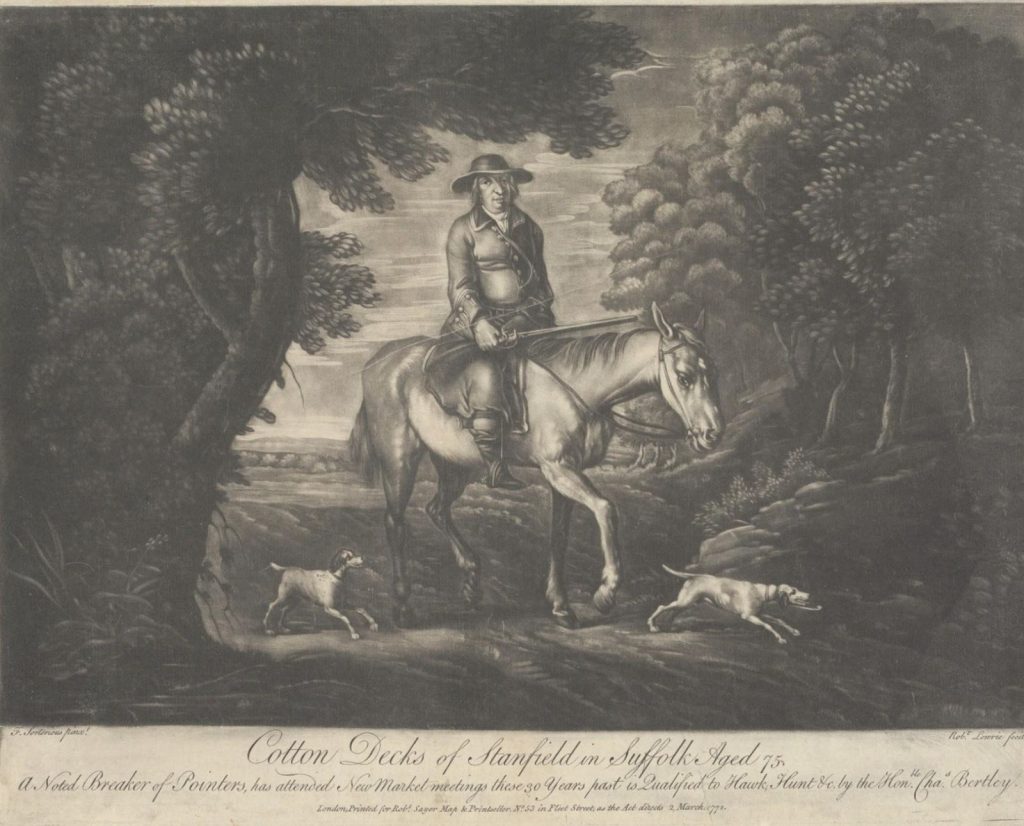
The caption reads: Cotton Decks of Stanfield in Suffolk, Aged 75. A noted breeder of Pointers, has attended New Market meetings these 30 years past, is qualified to hawk, hunt, etc. by the Honorable Chas. Bertley, 1772.
I believe Teasdale-Buckell is correct and that “riding to Pointers and Setters” was first done in the United Kingdom. British sportsmen would have used horses from the earliest days when setters helped them catch birds in nets. In the 1686 illustration by Richard Blome, we see two mounted riders following two gentlemen and their setter as they attempt to catch a covey of partridges. In the background, two other hunters use a “stalking horse” to push birds into a funnel net.
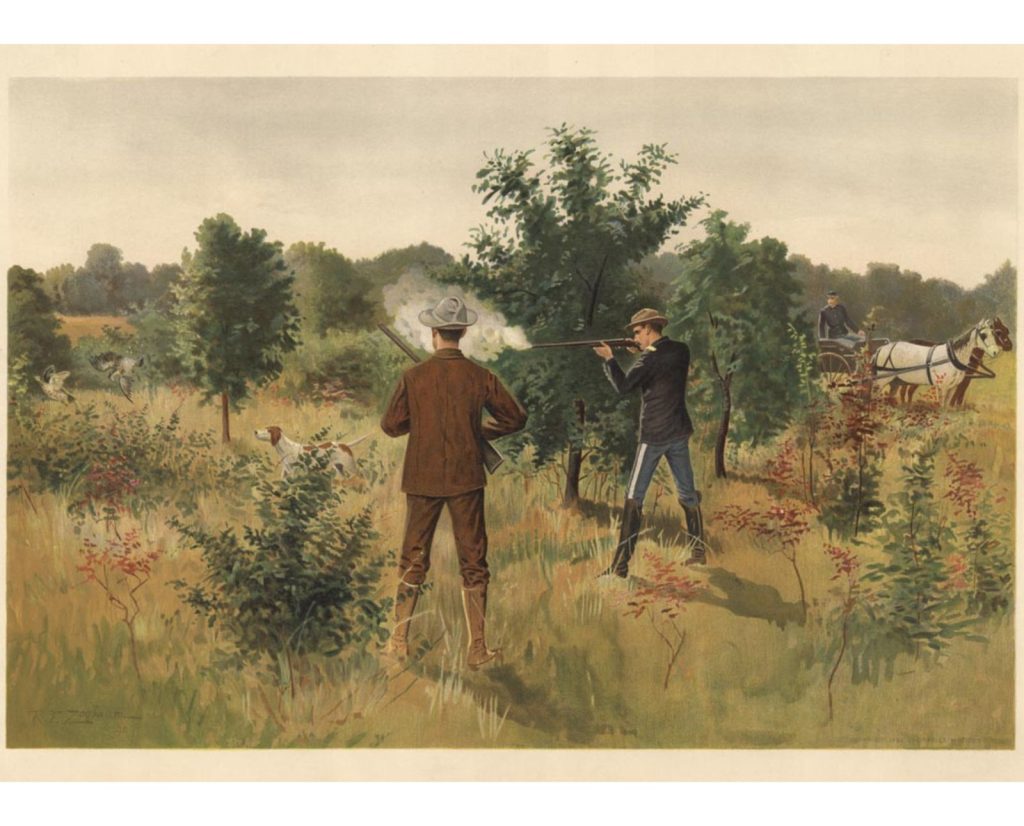
With the advent of light, portable firearms came new ways of employing dogs and horses in the chase. There are also images of hunters not only using horses to take them to the field, chase game, or transport bagged game back to camp, but a surprising number show hunters actually shooting game, even birds on the wing, from horseback.
Here is an account from The Sportsman’s Cabinet from December 1832 that indicates ponies were sometimes used on the moors and some hunters even shot from horseback. However, the writer explains that the moors were not well suited to that sort of thing due to the rough, uneven surface of the ground:
…I sent my gun, according to previous agreement, several weeks before I left home, and heard of their safe arrival in Weardale were I departed: my friend, I knew would provide plenty of dogs: and, therefore, under these circumstances, I had only myself to convey to the appointed spot, and this I intended to do upon the back of a stout pony, which I had so familiarized to the gun that he would stand like a rampart, when I fired from his back…
….The following day I determined not only to ride to the shooting ground, but to take my pony on the moors. I did so; and occasionally shot from his back; but the nature of the ground, the bogs, so uniformly met with in such beats, rendered my little steed, in some degree, a troublesome companion; and as far as I am able to form an opinion from this experiment, I should in future be content with riding to the ground, and pursue my diversion, sans horsemanship, afterwards.
Other English sources later indicated that at some field trials judges and members of the gallery were on horseback: “The scenery round the moors was very picturesque; the hills in the distance were often topped with clouds, and the rugged outline and varied colour would have delighted the heart of a water-colour artist. Of course, the walking part of the business was rather punishing. Ponies were procurable, but the banks were rotten, and bogs and quagmires of frequent occurrence, so that the greater part of the spectators preferred going on foot.”
Stonehenge was of the opinion that walking was the best way to shoot over bird dogs on the moors, but a “naturally weakly sportsman” could consider using a horse:
On the moors especially, but sometimes also in partridge shooting men and even in the battue, the shooter prefers four legs to two. This may arise either from inability to walk, or from disinclination, or perhaps from both combined in many instances. Colonel Hawker advised that the sportsman should have a pony calculated to carry double, and that in this way not only he, but his marker, would be able to get over the ground better than on foot. On the moors, no doubt a bad walker has a poor chance, and as the distance to begot over is very considerable, we can hardly wonder that those gentlemen who only walk should require assistance.
When a pony is used for this purpose, the shot is sometimes taken from his back, but generally speaking, the rider dismounts when his dogs find, and leaves his quadruped to take care of himself while he re-loads. In either case the pony must be carefully broken to stand fire, and he should be also made extremely clever in leaping “in hand,”and also in standing without being held wherever he is left.
A high-couraged horse will seldom serve the purpose, as he will demand a very long-continued education; nor will the stubborn temper so often displayed among the Welsh galloways be likely to submit to the discipline of the breakers in the implicit manner which is essential to success. But the Highland pony will generally be found to combine the various requisites, and is also instructed by practice in his early life in the treacherous nature of bogs. Nothing is more common on the moors than for a mounted sportsman to get stuck in one of these traps, and if he then is on an animal which is not “ up to trap,” he will flounder deeper and deeper,and at last perhaps be obliged to call assistance to get himself and his stupid brute out. On the other hand, the Scotch pony may get him into a bog, but then he will stand till his master quietly gets off upon the surface, which will bear the weight of the latter, with the aid of his broader feet, but will allow the more bulky proportions supported upon the smaller pedestals of the pony to sink through.
In selecting ponies for making into shooting cobs, this quality should be taken into consideration, if they are wanted for the moors, but very many are required by the less ambitious partridge shot, who is too unwieldy for the active exercise in any case required in grouse shooting. Generally in the north, the pony is only required (except for the lazy and infirm) to take the shooter to the moor; once there, he can scarcely avail himself of his pony’s assistance without sacrificing his sport. During the time in which a man is dismounting, the grouse are getting on the run, and the interval, short as it is, will very often enable them to rise out of shot. Few active men try the experiment, but I fancy if they did, they would find that they could kill more birds with than without a pony. With his aid, you may get up to the birds much more quickly; and I do not think that the noise made by the canter of the pony occasions any disturbance to them. No doubt the increased height is an advantage, but to balance this is the increased speed in getting to your dog’s point. How often do we see the pointer stand at 150 or 200 yards off, and what a time it takes to get up to him, especially if against the steep side of a hill; on the other hand, many parts of the moors are not rideable. In making the comparison, it is generally the case that the shooter on foot is an active young man, and the pony-man an old and infirm one, who takes five minutes to get off and perhaps rides up as slowly as the other walks.
Still, I should never advise any good walker to adopt the use of the pony, but at the same time, on most moors, I fully believe an active, wary man may, if he likes, use one with advantage, and especially when birds are running much. The pony only requires to be broken to stand the gun, to leap in hand, or follow over a fence, and to be handy, and used to stand without holding. All this is so easily taught, that it is unnecessary to allude to it here.
…the fatigue of walking the moors is not to be lightly encountered except by those in possession of health and strength. The invalid, or naturally weakly sportsman, should make up his mind either to put up with an inferior bag, or else he must take to a shooting pony, which will enable him to get over nearly as much ground as his more active friends. Furnished with a well-broken animal of this class he may generally keep within reach of his dogs; but it will often happen, nevertheless, that he will be obliged to make slight detours, where an active man on foot could readily go straight to his point.
And when it comes to snipe shooting, “Unlike grouse and partridge shooting, a pony cannot be used on this ground, and the delicate-constitutioned sportsman cannot in any way partake of the amusement without risk.”
Hunting Dogs and Horses In America
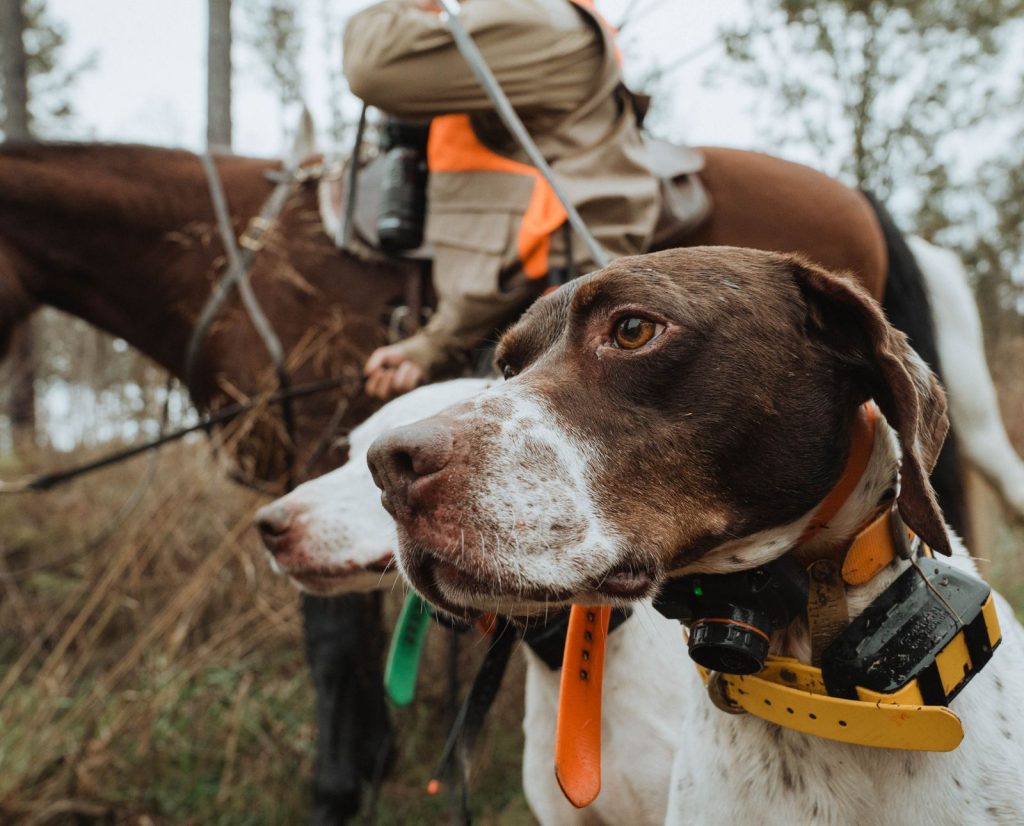
Horses were used by hunters shooting over Pointers and setters and were used in field trials from the very start. But in the early days, only judges were on horseback, with handlers following their dogs on foot. It wasn’t until the early 1900s that handling from horseback became common. In the 1930s, field trialers began to use gaited horses like the Tennessee Walker. Jack Harper claims to be the first one to do so and wrote that there was actually some resistance to the idea:
I was riding a big Tennessee Walking Horse I’d just bought. This was the first walking horse the handlers had ever seen used for handling at a field trial. … Although Big Red was a spirited horse there was no mean streak in him whatever. I could walk him from high spot to high spot the better to keep track of the dog. Another horse would have had to gallop to do this. Clyde Morton noticed this and later expostulated to listeners on the bad effects of using walking horses to handle from. He said it would hurt field trials because the dogs would be pushed faster than they should be to hunt the country properly, and that the judges would not notice that they were being pushed because the handler was only at a fast walk. He recommended abolishment of their use by handlers.
Needless to say, the resistance was soon overcome, and handling dogs from gaited horses became the norm in most league field trials.
Using horses to hunt over Pointers and setters was not confined to America and England. In Gun and Camera in Southern Africa, published in 1893, author Henry Anderson Bryde writes of using horses to hunt birds with Pointers and setters in South Africa. He even boasted of shooting giraffe, wildebeest, springbok, and lechwe (antelope) while in the saddle:
Dove, who had been out of health, rode his hunting pony Dunboy, and, shooting mostly from the back of that steady quadruped, did as much execution as any of us. We had two pointers with us: Lt. Stephens’ Lassie, a capital and steady worker, and my Don, a big, liver-coloured young dog, possessed of a rare nose, but not very well broken, and a little too headstrong and impetuous at times.
Mackay also made a good shot off his pony, and knocked over a partridge at more than thirty yards. As a rule, we got off our horses when the dogs stood to game. The nags—all except St. Stephens’ mount, which had occasionally a nasty habit of trotting away—stood admirably, and gave us no trouble. The reins were, of course, always thrown over the head, and hung in front of the forelegs in the usual South African fashion.
We carried our guns of course, and had the dogs with us, and shot a few head of feathered game as we went along. Just before reaching Knox and Fanshawe’s huts I made a remarkable, if lucky, shot at a koorhaan (black and white bustard) as he flew across our left flank, cackling noisily, as these game birds always do. He seemed all but out of range, but I pulled up my pony, fired from the saddle, aiming well in front, and next instant, to the general astonishment, the koorhaan fell dead as mutton…
We rode oft’ early on the morning of March 31, with our shotguns and a brace of pointers, and, here and there pausing for a shot on the way, reached Hutton Farm with a leash of partridge, a brace of koorhaan, and one hare. Taking a short turn round St. Stephens’ camp just before sundown, we added to the bag by two brace of partridge, one koorhaan, [red-crested bustard (Lophotis ruficrista)] and one hare before supper.
The pick of Dove’s stud for running all kinds of game was a little dun pony with black points, barely fourteen hands in height, which he picked up at Kimberley for £16. Dunboy, as we christened him, was a willing, hardy, handy little nag, full of fire and courage, and a perfect wonder at game. Dove did some excellent shooting with him at giraffe, wildebeest, springbok, and lechwe (antelope). I used him while Dove was laid up, and, thanks to his speed and perfect behaviour, killed two giraffe off his back in one afternoon, besides zebra and other game on different occasions. He was an ideal shooting pony, had evidently been in the veldt before (he was understood to have been up in Matabeleland), and directly he saw game, chased them like a dog, taking his rider close up to giraffe, and thus affording an easy shot from his back.
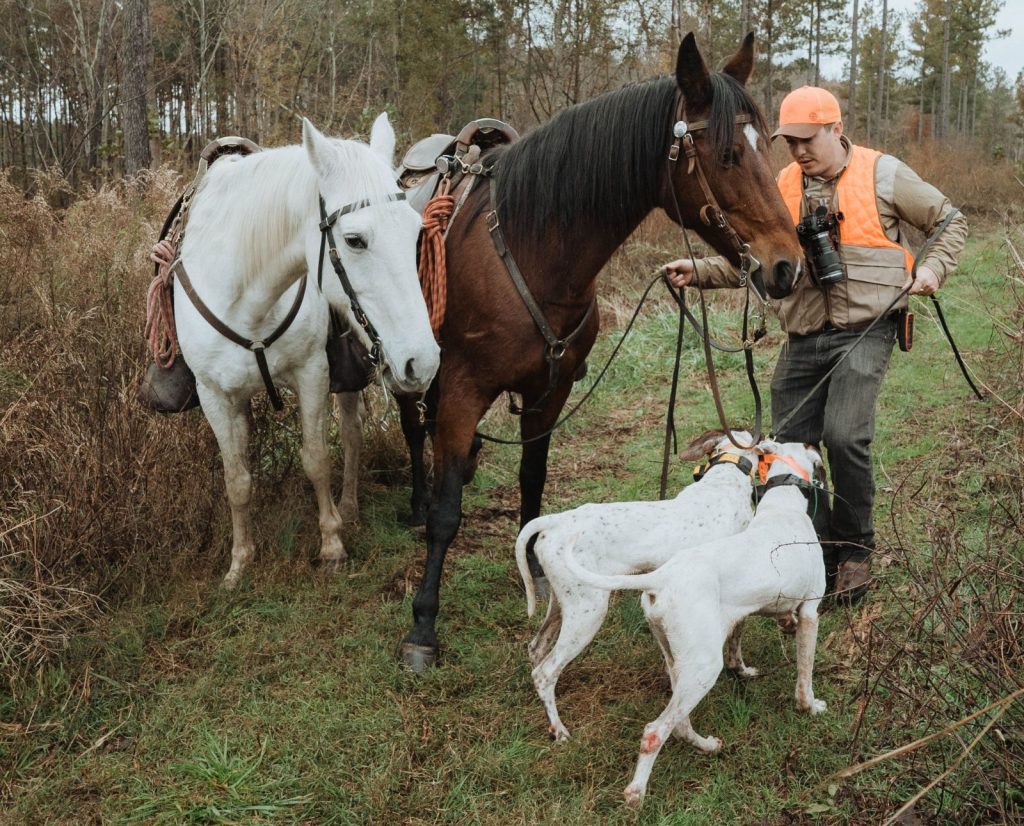
Today, to see horses and bird dogs work together, your best bet is to attend a horseback field trial where handlers, judges, and galleries are mounted. The breed of choice is usually the Tennessee Walking Horse, a breed developed by Southern landowners who wanted a comfortable, easy-to-handle mount that could cover a lot of ground with a smooth stride.
At most field trials, horses are usually available to rent or borrow if you want to follow the action, and I would encourage anyone to try it at least once. The view of the action from horseback is far better than on foot, and the easy, comfortable pace of a gaited horse makes it a pleasure to follow along, even for novice or first-time riders.
If you are lucky enough to live in a region where there are still a few hunters who follow their dogs from horseback during the hunting season, you may want to meet up with them to ask them all about it, or even try it out yourself!
I spoke to Kelli Aiken, a hunter, field trialer, and breeder of Irish Setters, about how she hunts prairie grouse in Kansas on horseback:
Hunting off horseback is fairly uncommon in Kansas. A lot of the public lands are just not conducive to it. But there are some places to hunt bobwhite quail, prairie chickens, and pheasants on public land out here.
We use the same horses that we use in trials, Tennessee Walkers. The best time for prairie chickens is in the early season, mid-September to mid-October. At that time of year it is usually really hot, so you need a lot of water. And a horse can help a lot with that. They can carry a lot of water for us, so it is really more practical than hunting on foot, and when bird numbers are down, horses let us cover a lot more ground as well.
We generally hunt in twos or threes with two to four dogs. We set out at sunrise and do one- to two-hour loops. It is basically like training in the Dakotas, but we are not just running dogs to train them, we are hunting with them. We make a giant circle in the area we’ve chosen and just follow the dogs. We don’t really handle them much; they go to the front, and we follow. We may whistle once in a while to get their attention, but we basically let them do their thing.
The horses generally move at a flat walk, and when you are mounted, you have a great vantage point, so you can see the dogs from a long way away. When a dog points, we make our way together to the dog. We get the horses to speed up just a wee bit, but not a trot or lope or anything that would shake the ground—the chickens are jumpy enough. Once we are close enough, we take our gun from the scabbard and dismount. If I can get close, I will dismount within 10–15 yards of the dog, then walk in and flush. If I am not sure, I will leave more room, especially with poor wind in dry conditions. I will dismount 20 yards or more away. All our horses are trained to ignore gunshot and most are trained to ground tie. If not, we hand the reins to another hunter while one or two of us dismount.