

Did the Český Fousek Shape the Wirehaired Breeds?
We explore the history, genetics, and legacy of the Český Fousek, and its place among Europe’s wirehaired hunting breeds.
Dog historian and author Craig Koshyk explores one of Europe’s most fascinating hunting breeds as he traces the remarkable history, genetics, and legacy of the Český Fousek. From medieval Bohemia through two world wars and the breed’s near extinction, Craig uncovers how the Český Fousek survived, evolved, and may have influenced the development of other wirehaired pointing breeds, including the German Wirehaired Pointer, Wirehaired Pointing Griffon, and Stichelhaar. Drawing on decades of research, firsthand travels in the Czech Republic, and the latest genetic studies, this episode separates myth from history to reveal the enduring story of one of the continent’s most important—and often misunderstood—gun dogs.
Episode Transcript
Hey everybody, welcome back to the Hunting Dog Confidential podcast. I am your host and resident gun dog nerd, Craig Koshyk.
In today’s episode, we’re going to take a look at a really cool breed from a very interesting part of the world. It’s the Český Fousek, which will continue our look at all of the wire-haired breeds from all over Europe.
Looking back on all those years I spent in public school, I now realize that the history lessons we got were based on the notion that the world was made up of England, Canada, the U.S., and France, in that order, more or less. The rest of the globe was considered foreign land, worthy of no more than a couple of questions on a multiple-choice quiz here and there.
So, like most Canadians, and I suspect most Americans, I graduated from high school having never heard of such a place as Bohemia. Well, except for in that song by Queen, “Bohemian Rhapsody.”
It wasn’t until I was in university that I learned that Bohemia is actually a region of the Czech Republic. Years later, when I began the research for my first book, Pointing Dogs, Volume 1, I also learned that the Czech Republic had its own breed of versatile gun dog.
When I found that out, I said to my wife, Lisa, “Listen, we’ve got to save our pennies this year because next summer I want to get a cheap budget flight to Prague to check out some of these dogs. It’s a breed called the Český Fousek, and it comes from a land of beer. So, honey, let’s pack our bags and check them out.”
Now, I should mention at this point that before we actually left on our trip to the Czech Republic to check out these dogs, I did my best to do some research on the breed to figure out, well, at least the basic outline of its history, its evolution, its development, and its current situation.
Keep in mind, this was during the internet days. Unlike some of the other breeds I studied, where there was no internet and I had to look at books and libraries and magazine articles and actually phone people on the telephone, running up a fortune in long-distance bills, this was during the internet days. The internet was fully up and functioning, and I was able to dig down and find some articles written on the breed, a website or two. I even contacted a breeder or two and the breed club.
Nevertheless, I’ve got to say that tracing the history, the evolution, and the development of this breed was fascinating on the one hand, but boy, oh boy, was it a rabbit hole. It was a really difficult thing to untangle.
When I arrived in the Czech Republic, I had a basic outline in my mind in terms of the history and development of what this breed was all about. I learned a lot from people on the ground there, from experts, from genetic experts, and from people who had been breeding this dog, or these types of dogs, for years and years.
One in particular stands out, and I’ll talk about him a little bit toward the end of this podcast: Dr. Dostál.
But even after that, and even after coming back with all of the information I gathered there, with all of the photographs, and with all of the interviews I did, I still didn’t have a 100 percent handle on exactly how this breed developed and what its contribution was to the other wire-haired breeds.
What’s really exciting now is that there has been an article published that goes way beyond what I do in my sort of research into breed histories. I look at the ancient literature. I look at the cultures of various places. I look at linguistic differences. I look at things like studbook records, if they exist. I look at old paintings and all sorts of stuff.
But I’m more interested in, or I’m more capable of, researching things that are available to the public. I am not an expert on genetics, but there are people out there who are. Recent genetic studies looking at the DNA of these dogs, focusing on the Český Fousek, have revealed some really interesting things that have helped flesh out the history of this fascinating breed.
There is a study you can check out online now. It’s called “Tracing Genetic Resurrection of Pointing Dog Breeds: Český Fousek as Both Survivor and Rescuer.” It was published in August 2019. It is by Silvie Neradilová and others—et al., as they say in the scientific community. So it’s Silvie Neradilová, Laurie Connell, Pavel Hulva, and Barbara Černá Bolfíková. Please forgive my pronunciation.
That group of researchers put together this really cool study that looks at the genetic history of the breed. They come to mostly the same conclusions that I will cover in my description of the history of the breed, but they really do provide some additional fascinating detail about the breed, as well as its current situation and how it was used sort of interchangeably with Wirehaired Pointing Griffons in America, its connection to the German Stichelhaar, the German Wirehaired Pointer, and the German Shorthaired Pointer.
All of those connections are explored, which I do on a surface level, but these researchers dig into the genetic connections between those breeds, and it’s a really cool read.
You can find it online. Go to journals.plos.org and look for “Tracing Genetic Resurrection of Pointing Dog Breeds: Český Fousek as Both Survivor and Rescuer.”
All right, let’s get into my history of the breed, or what I came up with when I did my research into the breed, and see where it came from and how it got to where it is today.
Officially, the Český Fousek is actually a new breed on the versatile gun dog scene. It seems strange to say that this dog, which we think of as an ancient breed from an ancient land, is actually kind of a new kid on the block. I mean, the FCI only recognized it in 1964.
Then again, there are references to Bohemian hunting dogs, generally assumed to be the Fousek’s ancestors. There are references to those dogs in documents dating as far back as the 14th century.
So is the Český Fousek a modern creation, or is it the grandfather of all rough-haired continental pointing dogs? There seem to be two camps, or two different answers that you can find, depending on who you talk to.
Those who argue in favor of an ancient origin invariably quote a 14th-century letter written by a nobleman called Vilém Zajíc of Valdek. He wrote, quote:
“In the year 1348, King Charles IV presented to the Margrave of Brandenburg, Ludwig, fine hounds known as Canis Bohemicus for the Margrave’s hunting pleasure.”
Now, of course, that quote was originally written in Latin, and you see that the author’s use of the term Canis Bohemicus, which we could translate into English as “Bohemian dog,” leads people to see it as proof that hunting dogs native to the Bohemia region must have existed at the time.
Unfortunately, Zajíc makes no mention of their color, their size, their coat type, or even the kind of hunting they were used for. I mean, these could have been tracking dogs or sighthounds or water dogs. It’s unlikely, though, that they were actually pointing dogs as we know pointing dogs today.
In the mid-1300s, when this was written, hunters were starting to use dogs that pointed, but most of those dogs were trained to point. There were a few dogs around that did have a natural tendency to point, but they were just starting to appear in Italy, Spain, and southern France, probably not in the region of Bohemia yet.
Nevertheless, we can assume that Bohemia was indeed home to some kind of hunting dog that had enough talent to warrant the attention of the great king at the time.
The next historical reference we see to dogs in Bohemia is one found in a really cool book called The Complete German Hunter. That’s the English title. I will not attempt to butcher the German title. It’s a cool title, but I can’t say it.
It was written by Johann Friedrich von Flemming around 1724, and it’s a richly illustrated two-volume encyclopedia. It mentions rough-haired dogs from Bohemia but says that they were used mainly for water work. Once again, no other details are provided.
Just like Zajíc of Valdek, Flemming was describing a type of dog, not a specific breed, and he didn’t give us any more details other than, “Yeah, these dogs are good in water.”
Okay, great. But this was written in 1724, so we might assume that at least some of those dogs could have had a natural inclination to point. They were good in the water, as Flemming mentioned, and who knows? Maybe some were used as pointing dogs.
We have to really fast-forward until 1883, when a six-volume set entitled Huntsmanship: Handbook for Hunters and Hunting Friends was published. The author, Joseph Willem Czerny, provides a description of a brown-and-white, or sometimes all-brown, medium-sized Czech pointing dog.
Three years later, we find the word Fousek in the record. It’s in an official Czech registry for purebred dogs, and it has a list of a bunch of dogs: 19 Pointers, 17 English Setters, nine Irish Setters, 17 Gordon Setters, two Griffons, 81 German Shorthaired Pointers, and 41 rough-haired pointing dogs, or Fouseks.
So that’s the first time we actually see the word Fousek referring to a rough-haired pointing dog.
Finally, in that same year, the word Český, meaning Czech or from the Czech Republic, and the word Fousek are seen together. They were formally combined when a group of hunters and breeders in a town south of Prague decided to form a club.
They named their club the Society for the Rough-Haired Pointer, Český Fousek, of the Czech Kingdom, based in Písek.
So there are the very first references that are beyond fuzzy paintings and descriptions of general types of dogs from a broad region. We have very specific references to a very specific type of dog from a particular region.
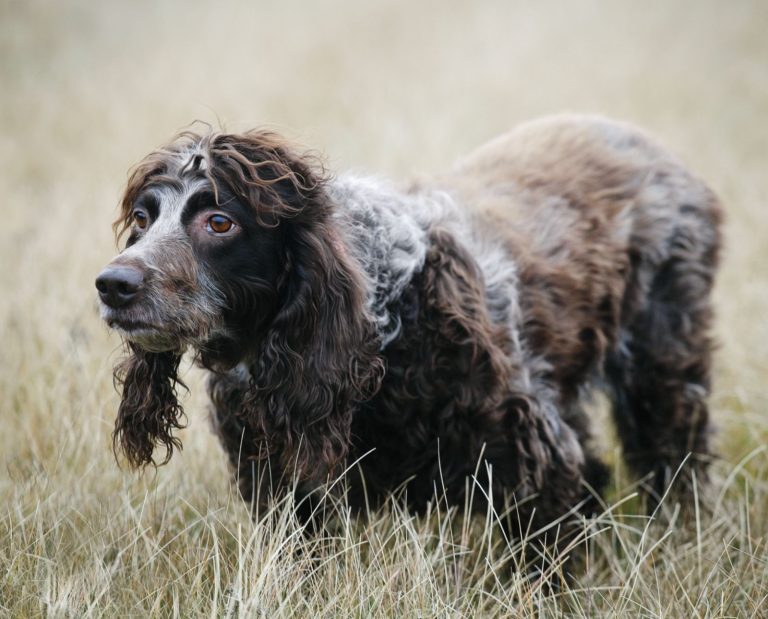
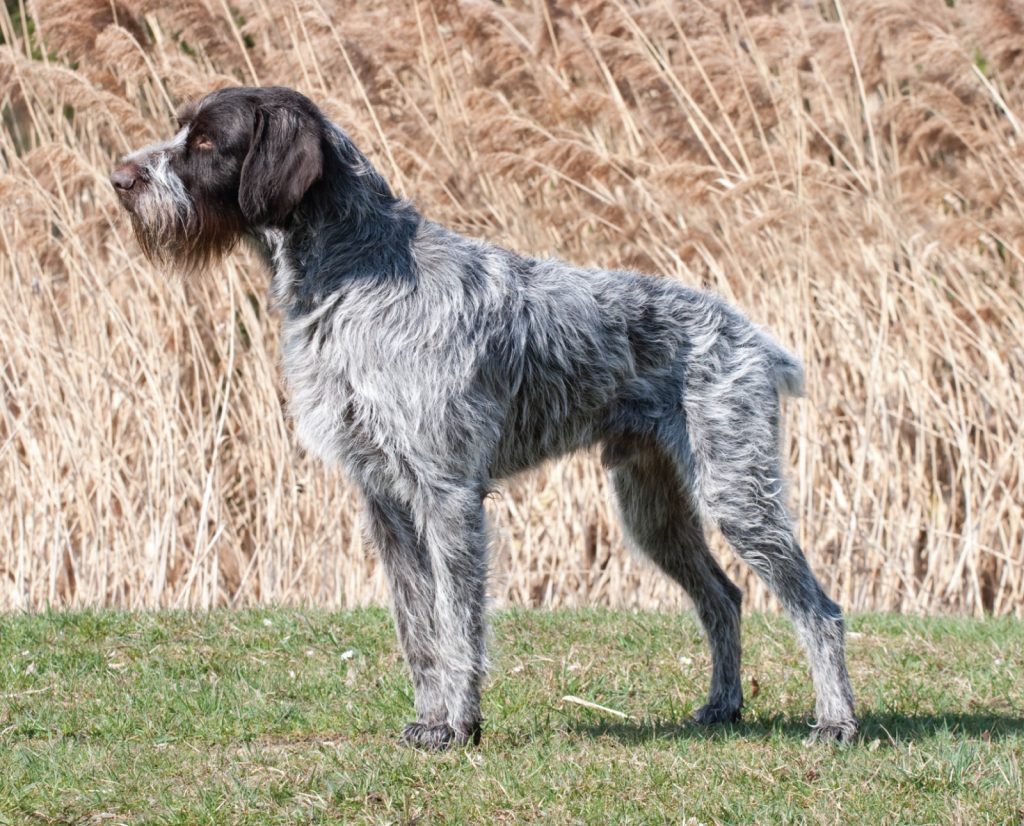
These dogs are Czech dogs. They have a rough-haired coat, and they point. They’re also brown or brown and white, just like the modern Český Fousek.
But we need to keep in mind that when that club was established and named the Society for the Rough-Haired Pointer, Český Fousek, of the Czech Kingdom, even at that time crossbreeding was still fairly common among hunters who simply wanted a good dog.
So the Český Fouseks of that club, and the ones owned by people in and around that area, were more a type of dog than a strictly pure breed at that particular moment. There was a lot of variation among them in terms of appearance.
In general, they must have been pretty darn good versatile gun dogs because they were much appreciated by Czech hunters, but also by German and Austrian hunters in nearby regions.
Depending on where those dogs were bred, they went by different names. The Czechs called them Český Fouseks. They even named their club after them. But those same dogs in Germany, guys like Dr. Hans von Kadich called them Stichelhaars, or, now I’m going to butcher this, straffhaarige Hühnerhunde—basically, rough-haired bird dogs.
Breeders like Franz Bonthant from Frankfurt called them Hessian Rough Beards.
Yet despite the different names people used, everybody agreed that those dogs, no matter what they were called, came from an area encompassing Bohemia and Moravia in what is now the Czech Republic, along with Brandenburg and Hesse in Germany.
Then came political turbulence, which was particularly violent in Eastern Europe at the beginning of the 20th century. For the Český Fousek, and all the other dogs, no matter what name they went by in that region, it was nearly fatal.
As war raged across the region, breeding of all of them came to a standstill.
At the war’s end in 1918, the Austro-Hungarian Empire had ceased to exist, and a new nation, Czechoslovakia, had been proclaimed. The Fousek was nearly extinct.
In 1924, a new association was formed with the express purpose of restoring the breed to its former glory. Unfortunately, there were very few dogs to work with.
Even worse, due to massive importations of English Pointers and Setters, German Shorthaired Pointers, and other breeds, the Český Fousek was kind of relegated to second-class status among hunters.
Undaunted, the few remaining Fousek enthusiasts continued their efforts. Then, in 1931, they drafted a new breed standard and enacted new breeding regulations. When they did that, the Fousek seemed to be on the road to recovery.
Then, in 1939, war once again broke out in the region, and the breed was dealt another devastating blow.
After the Second World War, efforts to revive the breed got underway once again. The Association of Breeders, which somehow managed to remain intact throughout that terrible war, issued new guidelines for its members.
The Český Fousek was to be bred only by and for hunters, and the top priority of all breeders was to retain the excellent hunting abilities and temperament of their dogs.
Due to the breed’s small population and its very narrow genetic base, crossbreeding with other breeds, such as German Shorthaired Pointers and German Wirehaired Pointers—Kurzhaars and Drahthaars—was permitted for a while.
However, when Czechoslovakia joined the FCI in 1957 and the breed club sought recognition for their breed, the Český Fousek, the studbook had to be closed, and the club was required to prove that they had at least three generations of, quote-unquote, “clean lines,” free of any foreign blood.
The breed also faced strong resistance from the German Kennel Club. The Germans opposed the idea of recognizing a breed that they thought was basically genetically identical to the Stichelhaar. They didn’t think that the Český Fousek was an independent, quote-unquote, “pure breed.” They figured, well, it’s just the Stichelhaar on the other side of the border.
It wasn’t until 1964, after an in-depth report on the origins of the breed was submitted to the FCI, and after the club finally met all the requirements for pure breeding, that the Český Fousek was officially recognized as a pure and independent breed, and its standard, FCI No. 245, was adopted.
Today, the breed is still represented by a strong and dynamic club in its native land, and they produce about 500 to 600 pups every year. There are also breeders active in Slovakia, Austria, Germany, France, the Netherlands, the U.S., Canada, and New Zealand.
Now, just as an aside before I get into my view and before I tell you all about what I saw in the Czech Republic, I should mention a little bit about the breed’s name.
As I’ve been pronouncing it, hopefully correctly, throughout this episode, it is Český Fousek, with “Fou” rhyming with “to”—Český Fousek.
Český obviously means Czech, and Fousek is derived from a Czech word that refers to facial hair or whiskers. It basically refers to the breed’s prominent mustache and beard.
Strictly speaking, Český Fousek refers only to a male dog. If you’ve got a female, well, she’s not a Český Fousek. She is a Česká Fouska.
The FCI has some cool translations for the name. They sometimes use the term “Bohemian Wire-Haired Pointing Griffon.” In French, it’s Barbu tchèque—in other words, the Czech bearded dog. In German, it’s Böhmisch Rauhbart, or the Bohemian rough beard. In Spanish, it’s Grifón de muestra bohemio de pelo duro, so “Bohemian rough-haired pointing griffon.”
Personally, I like the name Český Fousek, and next time I see a female, I’m going to call her a Česká Fouska.
All right, folks, let’s have a look at the Český Fousek’s history, development, and current situation in North America.
I can think of no better way to start this part than to fire up our trusty time machine and set the dial to August 31, 1893, in Lincoln, Nebraska.
When we arrive, we find a growing city of 55,000 residents, many of whom were immigrants, or the children of immigrants, who had come to the region from Eastern Europe. So, walking the streets of Lincoln at that time, we’d hear people speaking German, Polish, Ukrainian, Czech, and Russian.
In fact, one of the largest communities of immigrants in Lincoln at that time was known as the German Russians, or Volga Germans. They were the descendants of ethnic Germans who had migrated to Russia in the 1760s. In the mid-1800s, many of them left Russia for a new life in America, and by 1880 they were thriving over here.
They had established their own institutions, including a German-language newspaper right there in Lincoln called the Nebraska Staats-Anzeiger. On the day we arrive in our time machine, the latest issue was hot off the press, and it had an interesting story right there on page one. It’s about a dog that became a hero.
Here’s the English translation from that German-language newspaper of the time:
“The following account aims to shed light on the ways of the animal kingdom.
A dog had jumped into one of those mysterious swampy areas that harbor a thick, muddy bog covered with aquatic plants. The poor animal couldn’t walk or swim. It had laboriously worked its way to the shore but could not go any further because the bank was too high.
The people who were there could not help it, since the swampy ground could not support the weight of a human body. The poor dog, stuck in the mud and in danger of sinking, whined pitifully.
While the people were discussing what to do, another dog suddenly leaped into that dangerous area. His master called him back, firmly believing that his dog would also get stuck in the mud and make the dangerous situation even worse.
But his dog, otherwise a model of obedience, did not heed the call. He leaped onto the riverbank, lay himself flat on his belly, seized the other dog’s collar with his jaws, and pulled him up onto dry land.
The life-saving dog is of German Stichelhaar descent, a big, strong animal. He received enthusiastic praise from the entire hunting party, and even his master forgave him for this one instance of disobedience.”
Now, I left the original German word Stichelhaar in the translation to illustrate the point that German-speaking people of Lincoln, Nebraska, would have used that very word to describe a rough-coated hunting dog.
But there were also Czech immigrants in that same area at that same time, and they may have used the Czech word Fousek, or hrubosrstý ohař, which is the Czech way of saying “wire-haired pointer.” I hope I didn’t slaughter that pronunciation too badly.
What about the French people in that area? Would they have called it a griffon? Maybe.
What I can say is that English speakers at that time might have called it a Russian Setter. After all, we know from several references in English-language newspapers, magazines, and even kennel club records that rough-coated bird dogs were often called Russian Setters.
I’ve spoken about those dogs in previous episodes, and I’ve written about them in both of my books, Volume One and Volume Two.
So, when I read the article about a hero Stichelhaar dog in a German-language newspaper from Lincoln, Nebraska, I was reminded of a story from just 10 years earlier, in 1883. It appeared in Forest and Stream magazine. The title is “Shots Among the Prairie Chickens,” and in that story are several mentions of Russian Setters owned by an innkeeper in Omaha, Nebraska, where there was also a large population of German-Russian immigrants.
Now, I mention all this just to show you how complicated things can get when we dig into the history of the wirehaired breeds. Not only do we have to understand how, where, and why the breed came about, but we also have to account for differences in language, culture, and traditions in the breed’s homelands and in the regions of North America where they first appeared.
For the Český Fousek, wow, it’s like understanding 3D chess. There are just so many moving parts.
Let me give you an example. Remember that book by Josef Vilém Černý that I mentioned earlier? Well, it was published in 1883, just three years before the story of the Russian Setters in Omaha, but it was published in the Czech language in what is now the Czech Republic.
At that time, however, most of the ruling class in that entire region of Europe spoke German. But get this: in the chapters on training a bird dog, Černý explains most of the techniques and most of his theories in Czech, but many of the commands he uses are, get this, in French.
So here is a Czech hunter writing about bird dogs and other hunting dogs in his own native Czech language while most of the ruling class in the land he lives in speaks German, and he’s using French commands to train his dogs.
In any case, all of the twists and turns I uncovered in the Český Fousek’s development are fascinating, and there are even some really cool twists and turns that are much more modern. We don’t have to go all the way back to the 1860s. You know what we need to do? We just need to go to Idaho in 2014, and we’ll take a look at one of those little twists and turns that I was indirectly involved with.
You see, the Wirehaired Pointing Griffon Club of America, as it was called at the time, invited me to speak at a judges’ clinic they were hosting in Boise, Idaho.
At the time, the club was at an inflection point. Their program to infuse Český Fousek blood into their Wirehaired Pointing Griffon lines had paid off. They were producing better dogs with more consistent abilities, temperaments, and coats.
However, by the early 2000s, the dogs they were breeding were, from a pedigree point of view, basically Český Fouseks. They were no longer Wirehaired Pointing Griffons if you looked at the pedigree. Ninety percent of the dogs were basically purebred Český Fouseks.
So, after my talk on the history of versatile dogs, dog tests, and the wirehaired breeds in general, I offered to answer any questions from the folks in attendance. Among the very first questions I got was about the future of the breed and the club. They asked whether their breeding program of, quote-unquote, “Griffons” should continue, or if the club should simply accept the fact that they were now breeding Fouseks and just drop the name Wirehaired Pointing Griffon altogether.
In response, I expanded on an idea I had explored in my initial speech: the fact that the golden age of gun dog breeding was over and we were moving into a new era. In this new era, there was going to be a lot of turbulence. Across the gun dog world, many of the ideas, institutions, and ideologies we had relied on in the past were shifting, sometimes dramatically, and every single breed of gun dog out there would have to batten down the hatches for a while until things cleared up.
Since the Wirehaired Pointing Griffon world at that time was severely fractured, with several clubs and groups each claiming to have the real deal, it was among the more vulnerable breeds.
So I said that if I were in their position, I would look for the safest harbor I could find. I would align myself with the strongest, most well-established club and canine system available to them.
In my mind, that structure, that entity, was the Český Fousek Club in the breed’s homeland. If any group of people could help them find stability and clarity in a world that was getting more confusing by the day, it was the Czechs, the very creators of the dogs they were now breeding.
Now, I don’t claim to have had any direct impact on the club’s decision to take that route in the years that followed. I think they had already decided to go that way before I even gave my speech. But it was nice to be there on the ground at such a critical time for such a great group of people.
In the end, the club did forge deeper ties with the parent club in the Czech Republic. At first, they changed the club’s name to the Bohemian Wirehaired Pointing Griffon Club of America. Then, a few years later, they changed it to Český Fousek North America, and that’s the name they go by today.
As for the old Griffon—or one of the clubs that existed for the Griffon apart from the Wirehaired Pointing Griffon Club of America—the American Wirehaired Pointing Griffon Association kept its affiliation with the AKC. They continued with their approach, and they produce some great dogs to this day, as we explored in the episode on the Griffon.
More recently, yet another club for the breed came into the picture. This one is called the Korthals Griffon United States. It’s a club for the breed that follows all of the French rules and is forging deeper ties with the Griffon’s parent club in France.
In any case, I wasn’t in Idaho just to give a speech. I was also there to see dogs in action, and boy, oh boy, did I see some nice dogs.
I had the pleasure of watching Fouseks participate in the club’s hunt tests, which examined their abilities in the field and in the water. All of the dogs did a great job, and it was clear that the judges took their jobs seriously.
They watched each dog very closely and then discussed what they had seen among themselves as they tallied the scores.
Overall, the dogs I saw that day were more or less identical to the dogs I saw in the Czech Republic. Their coats were very consistent, their temperaments were excellent, and the dogs were calm and friendly around people. But they were all in full hunt mode every minute they were in the field or the water.
The club members were just as friendly as their dogs and just as focused on hunting. The time I spent with them was really enjoyable. I loved spending time with them and in the city of Boise, whose name I learned to pronounce properly.
When I first arrived, I kept saying it the French way, “Boisé,” but I was quickly corrected by the first person I met at the airport and then by the kind waitress who served me my first beer at the local pub.
Since then, Lisa and I have had the great pleasure of hunting over a couple of Fouseks in North Dakota and right here in Manitoba. My friend Rick Sojda has imported dogs from the Czech Republic, and he’s bred a few litters within the North American club over the years. Just like the dogs I’ve seen in tests south of Prague and out in Boise, Rick’s dogs are the real deal.
They’re dyed-in-the-wool versatile hunting dogs that are easy to handle and easy to live with.
In a recent conversation with Rick, he told me that things are going very well for the breed now. Growth has been steady within the club, and there has actually been a slight increase in the number of younger people joining.
That just confirms my original thoughts about the Český Fousek, the thoughts I had after I saw that sparkle in the eye of Dr. Dostál. It’s a lucky breed. It’s a lucky breed indeed.
Well, that’s our look at the Český Fousek, everybody. I hope you enjoyed this episode as much as I enjoyed putting it all together.
I’d like to thank the folks at Minam Store Outfitters in Oregon. I put a plea out online a little while ago asking folks to send me hats to cover my balding head, and they stepped up. So thanks, Minam Store.
They’re in Oregon. They offer bird hunts in Oregon and western Idaho, and they have Český Fouseks. So check them out. They’re online somewhere.
I’d also like to thank my friend Rick Sojda for giving me this line, or for letting me steal his line. I like to use it to sign off on these programs, so I’m going to sign off with it by saying, “May you shoot straight and often, and give that dog a biscuit for me, will you?”