

Bufflehead Duck: Identification, Habitat, and Hunting
These charismatic diving ducks remain a favorite among waterfowl hunters across North America.
Of all the diving ducks to grace a waterfowler’s decoy spread during hunting season, none are more renowned for saving a slow day more than the iconic bufflehead duck (Bucephala albeola). Often acclaimed for their uncanny ability to trust a spread of decoys even when you’re out in the middle of it, these tiny diving ducks live remarkable lives that most people only get to see a microscopic portion of.
The bufflehead duck is the smallest diving duck in North America, making it one of the easiest species to distinguish from larger diving ducks such as common goldeneyes and mergansers. Known for the drake’s striking white head patch, compact size, and willingness to decoy during hunting season, buffleheads breed across Canada’s boreal forests before migrating south each fall. Let’s have a look at what makes these cute little butterballs so special.
Bufflehead Identification
| Characteristic | Details |
| Scientific Name | Bucephala albeola |
| Family | Anatidae |
| Average Length | 13–16 inches |
| Wingspan | 21–22 inches |
| Weight | 9–19 ounces |
| Habitat | Lakes, ponds, rivers, coastal bays |
| Diet | Aquatic insects, crustaceans, mollusks, fish, vegetation |
| Nesting | Tree cavities or artificial nest boxes |
| Conservation Status | Least Concern |
| Similar Species | Common Goldeneye, Barrow’s Goldeneye, Hooded Merganser |
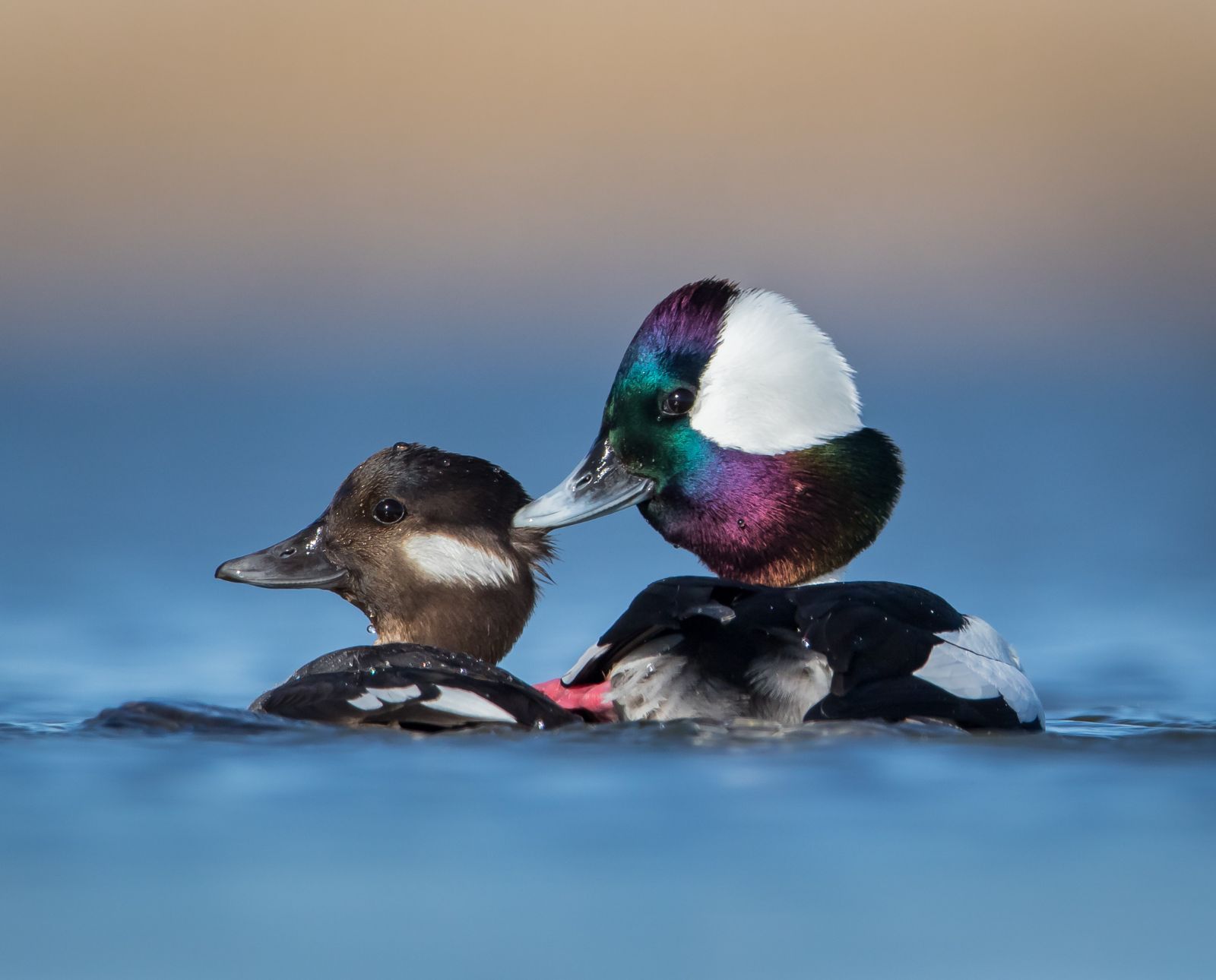
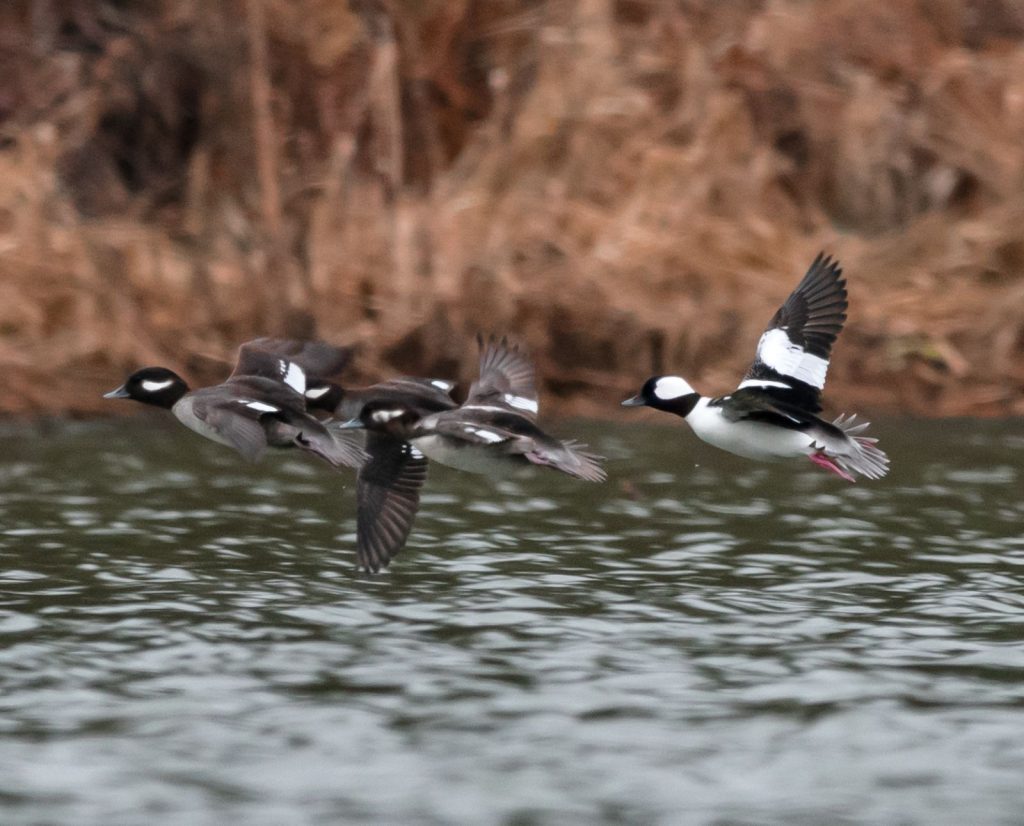
Buffleheads are a small diver duck with a large head and a petite body. Drakes have white flanks, black feathered backs, and purplish-green iridescent plumage on their head. Male buffleheads also have a large white patch that starts behind the eyes and wraps around the back of their heads. In flight, drakes have a large white band halfway down their wings.
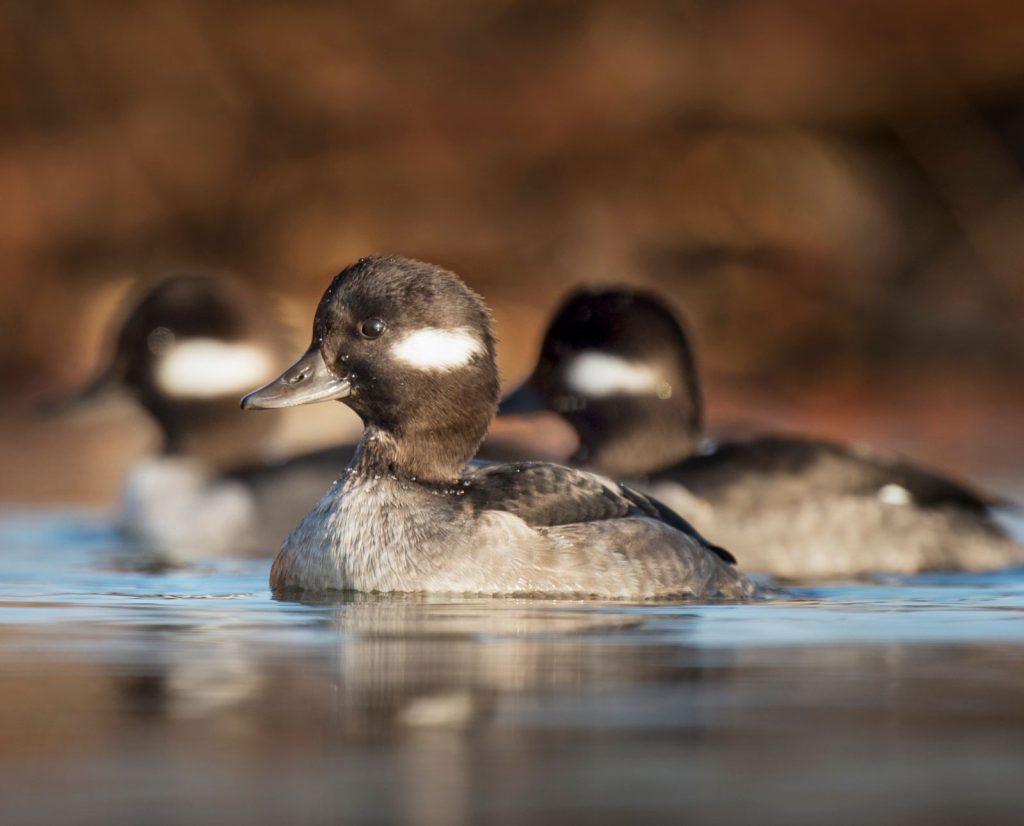
Female buffleheads are much more drab and noticeably smaller than the males. Hens have dull, light charcoal-colored flanks and dark charcoal-colored backs. Females also have a small white cheek patch on their heads. Hens and juvenile buffleheads both have a white patch on the rear of their wings that, unlike the drakes, doesn’t reach the front of their wings.
The average bufflehead life expectancy is 2.5 years. However, the oldest known bufflehead was over 18 years of age. It was initially banded in 1975, then captured and re-released in New York state in 1993 by a bird bander (All About Birds).
How To Tell the Difference Between a Bufflehead and a Goldeneye
One of the easiest ducks to confuse with a bufflehead is the common goldeneye, especially when you’re looking at hens or immature birds. At first glance, both have dark heads, gray bodies, and bright white patches on their heads, but a closer look quickly separates them.
Female buffleheads are noticeably smaller than female goldeneyes, with a compact body and a proportionally large, rounded head that gives them a distinctly “cute” appearance. Their white cheek patch is oval-shaped and sits low behind the eye. Female goldeneyes, by comparison, are nearly twice the size, have a longer neck and a more angular head that often appears peaked toward the back. They are also a rich chocolate-brown head instead of the bufflehead’s darker charcoal tones. When comparing female buffleheads and male goldeneyes, the goldeneye’s white facial patch is smaller and more circular, between the bill and the eyes rather than farther back on the cheek. If the birds take flight, goldeneyes also show much larger white wing patches, while buffleheads have a more compact white wing marking.
Once you’ve seen the two species side by side, the differences become surprisingly obvious.
Bufflehead Habitat, Migration, and Life History
On the water, Buffleheads don’t tend to raft together in large groups like most other species of diver ducks will. Instead, they live in sparse groups of four to ten individuals, especially during their winter migration. They’re not overly social creatures and will often avoid large congregations of other ducks if they can. Additionally, because of their small size, buffleheads don’t require a long, running start to fly off the water like other diver ducks like long-tailed ducks, mergansers, or common goldeneyes.
Buffleheads are birds of the North. According to Ducks Unlimited, their breeding range stretches across the boreal forests of Alaska and much of Canada, where they nest on small lakes, ponds, rivers, and wetlands surrounded by mature stands of aspen and poplar. Their reliance on abandoned northern flicker nesting cavities means they are most common where both suitable forest habitat and flickers occur together.
Bufflehead hens lay roughly six to twelve cream-colored eggs and incubate them for roughly 28 to 33 days. Once hatching occurs, the young ducklings will leave the nest with the hen within 48 hours (Audubon Society). Ducklings usually take their first flight between 50-55 days after hatching (All About Birds). Male buffleheads will leave the hen during the nesting process in order to molt, but as a general rule, these ducks tend to pair with the same mate for several years. The drake will return once his molt has come to an end (All About Birds).
As autumn approaches, buffleheads migrate south along all four major North American flyways, wintering anywhere from protected inland reservoirs and freshwater lakes to sheltered coastal bays and estuaries. Their winter range extends from southern Canada through much of the United States and into northern Mexico, with especially high concentrations found along the Pacific Coast, the Gulf Coast, the Atlantic seaboard, and the Great Lakes. During migration, buffleheads favor calm, shallow water where they can easily dive for food, often returning to the same stopover locations and wintering areas year after year if conditions remain favorable.
What Do Bufflehead Ducks Eat?
Buffleheads forage on a wide variety of food items that varies through the season. During spring and summer, these ducks typically will feed on mollusks, invertebrates, crustaceans and aquatic insects such as dragonfly nymphs, mayfly nymphs, just to name a few, with food sources varying between fresh and saltwater habitats (All About Birds). Buffleheads will also feed on several species of baitfish, gobies, shrimp, herring eggs, and are well known to forage on submerged aquatic vegetation in the autumn during their migration south, though this does tend to be specifically for things such as seeds from pondweeds and bullrushes (All About Birds).
Buffleheads only use the motion of their feet to dive to the bottom of a body of water to feed. When doing this, they condense their feathers to force excess air out. Because of this, these ducks prefer to feed in shallow water (4-12 feet) and will stay submerged for 12 to 25 seconds at a time and swallow their food while submerged. That said, they are perfectly capable of diving much deeper if they have to (All About Birds, Smithsonian).
Bufflehead Conservation
The Audubon Society lists the bufflehead duck as a species of least concern, yet still it also estimates that historically the species has lost a significant portion of its habitat due to various reasons including forest fires, logging, and agricultural practices, as well as unregulated harvest in the twentieth century which impacted the overall population.
Currently the overall population is considered to be stable and has actually increased by three percent between 1966 and 2019 (All About Birds). In areas where natural nesting cavities are limited, properly sized bufflehead nest boxes—with entrance holes approximately 2.5 inches in diameter—can help increase local nesting success while discouraging larger cavity-nesting species.
Practicing selective harvest on buffleheads by only taking drakes may or may not help keep populations stable.
How to Hunt Buffleheads
Buffleheads are a decoy-friendly species that, while preferring their own kind above all else, will often flank larger rafts of other species of diving ducks. In the fall, these ducks spend much of their time close to shore structure for feeding purposes and are prone to seeking out areas that both diver and puddle ducks prefer, making them an excellent species for hunters who target both types of ducks throughout the season. Having a half dozen bufflehead decoys in a spread will get their attention. A common tactic is to have two or three bufflehead decoys on the far left and far right of your regular spread, which mimics the common behavior of the species.
Read: Decoying Diver Ducks On A Budget
The hens of this species are particularly susceptible to decoys and are known for sticking around a spread even after several of their own flock have been dispatched. It’s also not uncommon for hunters to be breaking down a spread of decoys and have bufflehead hens still come in. It’s of popular opinion that refraining from shooting these hens is advisable, not only because they are much smaller than the drakes and don’t have much meat on them, but also because it would be easy to fill a limit with only hen buffleheads.
Because buffleheads frequent several different habitats in the autumn, scouting can play a major role in locating consistent concentrations of these birds. Remember that they tend not to raft in large numbers like other species of diver ducks. If you locate a group of a dozen or so, make note of both the location and time. These birds are creatures of habit and once a group has found a reliable source of food, they will return until the source has run dry or they are forced to migrate further south.
What Does a Bufflehead Taste Like?
As a diving duck, most hunters will skin these birds and breast them out. However, because this little duck also favors aquatic vegetation during its fall migration, it’s possible to leave the skin on and pluck them as well. When hunting, be sure to check the color of the fat underneath the skin. Make a small incision and see what color the fat appears to be. If the fat is white, it is entirely possible to roast these birds whole because they’ve been feeding on vegetation, not mollusks or small fish.
Although often overlooked because of their small size, the bufflehead duck is one of North America’s most fascinating waterfowl species. From nesting in abandoned northern flicker cavities to their remarkable diving ability and dependable response to decoy spreads, buffleheads occupy a unique niche among diving ducks. Whether you’re watching them migrate, hunting coastal bays, or preparing one for the table, understanding their biology and behavior offers a deeper appreciation for this charismatic little duck.