

Comparing Labrador Retrievers, Golden Retrievers, and Chesapeake Bay Retrievers
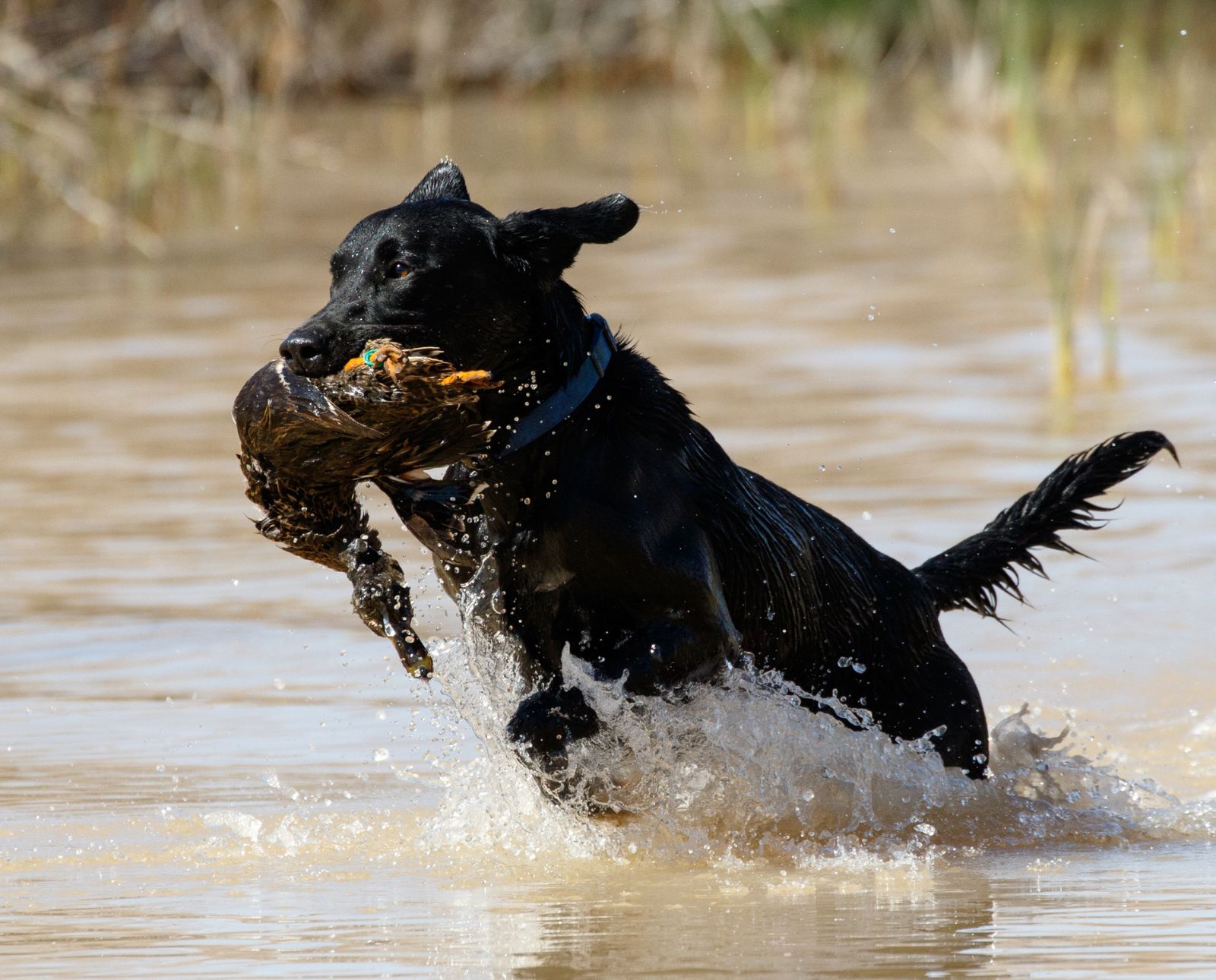
Each of the Big Three was bred for a different purpose. Understanding those purposes is the key to choosing the right retriever.
Find yourself at a boat launch on a blustery October morning or at a hunt test in the middle of July, and chances are you’ll see at least one of three retrievers at work: the Labrador Retriever, the Golden Retriever, or the Chesapeake Bay Retriever. Known simply as “the Big Three,” these breeds have earned reputations as versatile gun dogs capable of retrieving waterfowl in icy marshes, flushing pheasants across prairies, and settling quietly at home with the family after a hunt.
While they often perform the same jobs, they arrived there by very different paths. The Labrador was refined on Britain’s great shooting estates, the Golden emerged from Scotland through deliberate breeding for the sporting field, and the Chesapeake was forged by American market hunters who demanded toughness in some of the harshest waterfowling conditions in North America. Those histories shaped each breed’s instincts, temperament, and working style in ways that remain evident today.
Choosing between these retrievers is rarely a matter of which breed is “best.” Instead, it comes down to understanding what each was bred to do and deciding which one best matches your hunting style, training goals, and life outside the field.
Retrievers At A Glance
| Labrador Retriever | Golden Retriever | Chesapeake Bay Retriever | |
| Height | Males: 22.5 to 24.5 inches. Females: 21.5 to 23.5 inches. | Males: 23 to 24 inches. Females: 21.5 to 22.5 inches. | Males: 23 to 26 inches. Females: 21 to 24 inches. |
| Weight | Males: 65-80 lbs. Females: 55-70 lbs. | Males: 65-75 lbs. Females: 55-65 lbs. | Males: 60-80 lbs. Females: 55-70 lbs. |
| Coat | Short, dense double coat that sheds water and provides protection from cold weather and heavy cover. | Dense, water-repellent double coat with moderate feathering that provides insulation and protection. | Thick, oily double coat with a wooly undercoat that naturally sheds water much like a duck’s feathers. |
| Coat Color | Black, yellow, chocolate | Dark golden, golden, light golden | All shades of brown including sedge (red), or deadgrass (blonde) |
| Original Purpose | English driven shoot pick-up dog | Scottish estate retriever | American market waterfowl retriever |
| Developed In | England | Scotland | Chesapeake Bay, United States |
| Temperament | Active, friendly, outgoing | Intelligent, friendly, devoted | Bright, affectionate, sensitive |
| Popularity | As of 2025, they were the 2nd most popular breed out of the 205 recognized AKC breeds. In Project Upland’s 2026 Annual Survey, 16% of respondents reported owning one. Out of 31 breeds, Labs were the 3rd most popular hunting dog breed. | As of 2025, they were the 3rd most popular breed out of the 205 recognized AKC breeds. In Project Upland’s 2026 Annual Survey, 1.4% of respondents reported owning one. Out of 31 breeds, goldens were the 17th most popular hunting dog breed. | As of 2025, they were the 56th most popular breed out of the 205 recognized AKC breeds. In Project Upland’s 2026 Annual Survey, less than 0.5% of respondents reported owning one. Out of 31 breeds, Chesapeakes were the 27th most popular hunting dog breed. |
| Annual AKC Registrations | 38,000 | 27,000 | 3,700-4,000 |
| Health Issues* | Can be prone to hereditary conditions like hip/elbow dysplasia, hereditary myopathy, exercise-induced collapse (EIC), and eye disorders (PRA). | Can be prone to hereditary conditions like hip/elbow dysplasia, Neuronal Ceroid Lipofuscinosis (NCL), heart conditions, and eye disorders (PRA). | Can be prone to hereditary conditions like hip/elbow dysplasia, degenerative myelopathy (DM), exercise-induced collapse (EIC), and eye disorders (PRA). |
| Life Expectancy | 11-13 years | 10-12 years | 10-13 years |
*Common to all three breeds: Hip and elbow evaluations, eye clearances, and appropriate genetic testing should be considered when selecting a breeder. Like many deep-chested sporting breeds, all three can be susceptible to gastric dilatation-volvulus (bloat) and may experience ear or skin issues if their coats are not properly maintained.
England’s Labrador Retriever
With more than 38,000 Labrador Retrievers registered annually, the Labrador remains America’s most popular retriever and one of the most recognizable sporting dogs in the world. Although first recognized by the American Kennel Club (AKC) in 1917, the breed’s story begins much earlier with the St. John’s Water Dog of Newfoundland, Canada. Developed by local fishermen during the eighteenth century, these hardworking dogs retrieved fish, hauled nets, and excelled in the cold waters of the North Atlantic.
During the early nineteenth century, visiting English sportsmen recognized the dogs’ remarkable work ethic, natural swimming ability, weather-resistant coats, and webbed feet. Impressed by their abilities, they imported several back to England, where influential sportsmen—including the 3rd Earl of Malmesbury, the 6th Duke of Buccleuch, and the 12th Earl of Home—carefully refined the breed into what we know today as the Labrador Retriever. By the late 1800s, the descendants of humble fishing dogs had become established as elite gun dogs on Britain’s great shooting estates.
Listen: The History of the Labrador and Chesapeake Bay Retrievers: HDC Podcast
Unlike their Newfoundland ancestors whose work centered almost entirely on water, early Labradors spent much of their time retrieving game on land. During driven shoots, they served as pick-up dogs, using their exceptional marking ability, nose, speed, and trainability to recover large numbers of downed birds efficiently. Their reputation spread quickly among British sportsmen, and after being recognized by The Kennel Club in 1903, the Labrador became England’s most popular retriever in the shooting field by 1928.
The breed’s popularity soon crossed the Atlantic. American soldiers stationed in Europe during World War I encountered Labradors in the field, while wealthy American sportsmen began importing dogs from England during the 1920s for hunting and field trial competitions. From those early imports, the Labrador’s reputation continued to grow, eventually making it the dominant retriever in North America.
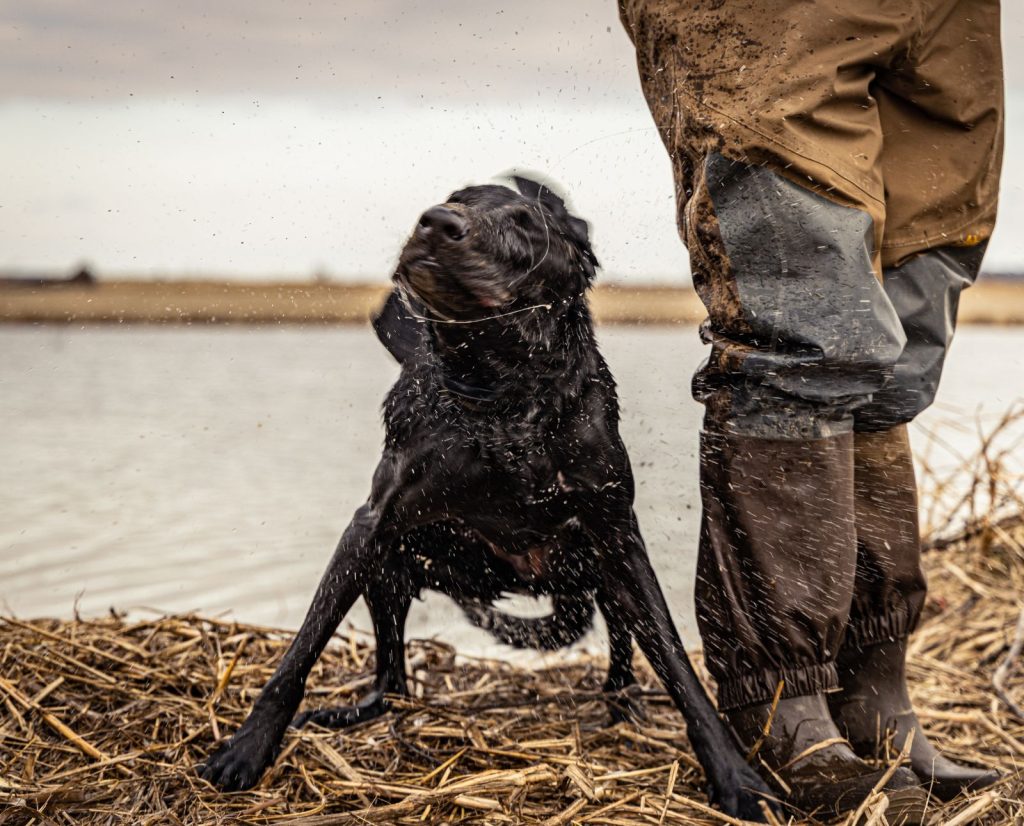
Today, the Labrador excels in nearly every aspect of the sporting world. It dominates retriever field trials and hunt tests while remaining one of the most versatile hunting dogs available. An exceptional nose allows it to track a wounded pheasant across a field, its short, dense coat sheds burrs with ease, and its natural quartering ability enables it to hunt upland birds much like a spaniel. In the marsh, few breeds can match the Labrador’s enthusiasm for water, keen marking ability, and powerful swimming. Combined with its trainability and adaptable temperament, those qualities have made the Labrador the benchmark by which modern retrievers are often judged.
Scotland’s Golden Retriever
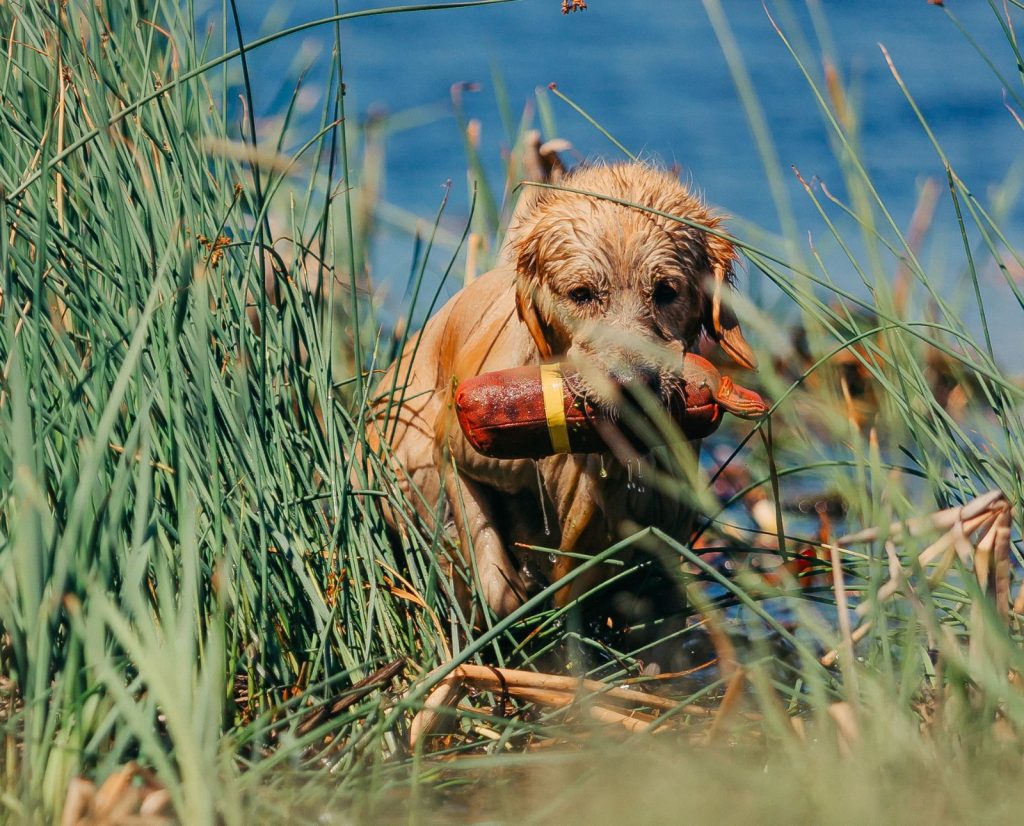
With over 27,000 Golden Retrievers registered annually, the Golden is just behind the Labrador in popularity. Long-coated with deep feathering on the legs and tail, the Golden is one of the most recognizable sporting dogs in the world. First recognized by the AKC in 1925, this sporting dog can trace its origins to the late 1800s in Scotland, where Sir Dudley Marjoribanks set his mind to developing the ideal retriever for his shooting estate.
According to Jeffrey Pepper’s “The Origins of the Golden Retriever Revisited,” the breed traces its foundation to an 1868 breeding between a yellow Wavy-Coated Retriever named Nous and a Tweed Water Spaniel named Belle. Through decades of careful breeding, Marjoribanks developed a dog with an excellent nose, a soft mouth, and a natural willingness to retrieve. In time, those efforts produced the versatile sporting dog we know today.
Listen: Curly-Coated, Flat-Coated, and Golden Retrievers: HDC Podcast
The Golden quickly earned a reputation among British sportsmen. Recognized by The Kennel Club as the Flat Coat-Golden in 1903, the breed proved itself in the field after winning the International Gundog League field trial in 1904. In 1911, the dogs were reclassified as Retriever-Golden and Yellow before officially becoming the Golden Retriever in 1920.
Like the Labrador, the Golden eventually found its way to America. Soldiers returning from Europe after World War I had seen the breed’s abilities firsthand, while American sportsmen began importing Goldens during the 1920s to hunt over and compete with in field trials.
Today, the Golden Retriever is still a very popular sporting dog breed. They have an excellent sense of smell, a strong instinct to retrieve, and a natural enthusiasm for both upland birds and waterfowl. Well-bred field Goldens continue to excel in hunt tests, field trials, and hunting situations while also earning a reputation as dependable family companions. Like the other members of the Big Three, the Golden Retriever remains a purpose-bred gun dog that has stood the test of time.
Chesapeake Bay Retriever: America’s Waterfowl Retriever
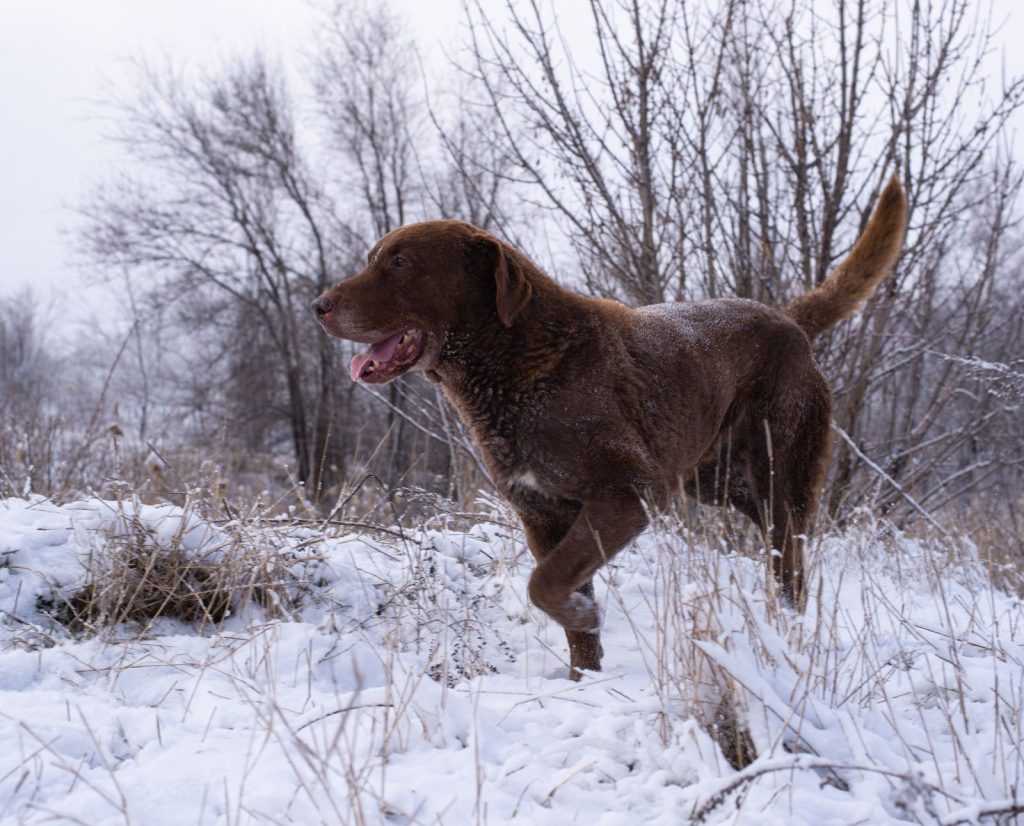
Early in the 1800s, while the English and the Scots were developing their own retrievers across the pond, American gunners were developing one of their own: the rugged Chesapeake Bay Retriever. With around 4,000 registered annually, the Chesapeake was the first of the Big Three to be formally recognized by a kennel club, earning AKC recognition in 1878.
The Chesapeake’s history can be traced to a pair of pups rescued from a sinking ship off the coast of Maryland in 1807. Canton and Sailor eventually earned reputations as outstanding water dogs. Living on opposite sides of the bay, they presumably were never bred together; however, some of their descendants inevitably were.
While Canton and Sailor provided the foundation for the Chesapeake, other breeds were naturally crossed with their descendants to create the dog we know today. The wealthy owners of the famous duck clubs that lined both shores of the bay worked hard to carefully select dogs and establish the breed. By the late 1800s, like their British counterparts, the Chesapeake Bay Retriever was firmly established.
The Chesapeake Bay Retriever was named after the famous bay where they originated. Unlike Labradors and Goldens, the Chesapeake is and always has been first and foremost a water dog. They were used by the market hunters that worked in the area and routinely retrieved hundreds of downed ducks, geese, and swans in an effort to fill American consumers’ demands for fresh game. After the long days, the dogs were then asked to perform the herculean task of guarding the gunner’s rig throughout the night as he traveled to the local market to deliver the fowl.
The Chesapeake is another purpose-bred retriever. It has a natural love for the water, an excellent sense of smell, a strong instinct to retrieve, and is known as an athletic companion dog. Like the other members of the Big Three, it has adapted into a versatile gun dog, equally at home in the uplands, on the line at field trials and hunt tests, and, of course, always ready for a day in the marsh.
Insights from Professional Trainers
To better understand the differences between Labradors, Goldens, and Chesapeakes in the field, I spoke with professional retriever trainers Andrew Barbouche and Adam Levy of Next Generation Retrievers. While every dog is an individual, both emphasized that each breed tends to have distinct characteristics that influence training, hunting, and competition.
On Labrador Retrievers
“Labradors are mild-mannered, easy to get along with, and pliable dogs. From die hard hunters who chase waterfowl and upland birds everyday during the open seasons. To the weekend warrior who hunts the opener and some weekends here and there but also wants a great family dog. One that can play with the kids and can go on family walks. The Labrador fits both of those molds equally. As far as breeding, the genetic pool for field bred Labradors is much larger than that of both Goldens and especially Chesapeakes allowing a buyer or breeder more options and opportunities. Additionally, regarding competitive-level dogs in high-end retriever sports, the Labrador is definitely the way to go and is generally the most competitive dog out there.”
— Andrew Barbouche, Next Generation Retrievers
On Chesapeake Bay Retrievers
“Chesapeakes have a human-like mentality. Each dog has its own individual personality traits, like in all breeds, but there’s something about a Chesapeake, when they look at you, you don’t feel like you’re working with a dog. You feel like you’re working with a person. They feel your mood a lot differently. They don’t work well off of too much repetition. They tend to be dogs that are tough on the exterior; you get to see the weather and ice on their coat during a hard hunt, but they tend to be softer internally. You don’t need a ton of pressure with a Chesapeake. It’s more about the teaching process. The old saying that ‘You need a 2×4 to train a Chesapeake’ is so far from true. I just like rough and tough dogs; I think they’re fun to hunt over and fun to work with. I tend to hunt more during the late season because we’re training so much during that September-October time frame. So, I like that dog that can withstand that late-season hunting.”
— Adam Levy, Next Generation Retrievers
On Golden Retrievers
What History Tells Us
Choosing the Right Retriever
While all members of the Big Three are proven personal gun dogs, successful competition dogs, and faithful companions, it is important for prospective buyers to choose a puppy from proven field lines with working titles or hunting certifications going back at least a few generations. It all starts with breeding. Some people hesitate at the cost of a well-bred puppy, but if you take your time, do your research, and start with the right dog, you’ll likely save yourself money, time, and frustration in the long run.
Whether the dog by your side and sharing your bed is a sleek Englishman, a handsome Scotsman, or a rugged American, you cannot go wrong with any member of the Big Three. They are true multi-purpose retrievers. Their continued success is a credit to the breeders and trainers, both past and present, and proof that more than two hundred years of careful, selective breeding have preserved the qualities that made these dogs exceptional gun dogs in the first place.