


The New England Cottontail: Life History, Research, and Conservation in a Changing World
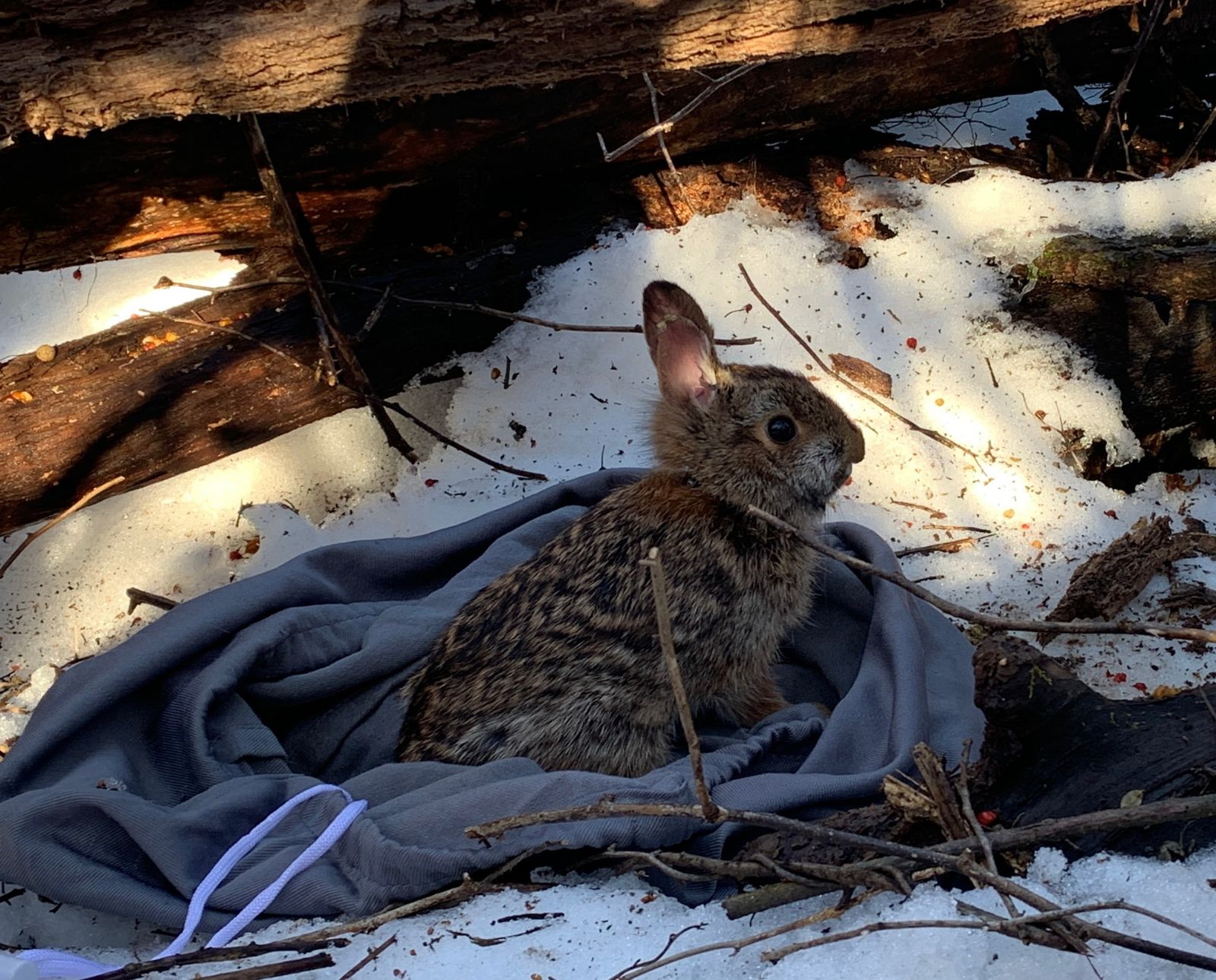
The New England cottontail (Sylvilagus transitionalis), the only native cottontail rabbit east of the Hudson River, is struggling to survive in a changing landscape
The Northeast is an area rich with history and dense with regional pride, and its wildlife is no exception. Although few people are familiar with it, the New England cottontail is as much a part of the region’s natural heritage as its autumn foliage or the Patriots. Today, the New England cottontail survives in less than 15 percent of its historic range and is quietly disappearing from northeastern forests.
What is a New England Cottontail?
If you picture your run-of-the-mill rabbit running across open fields or sneaking into backyard gardens, that is likely not a New England cottontail. While these reclusive rabbits look nearly identical to the more prevalent eastern cottontail (Sylvilagus floridanus), New England cottontails prefer heavy understory cover to open fields and forest edges, earning them the nicknames “brush rabbit” and “wood rabbit.”
New England cottontails grow to be approximately 2 to 3 pounds and 15 to 17 inches, with a mottled brown and grey coat, white underside, and a striking white “cotton” tail. Upon closer inspection, they have hairier and more venous ears than an eastern cottontail. And while easterns often have a white patch on their foreheads, some New England cottontails have a small black patch of fur between their ears. However, these differences are hard to see from a distance, and aren’t always reliable indicators. The only true way to distinguish them is through genetic testing or close examination of the skull.
New England Cottontail Distribution and Abundance
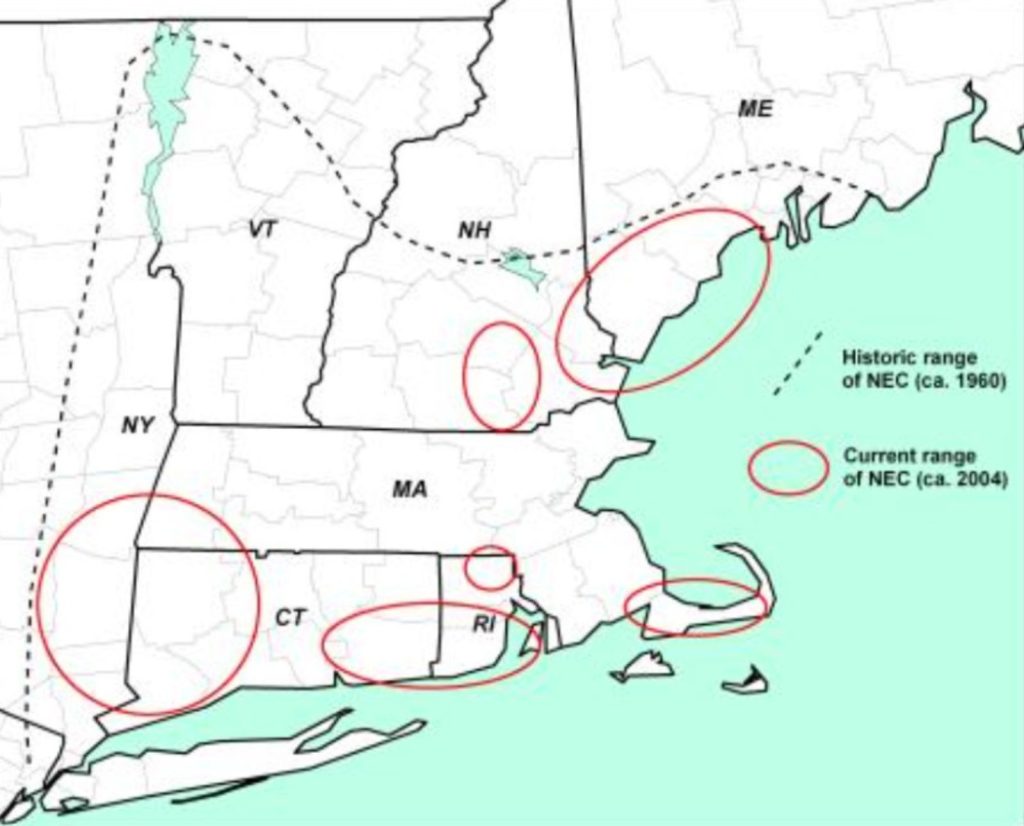
Fifty years ago, the New England cottontail was found almost anywhere in the northeast, from the Hudson River to the Atlantic Ocean. However, in recent decades, it has been extirpated from Vermont and now occupies less than 15 percent of its native range. Today, the rabbit persists in five distinct population areas: southern Maine and coastal New Hampshire; the Merrimack River Valley; Rhode Island and eastern Connecticut; Cape Cod; and the border region of eastern New York, western Connecticut, and southwestern Massachusetts.
At one time, the New England cottontail was the only cottontail of the genus Sylvilagus in the area. But during the early 1900s, humans brought eastern cottontails across the Hudson River as a game species. Eastern cottontails fared better than their cousins in the open farmland that was quickly dominating the Northeast. Adept at utilizing habitats that New England cottontails could not, eastern cottontails were often able to outcompete their native counterparts, becoming significantly more numerous and widespread in the region.
Wildlife agencies and researchers have been monitoring the presence of rabbits in these areas for decades. They are currently working to better estimate the rabbits’ abundance and distribution.
This past winter, I was fortunate enough to assist graduate students Molly Picillo and Melinda Houtman under Dr. Jonathan Cohen at the State University of New York College of Environmental Science and Forestry. They are studying New England cottontails in the New York Hudson Valley. They, alongside the New York State Department of Environmental Conservation (NYSDEC), collect fecal pellets of rabbits all winter and spend the summer conducting genetic analysis on them. With such a small population and striking visual similarity to other species, collecting droppings has been the most reliable, accurate, and non-invasive method of monitoring the species. But warmer winters and variable weather conditions are making this method more challenging.
Pellets must be collected below a certain temperature within a certain number of days after snowfall in order to preserve the genetic material left on the outside of the pellet when a rabbit passes it. Shorter winters, infrequent but extreme precipitation events, and large temperature swings like those the Northeast has experienced in recent years have left researchers struggling to collect usable samples under increasingly variable conditions.
New England Cottontail Habitat and Diet
New England cottontails are habitat specialists. They are highly dependent on young successional forests and dense thickets for shelter and food. Their concerning decline can be attributed in part to loss of vital habitat and increased fragmentation of the landscape from urban development. Historically, disturbances like those caused by wildfire or beaver activity would prevent forests from maturing uninterrupted, opening the canopy for understory plants and shrubs to grow. These shrubs provide cover and food not only for New England cottontails, but for woodcock, ruffed grouse, wild turkeys, and snowshoe hares; these, in turn, feed bobcat, coyotes, and raptors.
Read: What’s Limiting Eastern Ruffed Grouse Populations?
A patchwork of regenerating young forest among older, mature woods is needed to support this broader wildlife community. Today, the landscape in New England is highly developed, such that encroaching roads, residential neighborhoods, and commercial properties have further decreased and disconnected patches of young forests.
Cottontails, like all other rabbits, are herbivores. They consume grasses and forbs in the summer before transitioning to woody plants in the winter. In 2025, researchers at the Wildlife Genetics & Ecology Lab at the University of Rhode Island found that New England cottontails on Patience Island strongly preferred native species to invasive ones, including blackberry, wineberry, and raspberry bushes. On Cape Cod, they similarly preferred native shrubs like aspen, dewberry, and hawthorn. While native plants like red maple, holly, and poplar were preferred in New York forests, invasive plants like bittersweet and multiflora rose were also being consumed in large quantities. These food preference trends are attributed to the prevalence of these plants in the landscape.
Decades after invasion, many landscapes have become so thoroughly altered that invasive shrubs now provide structure where native thickets no longer exist. Some highly available invasive species like Japanese barberry are avoided for food and provide less than ideal habitat, but in areas where eastern and New England cottontails are in competition, the presence of dense barberry can actually lower stress in New England cottontails.
Historically, introducing invasive plant species to the New England cottontail’s homeland reduced their food and degraded their habitat. But now, many young forests are dominated by these invasive species: as of 2019, over 55 percent of forest plots monitored by the Forest Service in the Northeast had invasive species present. Since these invasives provide the dense cover that New England cottontails need, those managing for the species’ success must question if removing them might do more harm than good.
New England Cottontail Conservation in a Changing World
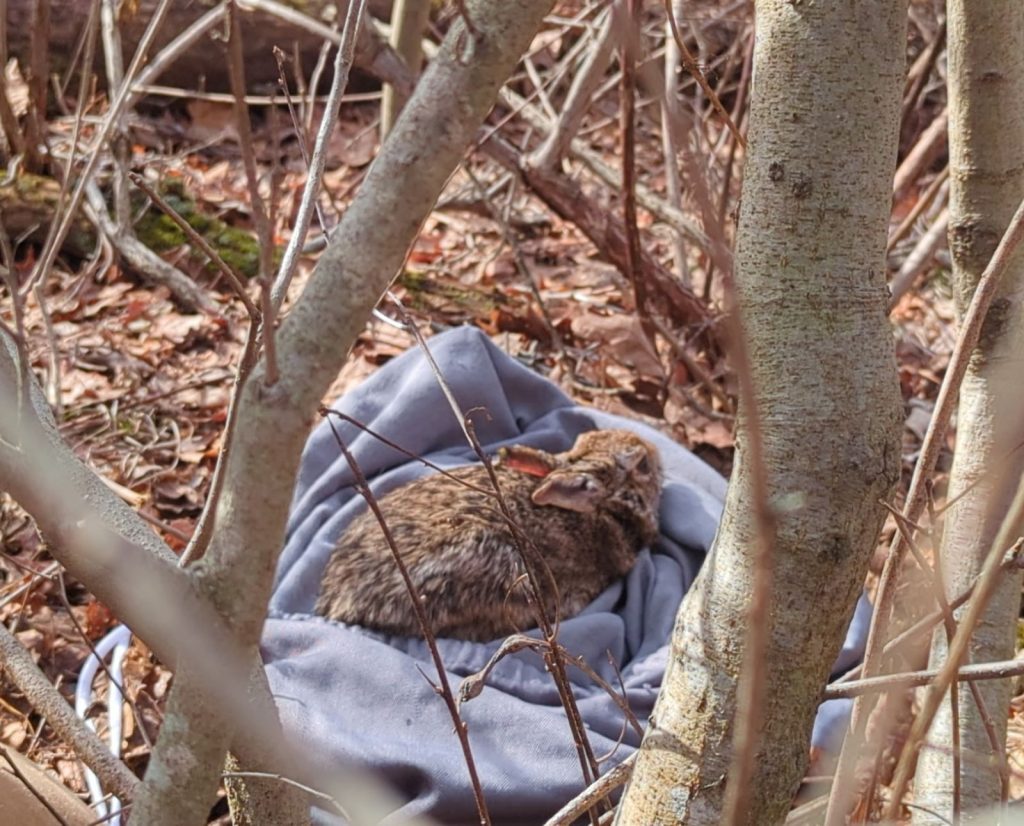
The New England cottontail has a relatively short but complicated conservation history. It has been touted by some as a conservation success story, while others recognize the ongoing threats to the species and the need to re-evaluate management strategies as we continue to learn more about these rabbits.
The New England cottontail was once considered for federal listing under the Endangered Species Act. In 2015, however, it was removed from consideration under the Policy for Evaluation of Conservation Efforts because of early collaboration among state and federal agencies, nonprofit organizations, land trusts, universities, and private landowners. The New England Cottontail Conservation Initiative, formed in 2011, has been instrumental in the implementation of best management practices like tree removal, forest harvesting, native shrub plantings, and prescribed burns across thousands of acres. In the absence of natural disturbance regimes, creating suitable habitat requires active management, which in turn requires expensive and time-consuming monitoring and maintenance of these habitat alterations.
Read: Why Losing Funding for Songbird Science Would Hurt All Bird Species
Although there is a comprehensive foundational understanding of the types of management needed to create quality thickets, some details still need to be worked out. Researchers are still looking for answers to questions like how to regenerate big, dense thickets with native plants or how to encourage New England cottontails to move into suitable habitat when they don’t disperse very far from their home territory.
As more is discovered about this species’ preferences and behaviors, implementing these best management practices has not been as straightforward as early conservation efforts may have hoped. Despite all of these proactive measures, the species has continued to decline.
A changing landscape has limited available resources and habitat, while a changing climate has challenged the most effective methods for monitoring populations; therefore, changing policy actions may be required to re-evaluate the protections available for this species caught in its legal limbo. The world is far from a static place, and such changes require that wildlife management agencies, researchers, and landowners alike continually update how they think about the conservation of this species.
New England Cottontail and Closed Rabbit Hunting Seasons
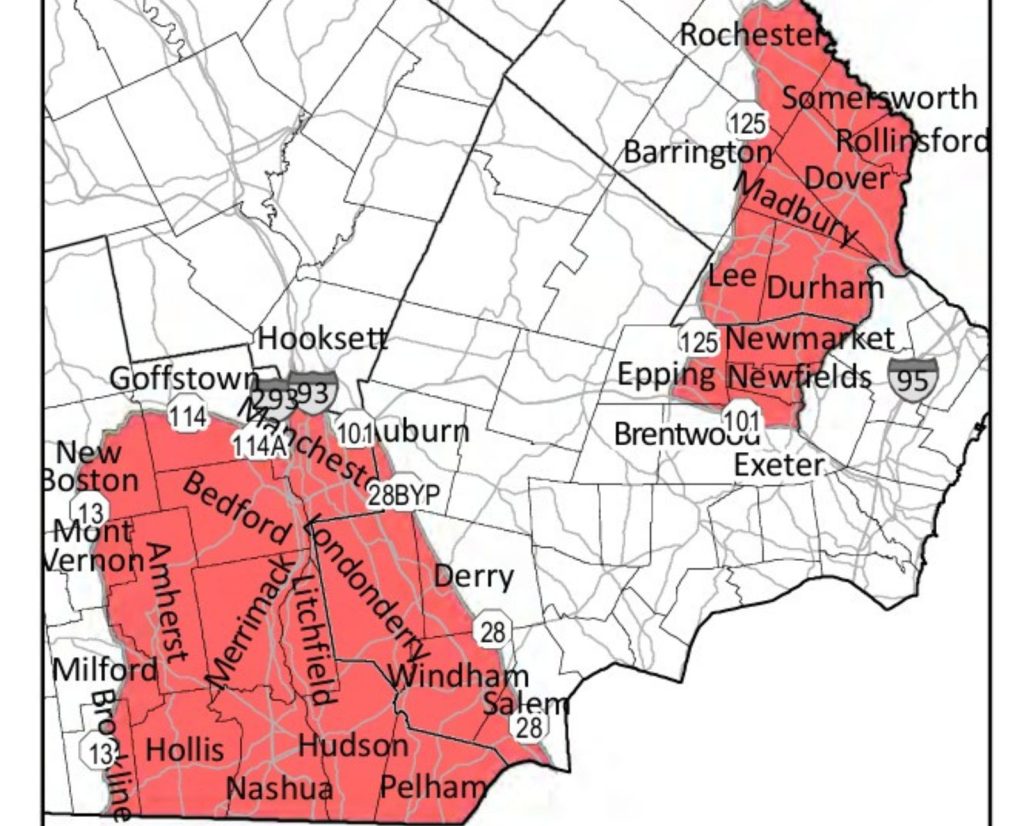
Finally, what does this all mean for those who enjoy hunting rabbits in the Northeast? New England cottontails are a regulated game species in Connecticut, New York, Massachusetts, and Rhode Island. In New Hampshire and Maine, however, the cottontail is listed as endangered at a state level and its take is illegal. Because the two species are nearly impossible to distinguish from each other in the field, small areas where New England cottontails are known to occur are closed to rabbit hunting. There is no open season for cottontail hunting in Maine, and the map of closed areas in New Hampshire is above.
Hunters have the opportunity to aid state wildlife agencies and researchers in learning more about New England cottontail’s range and health. New York has a program in place for the collection of hunter-harvested rabbit skulls in Rensselaer, Columbia, Dutchess, Putnam, and Westchester counties for species identification, providing more data on the New England cottontail’s range. The hope is that, through specific management of adjacent areas to promote young forest growth, New England cottontail populations may expand their range and move into nearby patches of good habitat.
If you do harvest rabbits in those areas, you can reach out to [email protected] to fill out a survey and potentially submit skulls. In New Hampshire, you can submit rabbit sightings to the New Hampshire Fish & Game Department and University of New Hampshire Cooperative Extension to help track the distribution of eastern cottontails in the state, aiding in the management of New England cottontail populations. If you ever harvest a collared rabbit, you can return the collar to your closest state wildlife office so its data can be recovered. Sometimes, collars can be re-deployed on new rabbits.
A looming threat that hunters can also help combat is Rabbit Hemorrhagic Disease Virus (RHDV2), a virus which originated in domestic rabbits. This disease is highly contagious with high mortality rates. In 2020, it was found in wild populations in six states throughout the southwestern United States. RHDV2 hasn’t reached wild rabbits in the northeast yet, and hopefully, with the proper precautions, it never will. To help prevent its spread, hunters can properly use and dispose of rabbit carcasses, disinfect gear used for rabbit hunting in the southwest with 10 percent bleach, and avoid transporting rabbit carcasses across state lines. Beagle clubs can restrict their practice to either domestic or wild rabbits, so long as they avoid mixing the two. Any unusual rabbit mortalities, like those that do not appear to be from predation or vehicle strikes, can be reported to your state wildlife health unit.
As the New England cottontail is replaced by a competitor that seems to fill the same ecological role, many may wonder why saving the native species is worthwhile. The answer is subtle, yet simple: a healthy ecosystem is a diverse ecosystem. Individual species have different capabilities and vulnerabilities that we often don’t discover until it’s too late, which is especially true for native species that have evolved in relation to a region’s other species for thousands of years.
In this context, rabbits can even be thought of like crops; monocultures are highly susceptible to drought and disease, but keeping a variety of crops in rotation protects against total devastation. If we can see that our world is changing, then we know nothing for certain except that the future is uncertain. Planning for an uncertain future means keeping our metaphorical eggs in as many baskets as possible. Those working to protect the New England cottontail are working to protect the future of northeastern forests.



Wow. Being from the Great Lakes region I was completely unaware of the New England Cottontail. Thanks for this information.