

Lesser Scaup: Identification, Habitat, Migration, and Hunting
Identify lesser scaup, learn about their migration and feeding behavior, and discover hunting tips for targeting bluebills
As a diehard waterfowler, I’m embarrassed to admit that when I started hunting “bluebills,” I hadn’t any idea that there was a difference between lesser scaup and greater scaup. Back then, these ducks were all the same to me, and they were numerous enough that they quickly became the most hunted diver species in my region.
What I didn’t know then was that the lesser scaup was the species that mostly visited my decoy spread. They decoyed well not because they were more numerous, but because their habits aligned with the kinds of places I usually hunt. Make no mistake about it, lesser scaup and greater scaup, though exceptionally similar in appearance to the untrained eye, live very different lives.
The sooner you understand the difference between lesser and greater scaup, the sooner you’ll understand how to hunt them more effectively.
Lesser Scaup Quick Facts
| Characteristic | Details |
| Scientific Name | Aythya affinis |
| Taxonomic Order and Family | Order: AnseriformesFamily: Anatidae |
| Average Length | 17 inches |
| Average Weight | 1.7 pounds |
| Average Wingspan | 28 inches |
| Habitat | Freshwater lakes, reservoirs, marshes, wetlands, ponds, estuaries, brackish bays, shallow saltwater areas |
| Range | Interior Alaska and Canada to southern Central America and the northern edge of South America, and west to the Pacific Ocean and east to the Atlantic Ocean |
| Conservation Status | Relatively low concern |
| Conservation Concerns | Protection of nesting habitat, access to resources while migrating, and uncertainty around recent population declines |
| Similar Species | Greater Scaup, Ring-necked Duck |
How To Identify Lesser Scaup
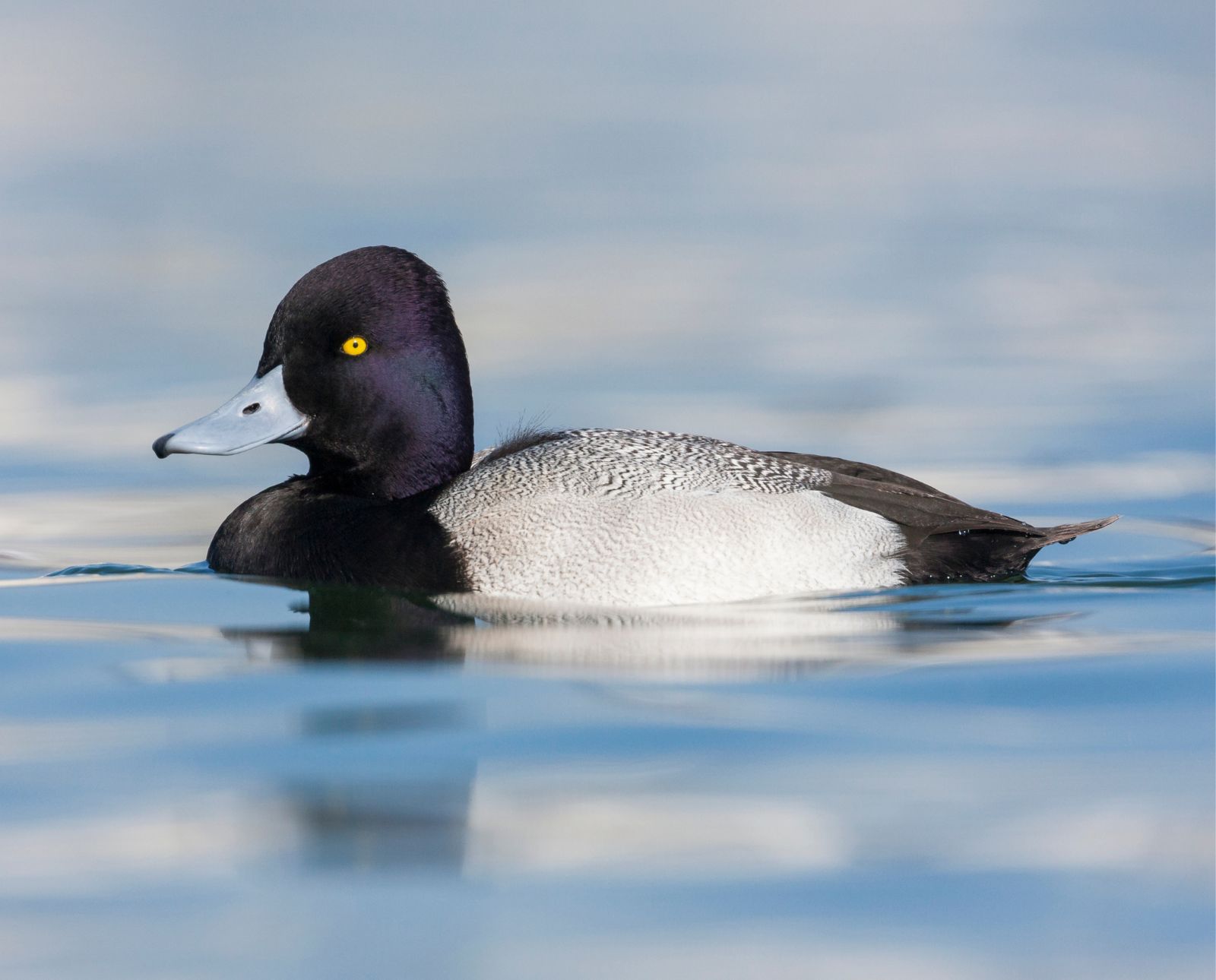
When identifying lesser scaup, look for their slightly pointed and blue or purple iridescence on their otherwise black head, white wing bars that stop a little less than halfway down their wings, blue bill, and the small black spot on the tip of their bill that does not “bleed” onto the blue areas.
During the fall migration, lesser scaup will often raft by the thousands on large bodies of water especially in and around the Great Lakes Region. One key feature in identifying lesser scaup from other ducks is the telltale blue bill tipped with a black spot at the end. However, this fine detail will not help in telling the difference between the greater scaup and lesser scaup.
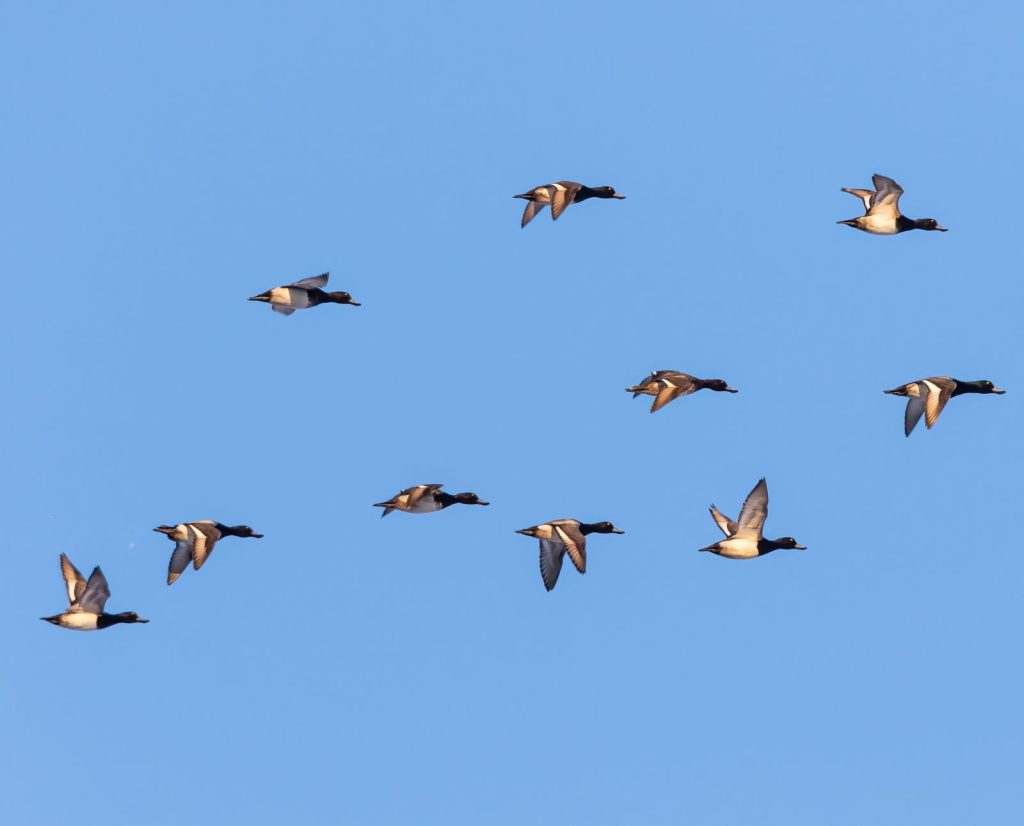
Lesser scaup are smaller than greater scaup. In flight, the lesser scaup can be identified by the short white stripe across the outer side of their wings. The white line will extend a little less than halfway across each wing. For comparison, the greater scaup’s white wing stripes extend more than halfway down their wings.
My preferred way to differentiate between lesser and greater scaup is twofold. First, if the duck has a purple iridescence in the plumage on its head, it is most likely a lesser scaup. Greater scaup drakes often have a more greenish iridescence to the plumage on their head. If it looks as though there is a slight tuft of feathers protruding subtly from the back of the duck’s head, it is almost certainly a lesser scaup. The hens also display a less prominent white patch at the base of the bills, whereas a female greater scaup will have a much more visible white patch.
Lesser Scaup Range and Distribution
Lesser scaup are a very commonly dispersed species of waterfowl, often found across the North American continent from coast to coast. Their range spreads from northern Alaska all the way to the western fringes of the province of Quebec during their breeding season—essentially the entire length of the boreal forest—and as far south as the top portion of South America. They are commonly seen throughout the Caribbean, California, and Mexico during the winter.
Lesser Scaup Habitat and Migration Patterns
Lesser Scaup spend their breeding season (late spring and summer) on inland lakes in the boreal forest. These lakes are usually shallow in nature and offer little in the water of human interference. They breed in the prairie pothole region as well.
During autumn migration, these ducks seek out coastal wetlands, large bays, rivers, and the Great Lakes, where they frequent the shallow-water locations their preferred food sources call home. According to Ducks Unlimited, as variations in seasonal changes in some areas continue, many of which are associated with climate change, lesser scaup are one such species that has begun to linger in some of the more northern fringes of its known migration routes. This is also attributed with greater numbers of prey species, such as zebra and quagga Mussels, which the ducks feed on.
Read: Why Biologists Band Waterfowl
It is worth noting that among the many species of migratory ducks, lesser scaup are among the latest to vacate their breeding grounds and head south. Ducks Unlimited states that lesser scaup migrations tend to be nocturnal in nature and often coincide with a strong north wind, which aids in the distance these waterfowl can cover in a single flight.
Lesser Scaup Food and Feeding Behavior
The Cornell Lab of Ornithology states that lesser scaup feed on a wide variety of mollusks and crustaceans. Much like many other species of diver ducks, they tend to not like to work any harder for their meals than they already have to. What that means is that lesser scaup like to feed in relatively shallow water, usually between 10 to 15 feet of water, and if that water has no current in it, all the better.
However, these birds are not impervious to eating other things. In the last few years, I’ve seen several eating round gobies as well. These ducks are varied foragers based on food availability, and according to the Audubon Society, it’s also not uncommon for them to take advantage of aquatic vegetation such as pondweeds, wild celery, and sea lettuce.
Lesser scaup propel themselves forward using their feet, and when feeding on aquatic invertebrates in muddy water, they’ll swim down to the bottom and quickly open their bills to trap food items before swimming back to the surface. On some occasions, lesser scaup have been known to feed periodically on aquatic vegetation, though this is considered to be a rare occurrence.
Lesser Scaup Breeding Behavior and Nesting
Lesser scaup are a seasonally monogamous species, meaning that a drake and a hen will pair together during the breeding season in late spring. Males engage in a very elaborate mating dance to attract the attention of hens. Ducks.org describes the courtship process as the drakes flicking their wings as well as their tails, then tossing their heads backward against their backs while pushing the feathers on their heads down to create a sleek appearance.
The hens average a clutch of six to nine eggs that are subject to a varying incubation period of 21 to 27 days. According to the Cornell Lab of Ornithology, nesting takes place on the ground in tall vegetation, such as prairie grasses, shoreline vegetation, and hay fields near marshy or brackish bodies of water. The hen will continue to build up the nest even when she has begun to lay her clutch of eggs.
Lesser scaup ducklings are remarkably resilient little things, and by the time that their down feathers have dried after hatching, they make for the water with their mother. The hen does very little to aid in the feeding of the ducklings, and The National Audubon Society states that it’s not all that uncommon for multiple hens to bring together several clutches of ducklings and raise them collectively.

Lesser Scaup Hunting
In my neck of the woods, entire clubs and lodges had, at one point in time, been tailor-made to accommodate the swaths of hunters who lived and died by the autumn migration of diver ducks. Both greater and lesser scaup made up the majority of birds targeted, especially in and around the Great Lakes. Lesser scaup are their own bird, and they tend to make up the largest percentage of both species shot by hunters, mainly because of their tendency to frequent areas much closer to land than their greater cousins.
This is a clue as to where the prospecting hunter should start to look. Points, sheltered bays, the confluences of rivers, and shallow estuaries are all prime lesser scaup territory.
Read: How to Hunt Ring-necked Ducks: Habitat, Decoy Spreads, and Calling Tips
Most of my pursuits for lesser scaup are dictated by what the wind is going to do. If I catch word that a strong southwest wind is coming in, I start scouring Google Earth for sheltered bays with any kind of shoreline structure facing northeast. If it’s adjacent to a drop-off, even better. If this weather pattern coincides with a couple of days of north winds, which almost always means a fresh push of birds coming in from up north, the lesser scaup hunting can be absolutely productive.
Layout boats are the dream when chasing lesser scaup. If you have one, certainly use it to your advantage when the hunting pressure is on and the birds are more wary of feeding anywhere close to shore. If you don’t have a layout boat but you do have a tinner or canoe, look for small islands that offer shelter to the ducks.
Lesser Scaup Cleaning and Cooking
Eating lesser scaup is a lesson in that not all ducks are created equal. Because of their preference towards eating mollusks and invertebrates, they absolutely can take on a fishy smell. But that’s not to say that you shouldn’t bother eating them. These ducks offer the hunter an experience to try different methods in preparing and cooking meat, and one of my favorite ways to prepare lesser scaup, especially in late season when I can almost guarantee that they’re feeding primarily on zebra mussels, is to brine the breast meat of the bird. If you’re going to smoke the breasts, use a salt and brown sugar brine with lots of rosemary in it. If you’re searing the breasts, try a sugary red wine.
With that being said, you can learn a lot about what you should or should not do with any lesser scaup based on the color of the fat between the skin and the breast meat. If the fat is dark orange and fishy-smelling, it’s best to skin the bird. If the fat is white or yellow, the skin (and fat) will be tasty and the breast is best left skin-on.
Lesser scaup may never receive the same admiration as puddle ducks or canvasbacks, but for many hunters across the Great Lakes and beyond, they are the backbone of late-season diver hunting. Their willingness to raft in massive numbers, adapt to changing food sources, and use shallow water habitat keeps them closely tied to weather, wind, and migration conditions. For hunters willing to learn the subtle differences between lesser and greater scaup, these birds can offer some of the best waterfowling of the season. And while their table fare reputation may always be debated, a lesser scaup taken from clean water and prepared properly can surprise you.