

Milkweed Buds with Bacon, Garlic, Chilies, and Anchovies
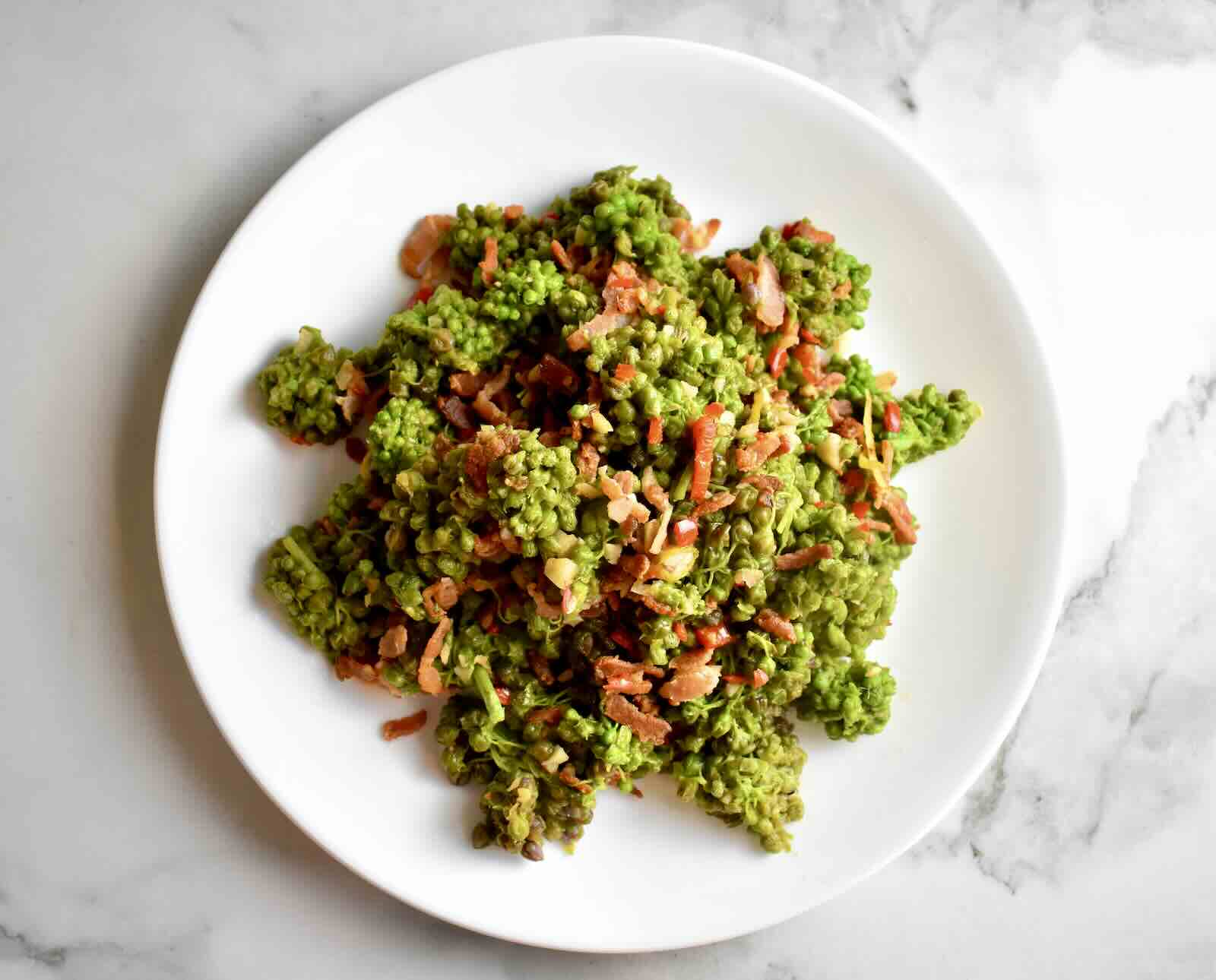
When foraged carefully and prepared correctly, milkweed offers a fresh, spring flavor to your meal
Editor’s note: don’t skip ahead to the recipe for this one – there are very important notes in the text for safely foraging and preparing milkweed buds. Read it carefully and forage with caution!
This is a simple, but delicious recipe using a plant that I’ve been familiarizing myself with for the last few years: milkweed.
There’s a lot of discussion online about whether or not milkweed is a good wild edible to eat, but so far, all of my experiments with cooking it have gone very well, with no bitterness or gastrointestinal issues to be found.
Milkweed is an amazing wild edible and generally goes underappreciated, but there are some things you must know before you go out to harvest and eat it.
Not all milkweed is edible!
I recommend you only harvest from common milkweed (Asclepias syriaca). Many say showy milkweed (Asclepias speciosa) is also edible, but I haven’t personally tried it. Do not harvest from other types of milkweed, or you may get sick.
Always be 100% positive about your identification of the plant before harvesting and eating. Using plant identification apps is a good idea, but you shouldn’t trust them blindly, as they do make mistakes. Use it to narrow down the possibilities, then double and triple check with foraging books, experts, and websites.
Even though common milkweed is proven to be a delicious edible, some people still have bad reactions to it. A few people who eat the plant seem to have an intolerance and may develop stomach upset after eating it. If you are trying milkweed for the first time, be sure to only ingest a small amount to see how your body handles it.
Most parts of common milkweed are edible.
Shoots, young leaves, tender tops, flower buds, flowers, young pods, and the partially formed silk from young pods are all edible with the proper preparation techniques. This recipe deals with the unopened flower buds.
There are levels of toxicity in the plant.
The common milkweed (Asclepias syriaca) is a plant known to contain cardioactive steroids, specifically asclepiadin, gomphoside, and afroside1.
Most eat this plant with no ill effects. Many common vegetables (eggplants, tomatoes, ground cherries, hot chilies, etc.) have similar levels of toxic compounds, but are eaten regularly. Use your own discretion, or have a chat with your doctor about eating this plant.
Make sure you cook milkweed. Do not eat it raw.
Raw milkweed contains compounds that need to be denatured by cooking. Eating it raw may make you sick.
Steaming or boiling milkweed will make it safe to eat.
Milkweed is rare in some areas and provides food for the monarch butterfly as well as other pollinators.
Take only one flower or pod off of each milkweed plant.
Only harvest from large, healthy colonies. These can often be found near agricultural areas, abandoned fields, and fringe areas.
If there are any signs of monarch butterflies on the plant, leave it alone.
Milkweed does regrow in the same season, so harvesting milkweed shoots remains a sustainable option.
Familiarize yourself with dogbane, a toxic common milkweed lookalike.
The two plants are actually easy to tell apart, but it does get a little tricky when harvesting shoots. Common milkweed will always have a thick, juicy stalk, while dogbane is narrower and stick-like.
Dogbane also apparently tastes very bitter, which milkweed does not. If you get a big, bitter bite after cooking, throw everything out.
Learn what dogbane looks like so you don’t accidentally confuse it for common milkweed in the field.
For this recipe, you want young, tightly formed buds.
Search for tight clusters of flower buds that feel heavy for their size. You can use the larger, more mature clusters that have uncurled, but they’re not quite as good.
Treat the flower buds like broccoli if using them to make other recipes. Just be sure to boil or steam them first.
The same goes for the pods if you plan on harvesting them for another recipe. Only harvest young pods, a little bigger than your thumb (well, my big thumb anyway), that are very firm to the touch. Older pods will be full of silk and seeds, which aren’t too fun to eat.
Hopefully, this preamble didn’t scare you off of foraging for milkweed, although I do hope you take everything I said to heart – foraging can be dangerous when the rules aren’t followed!
___
1Simpson NS, Cole JB, Ellsworth H. What toxicity may result from ingestion of the plant pictured below? Answer: cardioactive steroid toxicity from common milkweed. J Med Toxicol. 2013 Sep;9(3):287-8. doi: 10.1007/s13181-013-0322-y. PMID: 23842908; PMCID: PMC3770985.

Milkweed Buds with Bacon, Garlic, Chilies, and Anchovies
Ingredients
Method
- Bring a pot of water fitted with a steaming basket to a boil. Add the milkweed buds to the steamer and steam for 3 minutes.
- Meanwhile, add the sliced bacon to a skillet over medium heat. Fry until crispy. Set aside the bacon and discard all but 1 tablespoon of grease from the skillet.
- Increase heat to medium-high and add garlic, chiles, and anchovies. Sauté for 1 minute.
- Add the steamed milkweed buds and bacon (for crispier bacon, you can add it at the end) and sauté for 2 minutes. Add lemon juice and zest, toss and plate. Enjoy!