

Dog Car Safety: Crash Tests Reveal Most Dogs Aren’t Protected
What dog car safety crash tests reveal about harnesses, crates, and real risks—plus what veterinarians recommend for safer travel
Dog car safety crash tests reveal a hard truth: the most common ways people transport dogs in vehicles fail under real collision conditions. In many cases, kennel doors fail or dogs are not restrained at all, leading to escape, severe injury, or worse.
So how can we keep our dogs safe in the car? More importantly, how do we reduce the risks our canine companions face when traveling to the veterinarian, hunting spots, or on road trips?
When it comes to keeping dogs restrained and protected in vehicles, dog owners have a few options. Products like seatbelt or harness devices, backseat barriers, and wire kennels can keep dogs from distracting drivers, but they aren’t perfect. Independent crash testing has shown that many popular dog restraints fail under collision forces, highlighting a largely unregulated market. Similarly, heavy, rugged kennels and even truck bed mounted dog boxes and custom trailers can be deemed worthless if their kennel doors pop open during an accident. Dogs left to fend for themselves on highways, busy streets, or backroads are susceptible to being hit by oncoming traffic or being lost.
As dog owners, we’ve invested time, love, energy, and money into our beloved family members. It just makes sense to protect them as much as possible, especially during high-risk activities.
To learn more about best practices for keeping dogs safe in cars, I talked with Dr. Joe Spoo, a veterinarian and Diplomate of the American College of Veterinary Sports Medicine and Rehabilitation, and Addison Edmonds, the founder of GUNNER Kennels.
What Actually Happens to Dogs in Car Accidents
When you get into an accident with your dog in the car, oftentimes, they fare better physically than we humans do even when they’re unrestrained. According to Dr. Joe Spoo, dogs either die in the accident, have minor injuries like soreness, escape from the crash site, experience emotional trauma, or have no noticeable side effects at all.
“The biggest tragedy associated with car accidents is escape,” said Dr. Spoo. Dogs often escape containment after car accidents because their kennel broke, the kennel door failed to stay closed, or the dog wasn’t contained within the vehicle in the first place. “Say the dog kennel breaks but the dog survives without injury. The owners are taken by ambulance to the hospital, and then the dog gets out. Because it’s afraid and in an unknown location, the dog could get hit by a car, or people can have trouble relocating the escaped dog later.”
Somewhat reassuringly, Dr. Spoo mentioned that in the 20-plus years that he’s been a practicing veterinarian, he’s never seen a dog come into the office with a serious injury from being in a car accident. In his years of experience, it’s more likely that the dog either died in the accident, suffered superficial wounds, or got lost.
It is worth putting thought into how you safely travel with dogs. Even if many dogs survive the initial impact, that doesn’t mean they’re out of danger. Unrestrained dogs can distract drivers and, in a crash, become dangerous projectiles. Most importantly, in many cases, the crash itself isn’t what kills a dog—it’s what happens after it escapes.
Unrestrained Dogs Can Distract Drivers
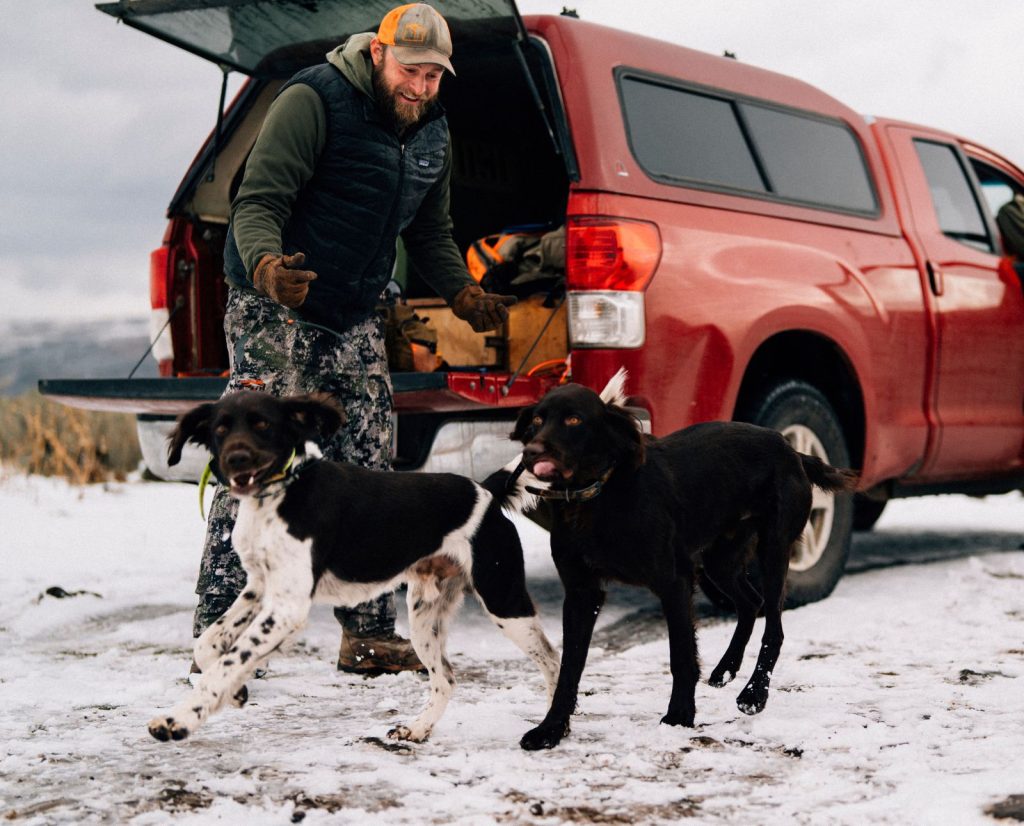
Dogs as projectiles pose risks to drivers, passengers, and the dog itself. This is where crash test rated seatbelt devices or backseat barriers come into play—these products can keep dogs in your car’s backseat in the event of an accident.
“These devices can help keep dogs from doing something stupid while we’re driving,” said Dr. Spoo. “We’ve all had that incident where we think they’re fine, and then they’re on the floorboards and you’re trying to keep them from stepping on the brake pedal or on the accelerator while we’re driving. The biggest benefit to these backseat barriers is that they keep dogs contained to the backseat.”
Dr. Spoo reflected on just how many dog owners he’s seen pull into his veterinary office with dogs on their laps, hanging out the windows, or otherwise unrestrained in their vehicles. “There is the potential for these dogs to pose as a distraction,” he said.
While there are many state laws regulating the use of cell phones while driving, only eight states have laws that apply to unrestrained dogs in vehicles. For example, Hawai’i’s statewide traffic code states that “While operating a motor vehicle, no person shall hold in the person’s lap, or allow to be in the driver’s immediate area, any person, animal, or object which interferes with the driver’s control over the driving mechanism of the vehicle.”
Dogs As Projectiles: The Force Behind Unrestrained Dogs in Car Accidents
Research on the threats dogs pose to passengers in vehicular accidents is limited. However, keeping in mind that I am not a mathematician, we can use some basic physics to illustrate the risks dogs pose to humans during a crash.
Say your 50-pound German Shorthaired Pointer is unrestrained in the backseat while you’re driving 55 miles per hour. A deer jumps into the road, and you collide at full speed. Your dog does not stop with the vehicle—it will not meaningfully slow down before impact. It continues moving forward at 55 miles per hour until something stops it (likely your windshield, or worse, you).
Using a simplified physics model based on kinetic energy, a dog of that size moving at that speed can generate roughly 10,000 pounds of force when it comes to a sudden stop. When concentrated inside a vehicle, that amount of force becomes extremely dangerous to both the dog and anyone else in the car.
In other words, in a crash, a 50-pound dog doesn’t stay 50 pounds. It becomes a projectile capable of causing catastrophic damage.
The Weakest Point in Dog Car Safety: The Kennel Door
Ultimately, while backseat restraints may not be perfect, they can reduce driver distraction. The more a driver can focus on the road, the less likely an accident will occur in the first place. But many products are designed to contain a dog, not to protect it in a car crash.
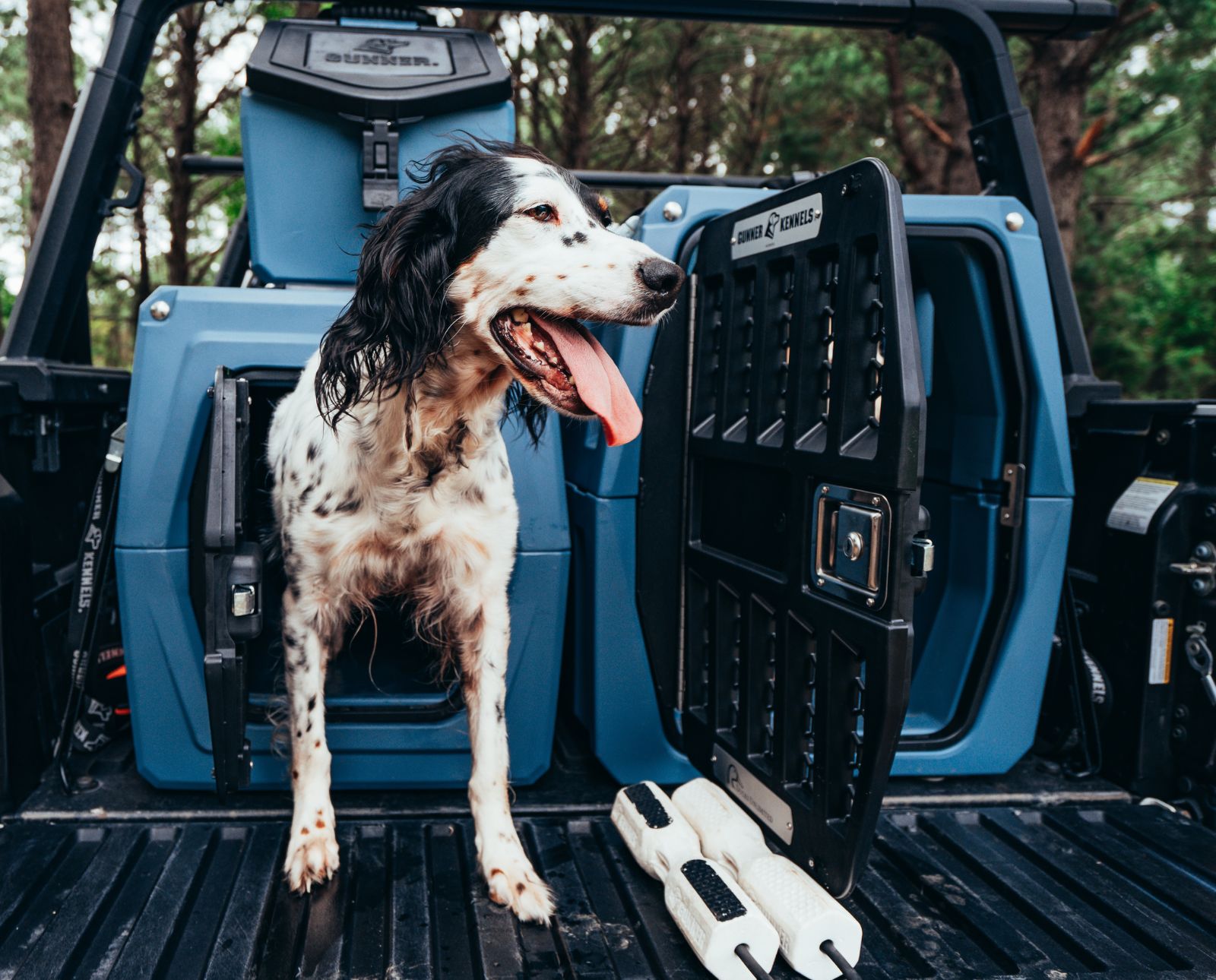
If your dog is in a kennel during a crash—whether from a rear-end collision, a T-bone, or hitting a deer—the weakest point of that system is often the kennel door. A kennel might survive a crash structurally, but if the door fails, the system has failed.
“The door is the biggest point,” said Dr. Spoo. “If the door to your kennel or dog box isn’t up to par, then you risk it opening during a crash. If the dog survives the crash, but the door fails and the dog gets hit by an oncoming car, it’s like the Alanis Morissette song: ‘Ironic.’”
Addison Edmonds, the founder of GUNNER Kennels, was present when his kennel’s design was being crash tested by an independent third party research testing facility. “They had a giant vise that could show how much pressure the kennel could hold,” Edmonds said. “It broke the machine three times at 2,000 pounds. They also dropped a huge sled on it from 10 feet, and it was the only kennel not to get completely crushed.”
It was at those crash test rating experiments that Addison realized just how important kennel doors are to a dog’s safety. “Crash tests are extremely violent,” he said. During these tests, dummy dogs are placed in the kennels. The kennel is then launched towards a cement wall at 30 mph. In testing, every other kennel failed at the door, allowing the dummy dog to be ejected. Only GUNNER’s reinforced door and backup pins remained secure.
“We tried to engineer GUNNER Kennels to give dogs the best chance of survival,” said Edmonds. According to its website, GUNNER’s G1 Kennel was the first kennel design to earn a five-star crash test rating from the Center for Pet Safety, a nonprofit organization dedicated to the protection of companion animals. They have many customer testimonials available to read on gunner.com, including this story about Cash, a black Labrador, who survived a rollover.
“Whether that door stays closed during a crash or not is the major sticking point,” said Dr. Spoo. “And using the safety features that are there. Full disclosure, sometimes I get lazy and I don’t hit the safety pins. How ridiculous is that?”

Keeping Dogs Safe in Cars: Consider Heat, Airflow, and the Broader Environment
When it comes to keeping our dogs safe in cars, crash test ratings are just one part of the equation. Temperature, airflow, and humidity are all things that put our dogs at risk of heatstroke, hypothermia, dehydration, or even death while traveling.
“What is your dog’s environment like? Is it hot in there? Is there airflow? We get complacent because we’re in a comfort controlled cab. But if that dog’s under a truck bed topper and we forget to open the vents, or you kennel a hot dog during the summer, now that kennel is like a sauna,” explained Dr. Spoo. Not only is the dog itself generating heat, it’s panting, too. As a result, temperatures inside of kennels can get even hotter than the interior of our vehicles.
“Tragically, people put their dogs in some of the safest kennels they could put them in, and they could kill them because of the environment,” said Dr. Spoo.
Read: Protect Your Dog from Overheating and Heat-Related Illness
Notably, Edmonds kept thermal properties in mind when creating the G1 Kennel’s design. Several features of these kennels help it maintain a safe temperature when compared to other kennels, including its rubber feet, double-walled construction, and windows. You can also mount a fan to the door in hot environments, and put on an all-weather kit on that covers the windows in cold or wet conditions.
“We have tested the thermal properties of our kennels with third party research groups as well,” said Edmonds. “Because the rubber feet elevate our kennel off of that hot truck bed, and because it’s double-walled, you’ve got a lot of thermal protection.” Edmonds has also stashed a Bluetooth thermometer in his dog’s kennel. He’s witnessed it maintain 45 degrees in single-digit weather.
Dr. Joe Spoo also recommends using Bluetooth thermometers to track the temperature of your dog’s environment while traveling. “Sometimes we just don’t realize the temperature of our dog’s kennel has changed 20 degrees. It’s a cheap solution.”

The Safest Way to Travel With a Dog in a Vehicle
For so many of us, our dogs are members of the family. They deserve to be intentionally safe while in vehicles. In the end, take the time to evaluate why you’re using a dog kennel. Is it simply to contain the dog for convenience, or is it actually designed to protect them in a crash?
In practical terms, keeping dogs safe in vehicles comes down to a few key decisions: reducing driver distraction, using a system designed for crash protection—not just containment—and ensuring that system is used correctly. Just as important, dog owners must consider the environment their dog is traveling in, from temperature to airflow. Small decisions in how we transport our dogs can have outsized consequences.
“It’s so simple. People think, ‘oh, I’ll just put my dog in a kennel.’ It’s almost too simple, but it truly is life or death,” said Dr. Spoo.
“Why is everybody okay with what’s out there?” said Addison. “Let’s think twice about how we transport our dogs because a lot of devastation could be avoided.”