


Attwater’s Prairie Chickens: The Last of Texas’s Prairie Chickens
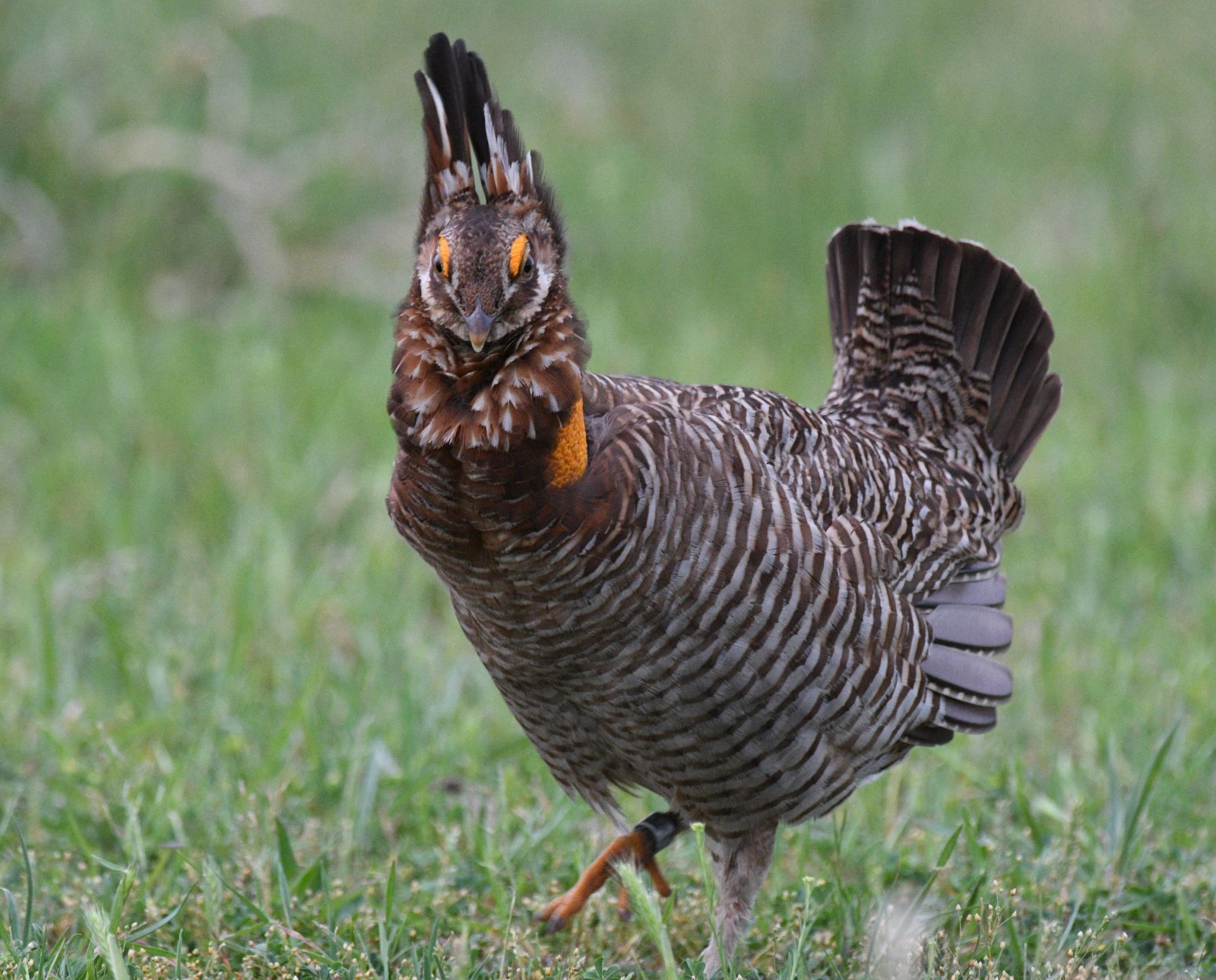
Over-hunting and the destruction of Texas’ coastal prairie have driven a 99.98 percent decline in Attwater’s prairie chickens
This article originally appeared in the winter 2023 issue of Project Upland Magazine.
The packed, silty soil and low grass cover made for a leisurely walk, although the pointers kept working too far in front of the line. The first grouse ran before a low flush, not more than ten to twenty feet off the ground. It didn’t seem to hurry in its escape, alternately flapping its wings and gliding. Side-by-side smoothbores barked, the gray smoke of opened chambers obscuring a second bird that flushed in front of an impatient point.
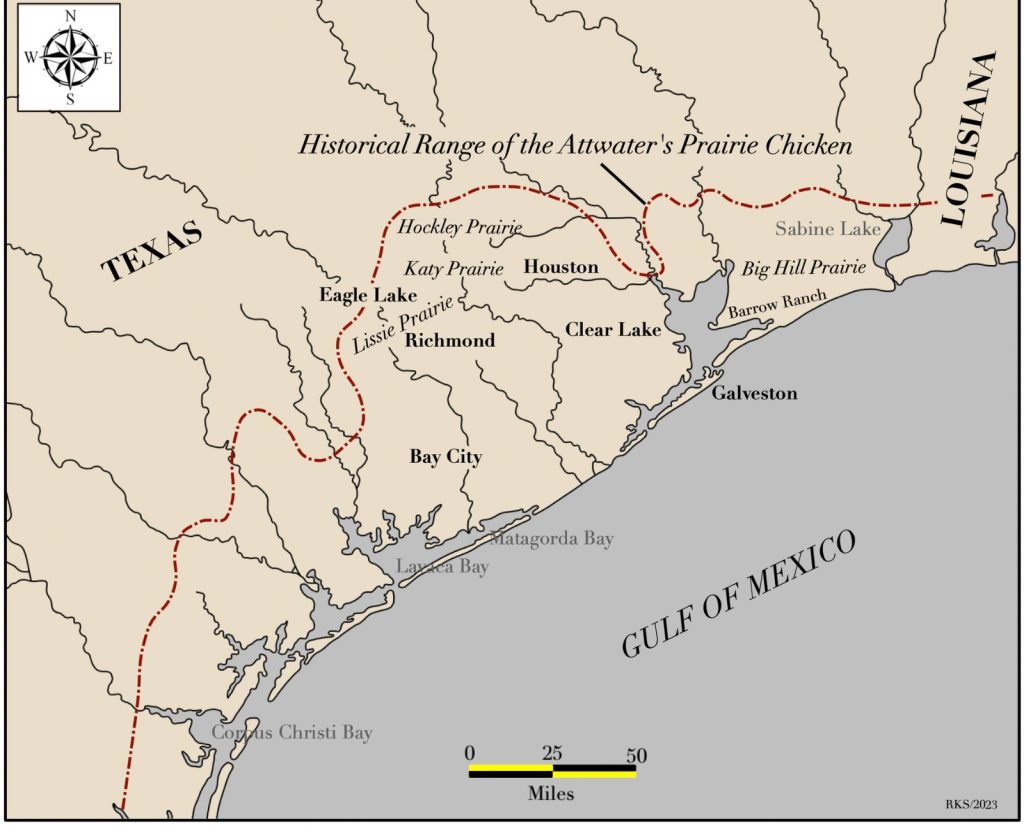
At the turn of the 20th century, the grassland diversity of Texas was home to three different grouse species—the greater prairie-chicken, lesser prairie-chicken, and Attwater’s prairie-chicken. The Attwater’s prairie-chicken (Tympanuchus cupido attwateri) was named in 1893 by ornithologist Charles E. Bendire for the “well-marked race of T. americanus” to honor Texas naturalist H. P. Attwater as “a slight recognition for his trouble in obtaining these specimens.” Its distribution paralleled the coast from Louisiana’s Atchafalaya Basin to Texas’ Corpus Christi Bay, encompassing some six million acres of tall-grass coastal prairie that supported as many as a million Attwater’s prairie-chickens.
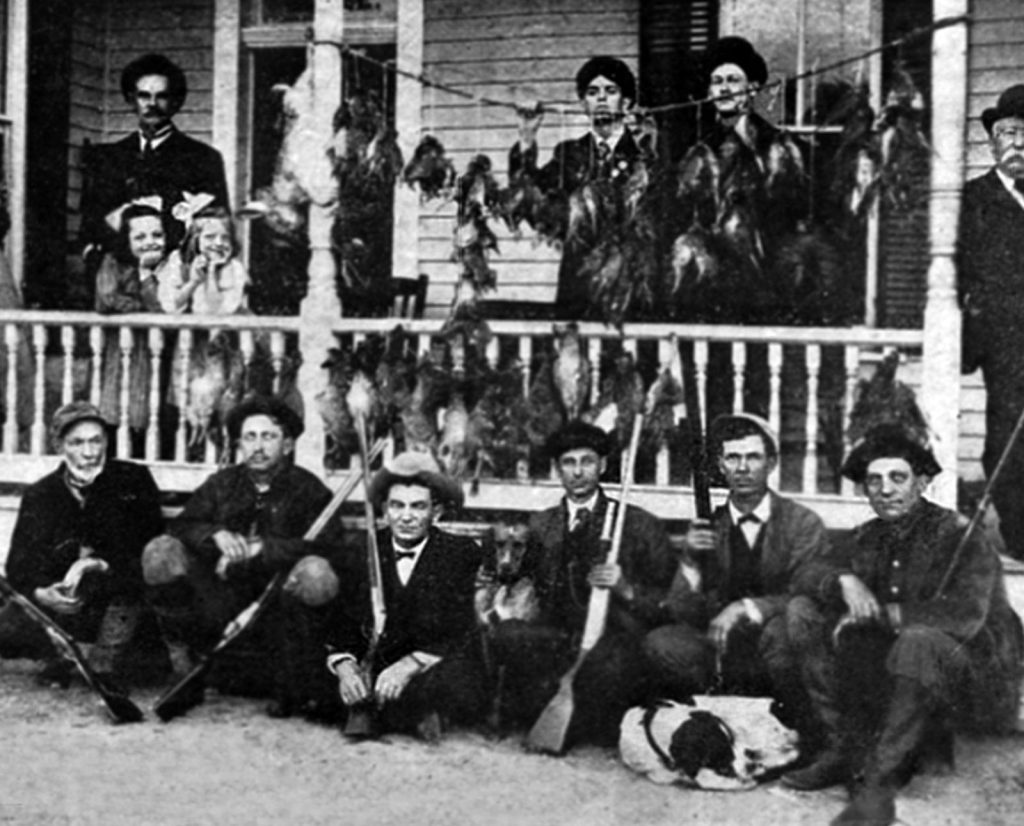
The sportsmen on that morning hunt thought of it in no special terms. They raised dozens of birds they called grouse, prairie hens, or prairie chickens, and it was something they had done for decades. But it was nearing the end. The year was 1919, and the bird they were pursuing was already extinct in Louisiana. There were still shootable numbers in parts of their former Lone Star State range, but they were getting harder to find. Texas closed its hunting season on Attwater’s prairie-chickens in 1937. By then, only 8,700 prairie chickens remained in the wild, and there was every indication that the bird’s epic decline would parallel Louisiana’s.
Early Birds
Prairie chickens never reached the staggering numbers of the passenger pigeon, but they were referenced in far more historical narratives. Captain William Sterling described the Matagorda Bay shoreline in the 1840s with native Karankawa Indians still living in crude huts and prairie chickens so abundant they roosted with barnyard fowl.
In the early 1850s, Capt. John W. Warren was the proprietor of the Warren Hotel on the stagecoach track through the Hockley Prairie. Warren, a former gamekeeper in his native England, supplied hunting dogs for his guests to shoot prairie chickens and quail. They killed enough to supply the hotel dinner table each night during winter months.
When Arthur Stilwell founded the town of Port Arthur on the still-wild shores of Sabine Lake, Joseph Bash owned one of the only two dozen buildings in town. Bash described flocks of prairie chickens that “passed through in droves” in a part of Texas where he kept his daughters indoors during warm months because of streets filled with alligators and snakes and mosquito plagues so thick that the sun appeared to be in eclipse.
Field to Table
Before the Civil War, prairie chickens were called partridges, the term more commonly used later for quail, and they sold in game markets for 40 to 50 cents a pair. They were common on the tables of early settlers, boarding houses, hotels, and market stalls, their flavor “highly esteemed.” Menus and game market entries reflect a by-gone era, their listings including the now-extinct passenger pigeons and Eskimo curlews and such birds as whooping cranes, swans, robins, meadowlarks, shorebirds, and wading birds.
Professional hunters supplied Texas markets. One was W. A. Hughs, dubbed by his customers as “Texas’ Greatest Hunter.” Hughs, who settled in Eagle Lake in 1875, hunted the Lissie Prairie, which was teeming with prairie chickens. During winter months, he made the 100-mile trip to Galveston markets in a wagon loaded with wild game. Another marketman was Mr. G. M. Oliver from Beaumont, “known at every farmhouse for his expert shooting and jovial disposition.” He tallied a remarkable 326 prairie chickens in a few days’ outing in 1896.
Days of travel by horse and wagon were made obsolete by the expansion of American railroads, and the fear of spoilage ended with the advent of refrigeration. Prairie chickens and other game could now be rapidly distributed nationwide, and it was big business. For example, a cold storage plant in New York in the late 1800s listed 4,200 prairie chickens in its inventory, although their numbers paled compared to its supply of 30,000 plovers and 15,600 snipes.
The Sport Afield
As new railroad lines were laid across the coastal prairie, sportsmen entertained themselves by firing at flying birds from train windows. Houston excursionists headed to Clear Lake on the GC & SF Railway in the 1870s shot dozens of prairie chickens, snipes, ducks, rabbits, and deer from their cars. In towns along the route, the practice was not shunned except on Sundays, when residents complained of the numbers of “Sabbath-breaking gunners.”
Read: Hunting Ducks Over Cattle: The Trained Waterfowling Steers of Texas
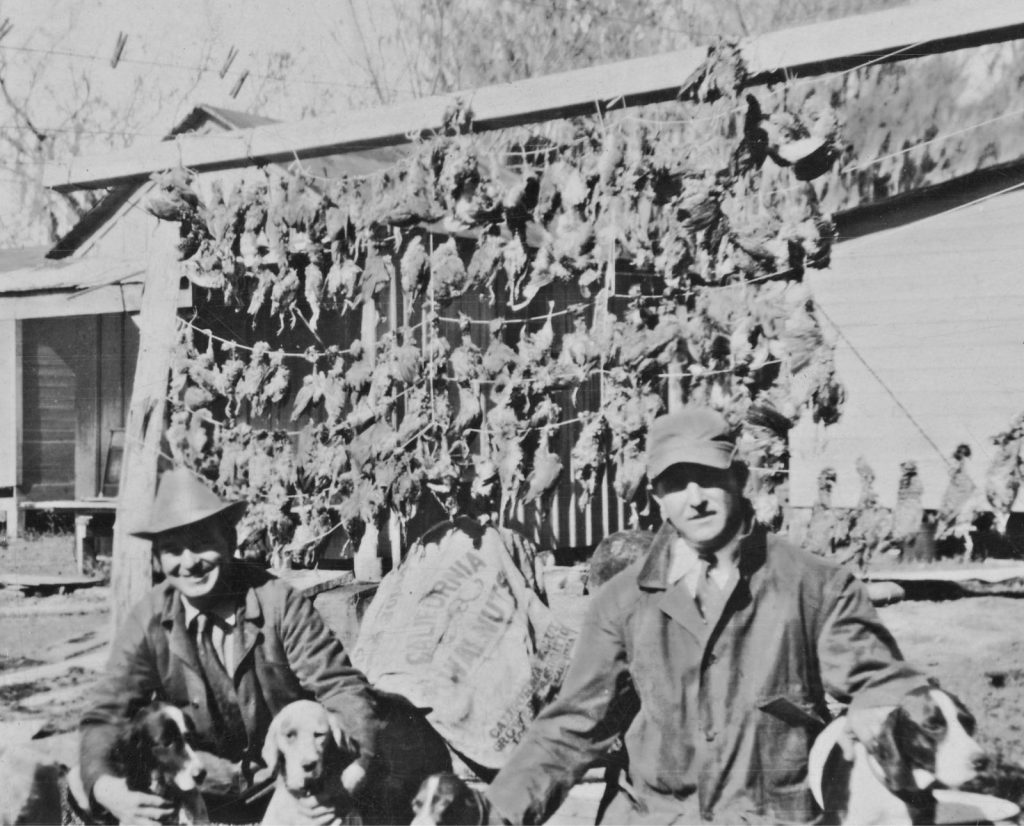
Wealthy gentlemen sportsmen were usually members of hunting clubs, and the “amiable spirit of rivalry” ran high between them. Shooting competitions using thrown glass ball targets were popular, as were prize hunts, in which teams competed for the highest number of birds killed on the wing. The score was kept for point values assigned to different bird species, the scorecard including prairie chickens and other abundant prairie birds such as woodcock, snipes, bobwhite quail, hawks, and owls. Sixty prize hunt participants harvested 4,000 birds in an 1884 competition, and the winning team in another contest that year netted a thousand.
Not every sportsman had money, but the volume of their harvest was equally impressive. Game warden Thomas Waddell wrote of hunting camps near Eagle Lake where sport hunters would return from the field with as many as a thousand prairie chickens. Near Bay City, in Matagorda County, hunters killed 71 Attwater’s in less than two hours.
In retrospect, the volume of the market hunter’s kill, which initially supplied a nation’s need and later its appetite, is perhaps easier to justify than the sportsman’s. The latter, however, was probably due less to arrogance than ignorance. Few thought that America’s wildlife bounty was anything other than endless. It was about to change.
The Best Intentions
Early conservationists rarely recognized the role of habitat destruction on declining wildlife populations, instead focusing their efforts almost exclusively on hunting regulations. During the years they battled for wildlife protection, some species were on a downward spiral so dramatic that the sportsman’s gun would never have had an impact. One of those was the prairie chicken.
Rather than the federal government, individual states had the sole authority to govern wildlife until the 20th century. Texas’s first upland game law was passed in 1860 and protected bobwhite quail on Galveston Island for two years. It was another 20 years before hunter-conservation groups were founded in Texas—but their associations were responsible for a quarter century or more of passionate, tireless efforts to craft and pass wildlife laws.
Hunter-conservationists contributed to the enactment of the first state-wide game law in 1881. Among its proposals was a restriction on the months that prairie chickens could be hunted, but it was stricken from the bill. It wouldn’t have mattered. The 1881 law was entirely ignored by the public and “violated day after day and year after year” with no known instances “wherein parties have been prosecuted.”
The Texas legislature, at last, passed an amendment to close the hunting season on prairie chickens for three years in 1897. Supporters were convinced that by prohibiting their killing, the birds would rebound sufficiently to “provide unlimited sport.”
Game law advocates enlisted Henry Philemon Attwater in their crusade in 1899. Attwater’s was an impressive pedigree. He was recognized as a “scientist and authority on Texas birds and animals” in his role as “general industrial agent” of the Southern Pacific Railway, a director of the National Association of Audubon Societies, and served on the American Ornithologists’ Union’s game law committee. In 1890, Attwater described the characteristics of Texas’s three grouse species and collected specimens for the Smithsonian.
One of Attwater’s conservation campaign strategies was to enlist support from farmers. “Useful insect-eating birds were becoming scarce,” he opined, but the good these birds do in preventing crop damage was “incalculable.” His new agricultural ally was cautious in its endorsement of game laws. However, their backing was not due to a “sudden increase in the habits of feathered animals” but “an awakening to the important fact that the birds have some value in destroying insects.”
Attwater and others prevailed with a Model Game Law in 1903 and a Permanent Game Law in 1907. Part of his success came from educating the public on conservation issues through a state-wide lecture series. In his address at College Station in 1905, Attwater spoke of the “wholesale slaughter of what remains of our game birds,” and warned that if it was not regulated, more “will soon be exterminated.” He accurately predicted that one of these would be the prairie chicken that bore his name.
For the first time, the 1907 Permanent Game Law provided funds to hire game wardens and a limit on the number of game birds that could be killed per day: 25, with a possession limit of 75. By the time the law passed, it was too late for the passenger pigeon. It was almost too late for prairie chicken. When the first moratorium on prairie chicken hunting lapsed in 1901, a season that ran from August until the end of January was reinstated. The following year it was shortened to November 1 to February 1. The daily bag limit of 25 was reduced by 1917 to five, and the legal hunting season was cut to just 30 days. Twenty years later, the season was closed for good.
In Their Own Words
Over the decades, historians and writers collected stories from old men whose names, a generation ago, were legends to Texas outdoorsmen and women. Often, they spoke about the last of the Attwater’s prairie-chickens. To them, it defined more than just the moment when they saw the last of a once prolific species, but their realization that the coastal prairie was also vanishing. Their voices are gone now, but their stories resonate.
Before he was the hunting manager of the East Bay Lodge for Brown & Root in Chambers County, Ralph Leggett landed at airstrips to deposit brown bags stuffed with campaign donations for Lyndon Johnson. Spaceland Airport was one of those surreptitious locations, its paved runways laid across the prairie where, a hundred years earlier, prairie chickens were harvested from GC & SF Railway car windows near Clear Lake. It was 1967, Leggett remembered, when he saw his last flock. There was “a ton of ’em,” he said, and “when I landed there, there’d be chickens just getting out of your way.”
Richmond Mayor Hilmar G. Moore also saw his last prairie chickens in the 1960s. He was working cattle on the family’s Orchard Lake ranch in Fort Bend County, west of Houston. Mayor Moore stood in the cold that day and counted them. It was during an ice storm, he recalled, and “I saw 18 of them in the hay field.” He never saw another.
“Prairie chickens, prairie hens, grouse,” Barrow Ranch hunting guide Elmer Jackson told Shannon Tompkins, then an outdoor writer for the Houston Chronicle. “We called ’em all those names. You could find ’em mostly on the little ridges and humps on the prairie. They were fine sport and good eatin’. On a spring morning, you could hear them drummin’ and hummin’ all over the prairie.” He didn’t care to think back to when he saw his last one. “There were a lot of them back then,” was all he said. “Back then” was 1917.
Henry Palmer ‘Peg’ Melton of Houston was 12 years old when, jumping on a train, he fell and lost a leg. He never considered he was disabled. Nearly every Sunday during the season, he shot prairie chickens at Pierce Junction and on the prairie west of Houston.
Today, the Houston Astrodome covers Pierce Junction, and the prairie west of Houston became Sharpstown within the city boundaries. When Melton worried that he might have seen his last prairie chicken in the 1930s, he did something about it. He prepared a publication and a radio address in 1935, cajoling sportsmen and lawmakers to recognize their duty to preserve habitat and wildlife. Among those who heard his message were game warden Thomas Waddell and biologist Val Lehman. They were already doing something about it.
The Last Stronghold
After the turn of the century, the largest remaining prairie chicken concentrations were in remnants of “the Big Prairie.” Covering over a thousand square miles, the Big Prairie was part of a six-million-acre ecosystem bordered to the north by piney woods and the Gulf of Mexico to the south. It was simply called the Big Prairie at first, then the Houston Prairie, and as farming communities came, smaller parts of it took on local names such as the Lissie Prairie, the Katy Prairie, and the Big Hill Prairie southeast of Houston. The problem with the Big Prairie was that it was too close to Houston.
When settlers first crossed the Big Prairie, they found high-standing grasses of bluestem, switch, yellow Indian, and eastern gamagrass in a gentle topography of topographic highs known as knolls or mima mounds, and natural pothole ponds they often called “buffalo wallows.” The Jordan family was among the pioneering families on the Katy Prairie. Chester Jordan said, “When my Dad came there, it was nothing but grass, red wolves, prairie chickens, and ducks.” He remembered that, on the high grounds, there were thousands of prairie chickens, quail, and “millions of jackrabbits on those knolls.” Jordan saw his last prairie chicken on one of those knolls in the 1970s.
The Problem with Prairie Chickens
Prairie chickens are just too fussy. Notoriously intolerant of land use changes, they have been unable to adapt to the many modifications of their native habitat. Farming and rice production, cattle grazing, and control of natural fires erased the grassland diversity they need for successful nesting. Land leveling removed the subtle elevation change of the knolls that ground-nesting prairie chickens relied upon to survive floods. Clouds of insects that once sustained chicks after their hatch succumbed to man-made land changes and pesticides.
Next came the invasives—Chinese tallow trees, the thorny McCartney rose bush that infilled grasslands, and fire ants that destroyed eggs and even adult birds. Then came urbanization and suburbanization. Texas may have banned hunting of Attwater’s prairie-chickens, but it did not prohibit the destruction of the coastal tall-grass prairie.
Boots on the Ground
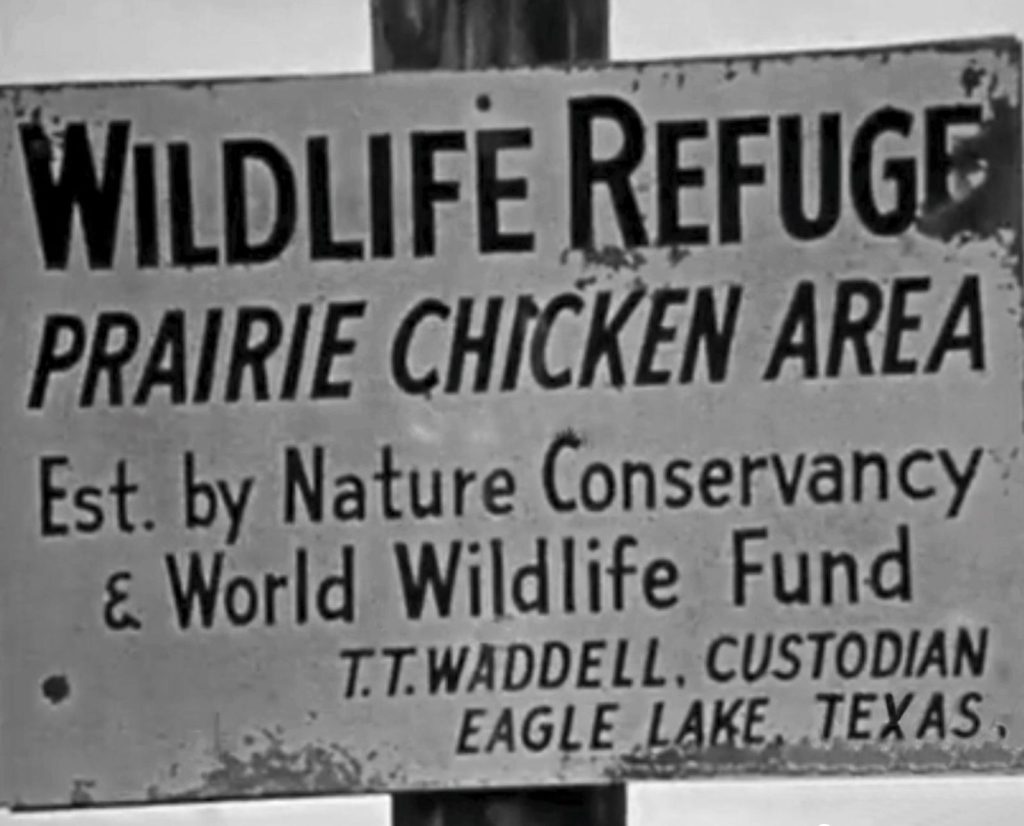
Texas game warden Thomas Waddell was one of the most influential 20th-century advocates for the Attwater’s prairie-chicken. Waddell, who viewed his job less as enforcement and more about wildlife awareness, dedicated years of his life to the bird. Between 1925 and 1937, he covered tens of thousands of prairie acres, counting nests and the numbers of young and adult birds. Looking for factors that influenced good counts and poor ones, he found correlations with such things as rainfall amounts and the burning of prairie grasses for agriculture during the spring nesting season.
In 1927, game warden Waddell hosted Texas Governor Dan Moody and W. J. Tucker of the Fish, Oyster, and Game Commission on a prairie chicken hunt near Eagle Lake. They had a good shoot, bagging 21. But Waddell was less interested in hunting than the opportunity to enlighten his distinguished guests on the future of the prairie chicken. He continued those efforts for the next 50 years.
Val W. Lehman, a field biologist finishing his degree at A&M College, brought scientific methods to the prairie chicken plight when he joined Waddell in the field in 1937. That year, Lehman estimated that just 8,700 prairie chickens remained in the state, their distribution limited to only a few Texas counties. One was the Lissie Prairie of Colorado County. Although the number of birds was “pitifully small,” he wrote, it was still “greater than any other place in the world.” Lehmann was blunt: “Whether or not the Attwater Prairie Chicken’s thrive or takes its place alongside the passenger pigeon, heath hen, and the Carolina parakeet depends to a greater extent upon the people of Colorado County.”
Colorado County people responded by forming a local Sportsmen’s Association in 1938, enrolling landowners in experimental programs to improve their lands for prairie chickens. Three years later, Lehman published the seminal “Attwater’s Prairie Chicken,” the benchmark work used as a basis, in part, for the Nature Conservancy and World Wildlife Fund’s purchase of 3,500 acres of Lissie Prairie habitat near Eagle Lake in the 1960s.
A Continuous Spiral
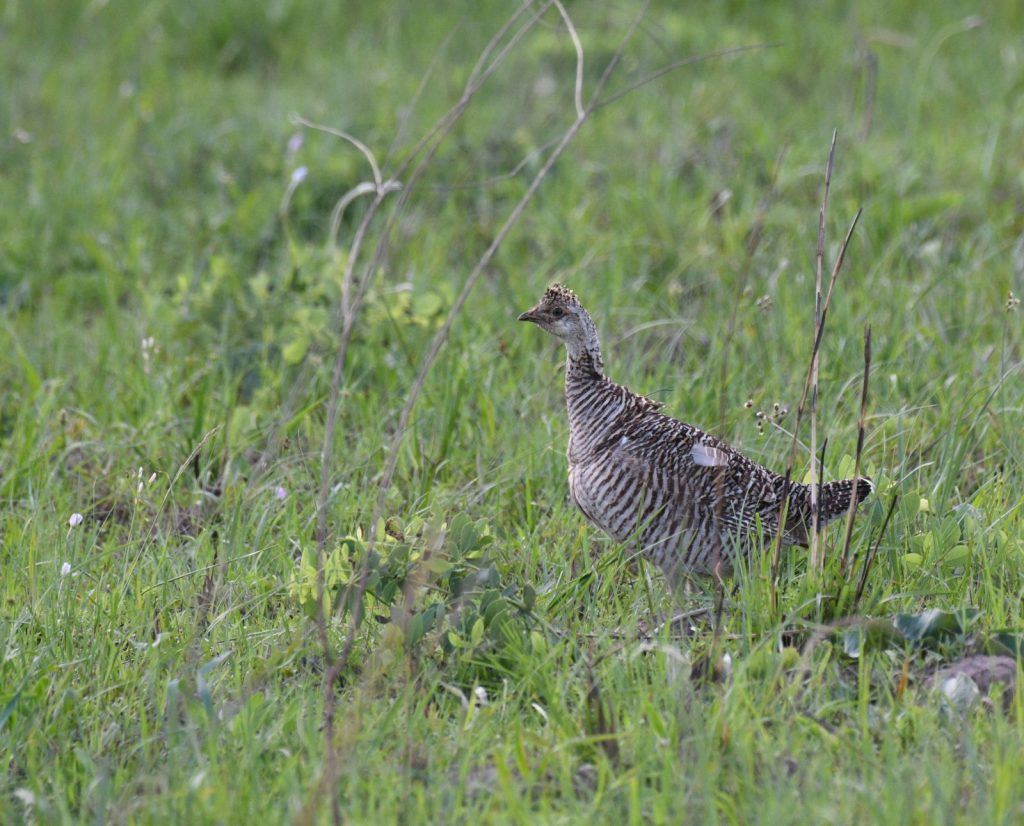
In 1967, the Attwater’s prairie-chicken was placed on the Federal Endangered Species list. Their population had declined to less than 2,000 birds. The Nature Conservancy and World Wildlife Fund’s prairie chicken oasis became the Attwater’s Prairie Chicken NWR in 1972 and quickly doubled its acreage.
Statewide numbers continued to plummet, from 456 wild birds in 1993 to 42 in 1996. Their numbers rose in the early 2000s to approximately 90, then crashed again after Hurricane Harvey in 2017, when only 13 males remained in the wild. It was a dangerous point in history, mitigated, for now, by a rebound in 2021 to just under 200 birds. Just one percent of the Attwater’s prairie-chicken’s original six-million-acre range remains today. The bird has fared worse than its habitat; it has experienced an unprecedented 99.98 percent decline from its million-bird peak.
It has been 125 years since hunter-conservationists hypothesized that, through regulation, the Attwater’s prairie-chicken might rebound sufficiently to “provide unlimited sport.” Instead, it became a race to prevent their extinction.

Interesting and important read, thanks for sharing with us. It’s sad such an abundant bird has been reduced to less than 200 in the wild.
Fantastic article. Thank you, RK!