

Big Trouble at Little Brook

When a beloved setter goes missing in a thunderstorm, a worried grouse hunter does everything he can to find him
This story was originally published in the fall 2025 issue of Project Upland Magazine. Illustrations by Tom Richardson.
October, 1971
Beside Jim Raybury’s farm lies Little Brook, a peaceful cover perfect for the opening day of the grouse season. Once an apple orchard, the forty-six-acre forest is now a conservation easement. A narrow brook, barely wider than a leg’s stretch, winds quietly toward a beaver pond. On one side, impenetrable alders tangled with rose hips fill the cover. The other side is thick with Baldwin apples, honeysuckle, and hawthorn. Sour fragrances fill the air on any autumn day. Brambles choked with fruit lead to rows of pine and cedar by the pond and furthest from Mr. Raybury’s farm.
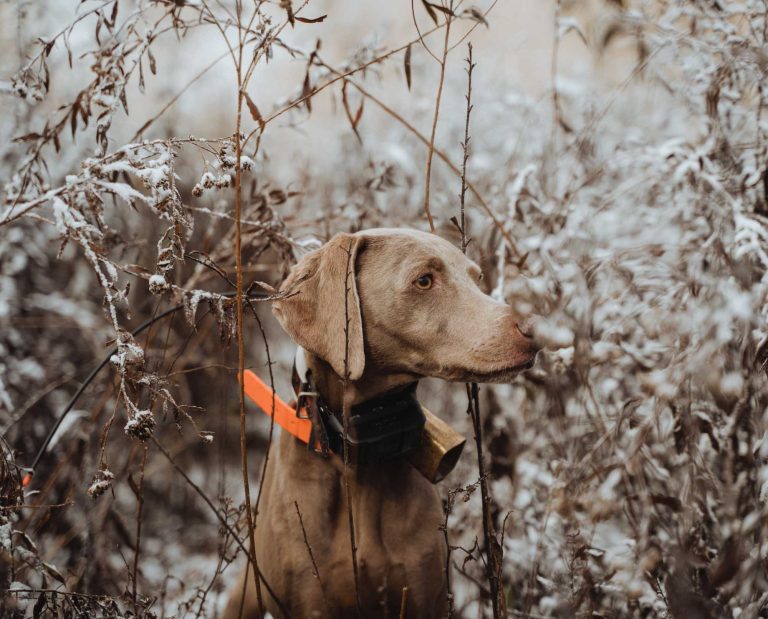
Tommy is my black-ticked setter, half-masked on his right, the number eight faintly dotted on his left cheek. His eyes beam black above his rounded snout. His coat is wiry and cowlicked along his neck and down to his sickled tail. In his fourth season, he has begun to prove himself to be an unworldly grouse dog.
Tommy stood anxious, shaking as I attached his bell. The aroma of crab apples was heavy. The tailgate echoed through the woods as I slammed it shut, and clouds began to cover the morning sun. The wind whistled, shaking the fiery leaves from the trees.
I have never owned a dog with a prey drive as strong as Tommy’s. His speed is like lightning, and he bolts to wherever the birds might be. He will hold a point two hundred yards away until someone comes to kick up whatever is beneath him. The birds often lay pinned, paralyzed with fear from the onslaught of such a beast, struck with some hypnosis that only nature and wild things might know. In my aging years, I find it troublesome to keep up.
As the clouds darkened and thunder rumbled, I hurried, not wanting to miss the morning’s hunt. Down the hill and through the orchard, Tommy worked the cover. I let him range thirty to forty yards, close enough to whistle him back, testing his distance and pace. My commands were subtle, hoping he’d stay within earshot, with the fear of the heavy wind drowning out the sound of the bell.
A grouse flushed wild in front of us and flew toward the brook. Another one, forty yards down the hill, took to the air, following the flight of the other. The birds were unusually wary today. I wondered if they felt the looming and unexpected storm. I watched Tommy push through a large cluster of honeysuckle before he crested a knoll out of sight toward the brook. I whistled for him. The wind crashed through the trees, drowning the bell. I whistled again, louder, until my throat strained. I cupped my palms behind my ears. The sound of the bell was gone.
“Tommy!” I yelled. “Tommy!”
The wind wouldn’t give me a break. The leaves were ripping from the trees and speeding sideways through the forest now. Dark clouds swirled and raced across the sky. There was lightning.
“Tommy! Come!” My voice cracked with pain.
I got that nervous feeling in the pit of my stomach. I hoped I would hear Tommy’s bell come into range again, but I was worried that it wouldn’t, all at the same time. I began running. I ran nervously in the direction I thought Tommy would have gone.
I blasted the whistle repeatedly. One blast. Five blasts. Three blasts. The wind made it impossible for my whistle to reach him.
“Tommy! Tommy!”
I turned toward the first road and called him from the edge. I hurried to the opposite end of the orchard along the spruce and belted my voice through the trees. I ran out of the tree line and echoed my cries off the pond. The rain began to pick up, and the thunder roared from above. Tommy would never leave the grouse woods if he didn’t have to. The thought of him pointing a bird, pinned beneath a blowdown or at the end of a hollowed log, haunted me.
I hurried toward the brook and stared across at the alders. They were thick, treacherous, and impassable. They spanned the entire south side of the cover, and it would likely take a whole day to navigate, if it didn’t kill me first.
I shoved my hand through the wall of alders and parted them to the side with force. I crouched and ducked, sliding my heavy boots through the mud. I blasted my whistle.
“Tommy! Come on, Tommy!” Again and again I called for him, with one hand around my lips and the other pulling myself through the tangle.
“Tommy, come on, boy! Come!”
The storm rolled heavily through the sky, and the vibrance of October was gone. I trudged fiercely. My bare hands were stabbed with inch-long thorns from the understory. I stopped frequently to free them from my flesh, the small holes welling with blood. I crawled like a soldier under soaking leaves and threaded my damp body between the stems and trunks of trees. I made it halfway through the cut but couldn’t push through the alders anymore. Soaked and heavy, my breath grew ragged. I turned over onto my back and tried to see the light. The patter of rain bounced and dripped off the alder leaves above, and lightning lit the sky.
The bell remained silent.

—
Over the following weeks, I walked all the streets in town and drove all the roads that wind through the country. I lost hope of finding Tommy on my own. I put an ad in the local paper offering a cash reward for him. I posted pictures in every town building, library, gas station, and post office within a thirty-mile radius. I paid extra to have the posters professionally made, laminated in color, and printed on card stock.
** MISSING DOG**
NAME: TOMMY
AGE: 4 YEARS OLD
BREED: BLACK AND WHITE TICKED SETTER
REWARD: $250
LAST SEEN: RAYBURY ROAD
CALL: 514 912 4136
—
It has been months since I stapled the posters to poles and tacked them to overfilled bulletin boards. Now, they have been forgotten and replaced with other ads for more relevant things. The posters on the poles have been replaced or covered with “GARAGE SALE” signs. Other missing dogs or cats have taken the spotlight on the poles throughout town. The ones I had posted on stakes along the country roads have vanished. I am sure the highway department plowed them into ditches and culverts over the winter, or the wind carried them off to places that don’t matter.
I searched until I couldn’t search for him anymore. Tommy should have shown up somewhere by now.
—
November, 1972
“Hello?” I answered the ringing telephone.
“Yes, sir,” said a soft-spoken man. “Is this the gentleman that used to hunt the old orchard down from the farm?”
“I’m sorry. Who is this?” I asked.
“It’s Jim Raybury from up on Raybury Road. I think I used to see you with your dog up here huntin’ pa’tridge in the fall. You had that black-ticked setter, right?”
“Yes. That was me,” I said hesitantly. “How did you . . .”
“I found a poster with your number blowin’ around the pasture this mornin’. I remember you comin’ up here last year looking for that dog of yours. It had really stuck with me. I had almost forgotten about it until about a month ago.”
There was silence.
“Right around the first week of October, I started hearin’ a bell ringin’ over in the woods. At first, I thought it was just the wind, or some other hunter down there. But then I heard it again, at night. It was awful strange.”
“Maybe someone else is hunting down there,” I said.
“No, no, no,” Jim proceeded. “It woke me from a sleep on more than one occasion. Not to mention, to get down into the woods, you gotta drive right past the farm here.”
I struggled to believe him. It couldn’t be Tommy. He wouldn’t have made it that far.
“Just hear me out. It was just around dusk the other night when the bell echoed up the road here to the house. The leaves flipped upside down on the maples out front, and it got really cold through here. The night came awful fast after that. If my legs let me, I would have gone down to see what it was all about,” Jim said.
I was skeptical now but curious. Could Tommy somehow have survived a year alone in the woods? Could he have made it through a hard winter by himself? In the extreme, the possibilities were there…
Jim interrupted my thought. “Sir, I just think you ought to check out these woods again before you give up on findin’ that huntin’ dog a yours. Maybe he’s out there waitin’ for you.”
The next morning, I drove the truck down the road and past the farm. Mr. Raybury waved and nodded warmly as I drove past. I parked the pickup in a clearing and got out. The air felt strange around my neck. Above the trees, rolling over the valley, were black clouds. I listened, but only heard the wind weaving heavily through the bare branches. Then, in the woods, I heard the crack of a limb. The limb broke and peeled the bark from the trunk where it stood. I felt the mist coming up the path, carried by the wind. Then, oppressive silence.
BOOM! A clap of thunder roared from above. The sky screamed and crashed, jolting lightning from its gurgling clouds. CRAACCKK! Thunder again.
The clouds rumbled and rolled into a familiar tone, suddenly turning into the beating wings of a grouse. I held my breath. A bell rang faintly in the distance.
I stood frozen, somewhat in fear, somewhat confused. The sound of the bell echoed through the cover. I stood still, listening closely to its sound. Soon, it became a soft rhythm, a harmonious ringing—softly, quietly, slowly. Then, the bell stopped.
CRAACCKK! Another loud clap of thunder echoed through the forest, and with it, another grouse flush. The bell resumed. The mist turned to rain and blew sideways across my face. The black clouds made it dark in the woods beneath the trees. The thunder continued. I listened closely between the fits for the bell as it rang aloud in the dark forest.
I had to follow the sound.

I walked through the orchard, pressing rotten apples into the soles of my boots. I found a trail and followed it toward the brook leading to the alders. The sound of the bell seemed farther away now. I stood still again, dripping wet from the downpour. I heard the whistle of a woodcock as it flew from somewhere in the alders in front of me. The bell sounded close again. Another grouse rose from the trees.
Hypnotized, speechless, I crossed the water. The sound pulled me in like a magnet.
I pushed my hands through the dense cut of alders. The drab, gray trees were lifeless, their leaves spread across the ground. I went farther, trying to follow the sound, but the heavy rain bounced off the trees above. My boots sloshed as I stomped through the mud and punched through the alders. The rain fell in buckets and sheets. I lost the sound of the bell entirely. But at the edge of the trees, something white caught my eye.
With each jolt of lightning, the image became clearer. In the mud, beneath the leafless canopy, was a pile of bones—a tiny skeleton resting upright against the alders. A second, even smaller pile of bones lay before the first, somewhat hidden beneath a hummock of grass. In front of the grass, beneath the bones, I caught the shimmer of a tarnished bell, still threaded through the collar that read, “TOMMY.”
As fate would have it, Tommy’s spirit and the grouse he pinned beneath the autumn grass lived eternally among the alders. There, on any chilled autumn night, you can sit above the orchard and hear the whirr of wings and the ringing of his bell.