

Korean Fire Rabbit (Cheesy Rabbit Buldak)
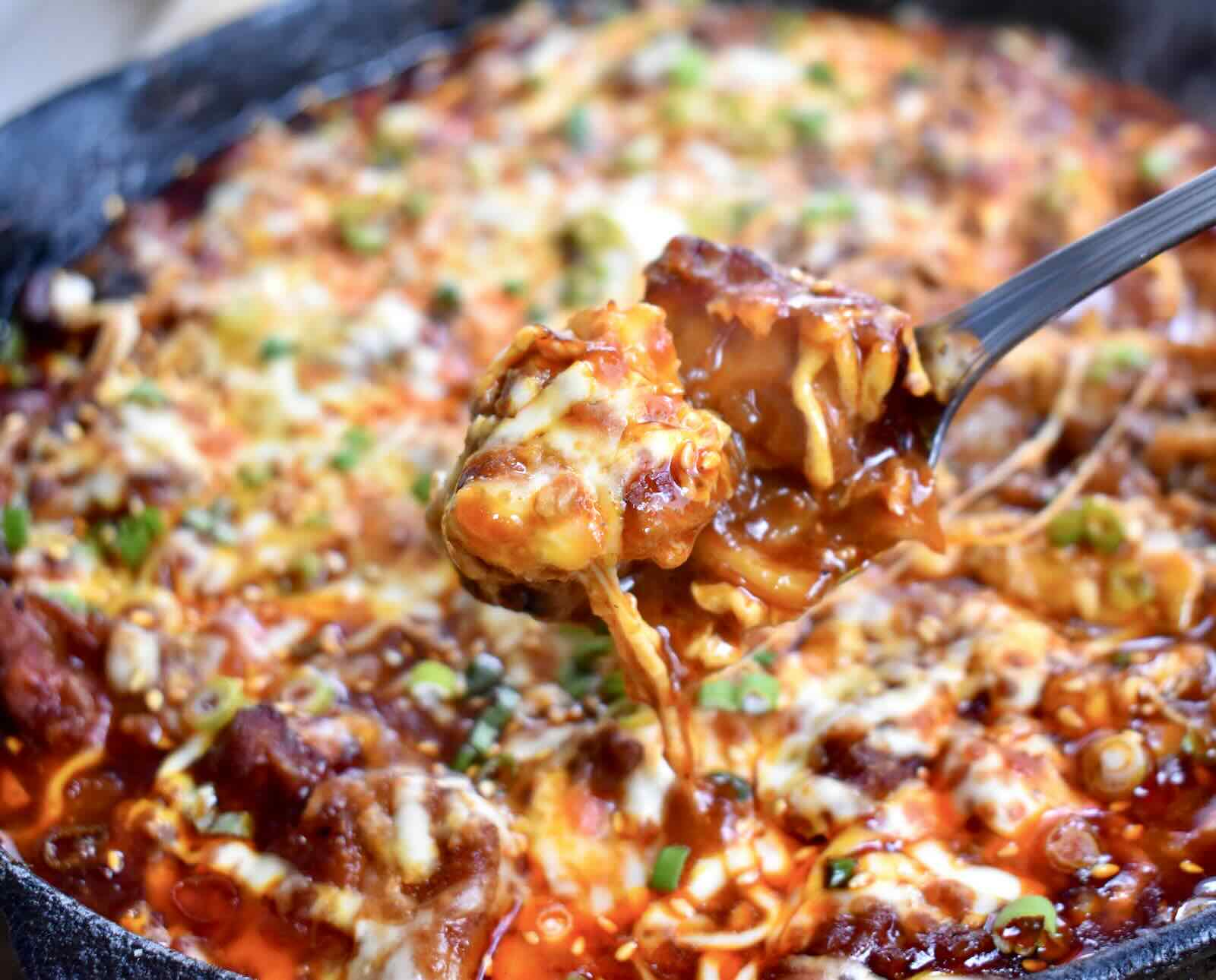
Spicy braised rabbit in a gochujang-based sauce with garlic, ginger, and chili, finished with melted cheese in classic Korean buldak style.
Picture this: A gaggle of American college students from a variety of backgrounds piles loudly into the entrance of a noraebang, or a Korean spot that rents out private karaoke rooms and serves food and drinks.
They’re whisked into their own room and, before long, are crooning and giggling along to the latest K-pop tracks, sipping on peach soju, and having fun. Soon, food arrives. Extra crispy Korean fried chicken dusted in cheesy powder, craggy and loaded Korean corndogs, chewy butter teok (chewy dumplings), and fiery buldak chicken smothered in mozzarella cheese.
Everybody except for the pair currently butchering their favorite BTS song digs into the food, which is decidedly Korean, but bears little resemblance to the Korean food their parents might have enjoyed on a night out not so long ago.
The first wave of Korean-American cuisine arrived with immigrants who, often limited by ingredient availability, opened restaurants that slowly spread across North America. They stuck close to traditional restaurant dishes and celebratory recipes that transferred well to Western kitchens—a selective snapshot of Korean food culture, locked in time.
Still, Westerners were more wary of Korean cuisine than Chinese-American or Japanese-American food, encountering funky, spicy, and fermented flavors from things like gochujang and kimchi for the first time and not so sure what they thought about it.
Then Korean BBQ came. This was something Westerners could easily get behind—piles of grilled meats, fun group setting, lots of drinks to help wash everything down. Sure, there were those fun little side dishes (banchan), many of which were left untouched, but the grilled beef ribs and pork belly were where it was at.
As time marched on, exposure to Korean food remained relatively narrow for years for most non-Korean North Americans. You had the mom-and-pop classic Korean restaurants with traditional dishes, which had better and better access to ingredients from home, and the huge Korean BBQ joints proliferating in downtown cores. Missing were the evolving tastes of Koreans back home: the drinking food culture, temple cooking, the convenience food hybrids, and dishes born from postwar army-base cooking.
Then something clicked. Kimchi and gochujang were suddenly everywhere. Nondescript Irish pub chains were selling gochujang chicken burgers and Korean Fried Chicken shops began popping up like mushrooms after the rain. Westerners were making kimchi on their counters at home, and food bloggers were taking liberties with traditional foods, as they do. Korean food was finally cool!
Due to its impressive ability to meld with wild foods, Korean influence could even be seen in the wild game and foraging worlds, with recipe developers like yours truly digging into traditional and modern flavors and techniques to use in wild dishes.
With the help of Korean-Mexican fusion food truck culture, the increasingly popular K-pop movement, and social media platforms like TikTok, food trends that were happening in Seoul were showing up in North America only weeks or months later, and there wasn’t much traditional about it. The cultural lag seen in so many immigrant groups had been shortened so much that it was practically nonexistent. Today, global media and modern supply chains allow food trends to travel almost instantly, meaning younger North Americans are increasingly experiencing contemporary Korean food culture in near real time—fiery, cheese-covered buldak included.
Earlier generations of Korean restaurants in North America often centered around dishes like bulgogi, bibimbap, japchae, and Korean stews—foods that translated well across cultures and could be built around available ingredients. But the modern wave of Korean food culture arriving today looks very different: cheese-covered buldak, Korean corndogs, convenience-store ramen hacks, and internet-famous drinking foods from contemporary Seoul.
Today, here in North America, we can go out and enjoy those Korean classics while simultaneously having access to modern Korean dishes, which have incorporated many Western techniques and ingredients. Cheese is a big one. You’d be hard-pressed to find cheese in traditional Korean cuisine, but now it’s hard to find a TikTok video of someone eating Korean food without a dramatic “cheese pull”.
This new cuisine is what I leaned into when I developed this rabbit dish. I wanted to incorporate something wild into that spicy, funky, cheesiness that has become so popular with younger Koreans.
The leanness of rabbit works well in this dish, as it soaks up the funky gochujang-based sauce, provides a subtle wild backdrop for the spices, and plays so nicely with that melted cheese.
The end product should be very spicy but slightly sweet, with a savory fermented depth which is very addicting when paired with the creamy melted cheese. I like to serve it steaming hot with white rice and fresh kimchi.
This is a dish open to interpretation. To make it a little more wild, you could add wild mushrooms, replace the scallions with ramps, or serve it with your own wild kimchi. Also, if you can find perilla leaves, they make a great addition with a complex herbal flavor, which is very distinctly Korean.
Note: For instructions on how to debone a rabbit, watch my video here.

Korean Fire Rabbit (Cheesy Rabbit Buldak)
Ingredients
Method
- Season rabbit pieces generously with salt and pepper.
- Heat the oil in a large skillet or braising pan over medium-high heat. Brown the rabbit pieces on all sides until lightly golden. Remove and set aside.
- In the same pan, add the onion and cook until softened, about 5 minutes. Add garlic and ginger and cook for another 1 minute.
- Stir in the gochujang, gochugaru, soy sauce, sugar, mirin, and sesame oil. Cook the mixture for 2 minutes.
- Return the rabbit to the pan. Add the stock and the cabbage and bring to a simmer. Cover and cook for 1 hour, until the rabbit is tender and the sauce thickens.
- Spread the mozzarella evenly over the top. Cover and cook on low heat until the cheese melts and becomes slightly bubbly. Sprinkle with scallions and sesame seeds.
- Serve hot with rice and kimchi. Enjoy!