


Common Puppy Congenital Defects: What to Look for When Buying a Hunting Dog Puppy
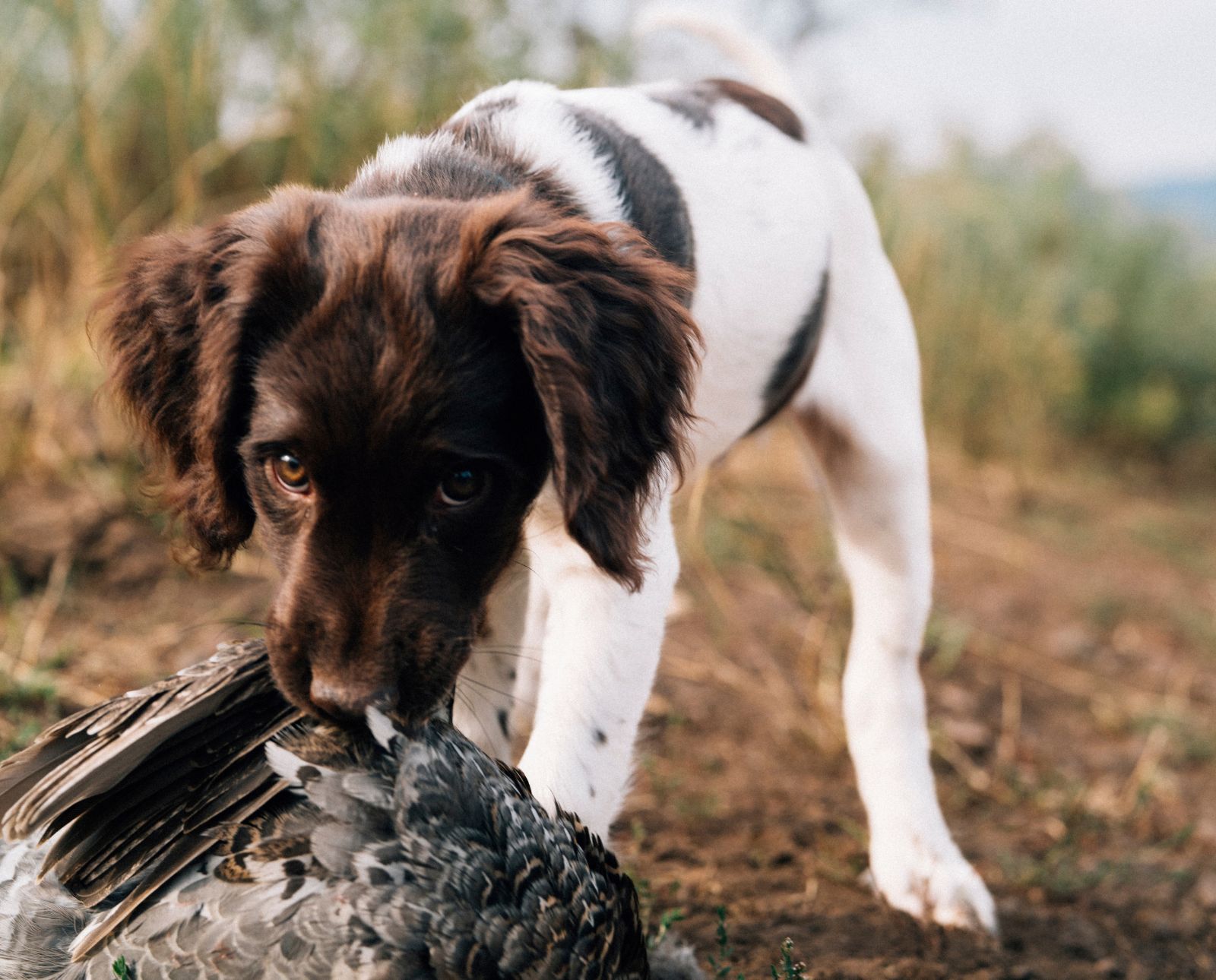
A veterinarian’s guide to spotting common congenital defects in puppies and how they may affect health, hunting performance, and breeding decisions
Most anyone in the market for a serious upland hunting puppy wants to buy the perfect dog. Fresh out of the box, unblemished from nose to tail, with nothing to distract you from nurturing, training, and dropping onX pins on spots that look birdy for their first full fall of hunting. Unfortunately, not every puppy comes to you as a flawless specimen—some puppies have congenital defects.
In January, my wife and I picked up a new Small Munsterlander puppy. My wife had our new furry bundle of joy on her lap. I was determined to let him know what name we had decided to give him. We gushed over “Nix” as he finally became comfortable with his unfamiliar bipedal abductors and rolled on his back to fall asleep. That’s when I noticed the little red bump on his belly, accompanied by a single suture.
“What the heck is that?” I asked my wife.
“I don’t know,” she said, “The breeder may have mentioned something about a fixed hernia, didn’t she?”
“Really? Did I miss that?” I guess I was distracted with the puppy, the paperwork, and the bird wings. I wasn’t paying attention. As my wife has become even more acutely aware as the years press on, this was classic Dan (I am easily distracted). But truly, this wasn’t a cause for buyer’s remorse. In the grand scheme of things, this minor issue would in no way impact my dog beyond the two weeks of managing the small skin infection associated with the surgery that had corrected an umbilical hernia.
However, I was frustrated with myself. I’m a veterinarian. I went so far as to bring my stethoscope, and I planned to give this puppy a solid once-over, including looking for common congenital defects, prior to signing the paperwork. Yet, in the heat of the moment, nothing resembling a thorough examination had occurred. Would I have still gone home with the puppy no matter what? Yes, I sure would have. Was I frustrated with the breeder? Not really. She was sending me home with a high-quality dog with only a minor flaw. I just felt that I had missed an opportunity to flex my professional muscles at a critical moment, and that made me feel like a true bonehead.
This article serves as an overview of common congenital defects in puppies that you might see in your new bird dog. I’d hope this doesn’t inspire you to show up to a puppy pickup with a magnifying glass and lab coat, but maybe it will arm you with knowledge regarding a particular puppy that the breeder would like to send you home with. Additionally, I’ve included notes of current knowledge on the heritability of these traits, in case you’re considering adding your new puppy to your kennel for future breedings.
As a disclaimer, I believe most quality breeders won’t knowingly put a client in the awkward position of taking home a puppy that they won’t be happy with. Many do a great job of assessing health, and this often means that they involve a veterinarian in the process of rearing puppies prior to sending them to their new homes.
What a Puppy’s First Physical Exam Should Include
As a veterinarian, the foundation of evaluating every puppy during its first appointment is a thorough physical exam. I don’t wish for there to be a problem, but if one exists, it’s my job to find it. My exam, tailored to find a potential defect, focuses on the following marquee anatomical locations: mouth, eyes, heart, belly, and genitalia. I also consider hip and elbow health, as it pertains to common heritable dog issues that should be on your mind when considering a new dog purchase.
Puppy Teeth and Congenital Bite Issues to Look For
When I examine the mouths of puppies, I’m focused on dentition and jaw alignment, as well as the palate. The term malocclusion includes over and underbite, crossbite, and the infamous NAVHDA notation of “butt bite.” A sub-category of dental abnormalities includes missing and extra teeth, which may not be fully apparent until adult teeth erupt completely. A reputable breeder will likely catch any significant changes in this category, and as such, you may find yourself being offered a new puppy at a discounted price.
Read: How To Prepare for a New Hunting Dog Puppy
Having a professional opinion on limitations due to abnormalities in this category would truly be based on the severity of the defect. Slight changes are not likely to be problematic in a hunting scenario, but may affect dental health by leading to periodontal disease as your dog matures. More significant abnormalities may affect performance in the field related to grasping crippled birds and overall retrieving ability. Consideration for avoiding breeding the individuals with significant malocclusions is fairly strong, as the likelihood to pass on such traits is well documented.
Cleft palate is an entirely different congenital defect, but I’ll include it in this category because it is anatomically related to the mouth defects. I nearly hesitate to mention it, as cleft palates would be a major red flag finding, and not one that a new puppy owner would likely be faced with. Regardless, it’s something that’s looked for with every new puppy exam.

Eye Problems to Watch for in Puppies
When examining a puppy’s eyes, changes to the eyelids may be subtle and not easily recognized upon first glance. The terms entropion and ectropion define inward and outward rolling of the eyelid, respectively. Both conditions can develop to varying degrees, and each can cause their own unique pathology.
An inward rolling eye can allow the haired aspect of the skin to contact the cornea, leading to irritation or even corneal ulcers. Ectropion can lead to eye exposure and dryness, as well as allowing more foreign material to collect in the conjunctiva, including things like grass seeds. Either condition can be successfully corrected surgically as the puppy progresses towards maturity. Select breeds are more prone to this condition, and these issues can be heritable.
Should You Worry About a Heart Murmur in a Hunting Dog Puppy?
Finding a heart murmur in a young puppy intended for serious upland hunting use would give me major pause for consideration. Any grade of heart murmur is significant, though a simple physical exam may not be sufficient to determine the severity. This category of congenital defect would hopefully have been caught prior to placement. However, if in some way an affected puppy would slip through the cracks and end up in a hunting home, a serious conversation may need to be had with the breeder.
Read: How to Make the Tough Decision to Not Breed Your Dog
A heart murmur could be more or less benign, but it has the potential to be very limiting if not devastating in the field. Depending on the type of heart murmur, it can certainly be heritable. Removal of that individual from the gene pool is an obvious best practice.
Umbilical Hernias in Puppies
Aside from cryptorchid testicles, this is the most common puppy “blemish” that I see professionally. There are two schools of thought on the origin of a true hernia. Often, umbilical hernias are blamed on mom being overly fastidious when licking her pups around the umbilicus, enough to cause tearing of the abdominal wall structure. However, my opinion is that it’s just as likely to be associated with a puppy born with a genetically weak belly wall, allowing a hernia to form. Currently, there is not enough evidence to suggest that breeding should be entirely avoided for this type of defect, but this may factor into your consideration of including them for propagation of future generations.
Regardless of the root cause, surgical correction of the umbilical defect may be required, with timing of that procedure based on how significant the defect is. Small hernias can simply be closely monitored, as they are likely to reduce and completely resolve with time. Larger hernias may be corrected at the time of spay/neuter, or once a dog is more mature. Extremely large hernias with the potential to be life threatening may best be corrected early, with aims to prevent a life threatening bowel strangulation. Using a reputable breeder will likely save you from having purchased a puppy with a large, life-threatening hernia, but is something that as a new buyer, you’d be wise to still have on your radar.

Cryptorchid Testicles in Male Dogs
Checking male dogs for cryptorchid testicles during the puppy vaccine series is standard practice. Though some testicles can be retained for an extended period of time prior to naturally descending, I’d be suspicious if this hasn’t occurred by the time we see them for their final puppy vaccine appointment at 16 to 18 weeks of age. Due to the heritability of cryptorchid testicles, these puppies are best not to be considered for your breeding stock. With the addition of an increased testicular cancer risk if left unmanaged, planning for a cryptorchid neuter procedure is recommended over letting a dog mature with a testicle remaining inside his abdomen.
Hooded Vulvas in Female Dogs
The female version of a genitalia-related abnormality is the hooded vulva. Redundant skin and a hooded vulva can predispose female dogs to developing urinary tract infections. Being aware of this anatomical variation early on and working with your veterinarian for best practices associated with management may make a world of a difference. Regardless of owner and breeder stance on spay timing, patients may see a corrective benefit of going through at least one heat cycle.
Congenital Hip and Elbow Dysplasia in Dogs
This is not a topic easily evaluated at a young puppy’s vet appointment, but I’ll include it in this article as it falls under the umbrella of congenital issues.
True hip and elbow dysplasia is very important for the individual, and carries the weight of being highly heritable. Dysplasia, and the associated pain, is important from the standpoint of functional mobility as the dog matures. As mentioned, subjective evaluation of joints in a very young puppy is of questionable accuracy. More objective measures can be accomplished at four months of age (PennHIP screening) and two years of age (OFA screening for both hips and elbows). These official evaluation methods require radiographs with a qualified veterinarian. Thankfully, responsible breeders will have taken this upon themselves to ensure that at least hips, if not elbows, were officially evaluated prior to breeding the parents. Many breeders will publish objective data for the dam and sire when the mating is announced, and this would be a clue that you’re dealing with a responsible puppy producer.
Many puppies are going to come with their own “official enough” looking contract. However, a subtle defect may not make itself known until a puppy is seen by its veterinarian for the first time days to weeks after going home. Meanwhile, the new owner and puppy are busy forming an inseparable bond, one that may make it hard to want to break ties with. With this in mind, it may be wise to familiarize yourself with the verbiage included in any contract in order to understand if you have the ability to seek any recuperation of cost if a major congenital defect is found later.
Some of the conditions covered in this article are fairly easily corrected by a qualified veterinarian, but that’s not the point. You’ve already invested in a new bird dog, the added sunk cost of an unforeseen veterinary bill is a difficult pill to swallow. It’s best to be as proactive as possible in order to ensure a positive, drama free purchase.
This article isn’t a complete encyclopedia of all possible congenital defects found in hunting dog breeds, but it certainly should cover the most likely subset of issues a prospective puppy buyer would be exposed to. I’d hope that you’re now more aware of unexpected pup problems, and empowered to have a productive conversation with both your breeder and your veterinarian.

With all due respect pertaining to umbilical hernia’s. Liters have been born were have the liter will have them and the other half will not. Some liters will have 90 percent umbilical hernia free well 10 percent may have one. Other times. The whole liter will have them. All out of the same sir and dam. Not to discredit your knowledge as a vet. But this is real life.