

American Coot: Identification, Habitat, Conservation, and Hunting Tips
Learn about the American coot and why hunters should appreciate this unique and tasty waterbird
Every year around mid-October, I start to see American coots (Fulica americana) show up in my area, usually in the marshy places where I’d conceal myself while waiting for other species like wigeon and mallards to show up. Curious little birds around my spread of decoys, they always seemed like a mystery to me, purely because I wasn’t overly educated in their general life history.
American coots are a funky, chicken-like waterbird that occur in healthy numbers in wetlands across North America. Although they are commonly mistaken for a duck, they are actually a member of the rail family.
While you can hunt coots, they are not a popular waterfowl species to pursue. Coots bear the brunt of many jokes in the waterfowling community, and they’re not well-regarded as far as edibility is concerned. However, I can think of no other marsh-dwelling bird that has provided action on those warm, slow days when the ducks don’t want to move. In recent years, the end result of a coot hunt has been a plate of one of my favorite dishes to cook on an autumn evening for friends: coot gumbo.
Let’s have a look at what makes these little birds who they are and why they are worth appreciating and conserving.
American Coot Quick Facts
| Characteristic | Details |
| Scientific Name | Fulica americana |
| Taxonomic Order and Family | Order: Gruiformes (crane form)Family: Rallidae (rails) |
| Average Length | 15-17 inches |
| Wingspan | 23-25 inches |
| Weight | 1.3-1.5 pounds |
| Habitat | Marshes, wetlands, ponds, lakes, rivers, and other fresh or brackish waters |
| Range | North-central Canada to southern Central America, from the Pacific coast to the Atlantic coast |
| Conservation Status | Low Concern |
| Conservation Concerns | Toxin bioaccumulation, pollution in wetlands, conversion of wetlands to other land uses |
| Similar Species | Hawaiian coot, Eurasian coot, Virginia rail, clapper rail, king rail, gallinules, sora, crakes, moorhens |
American Coots Are Not Actually A Duck
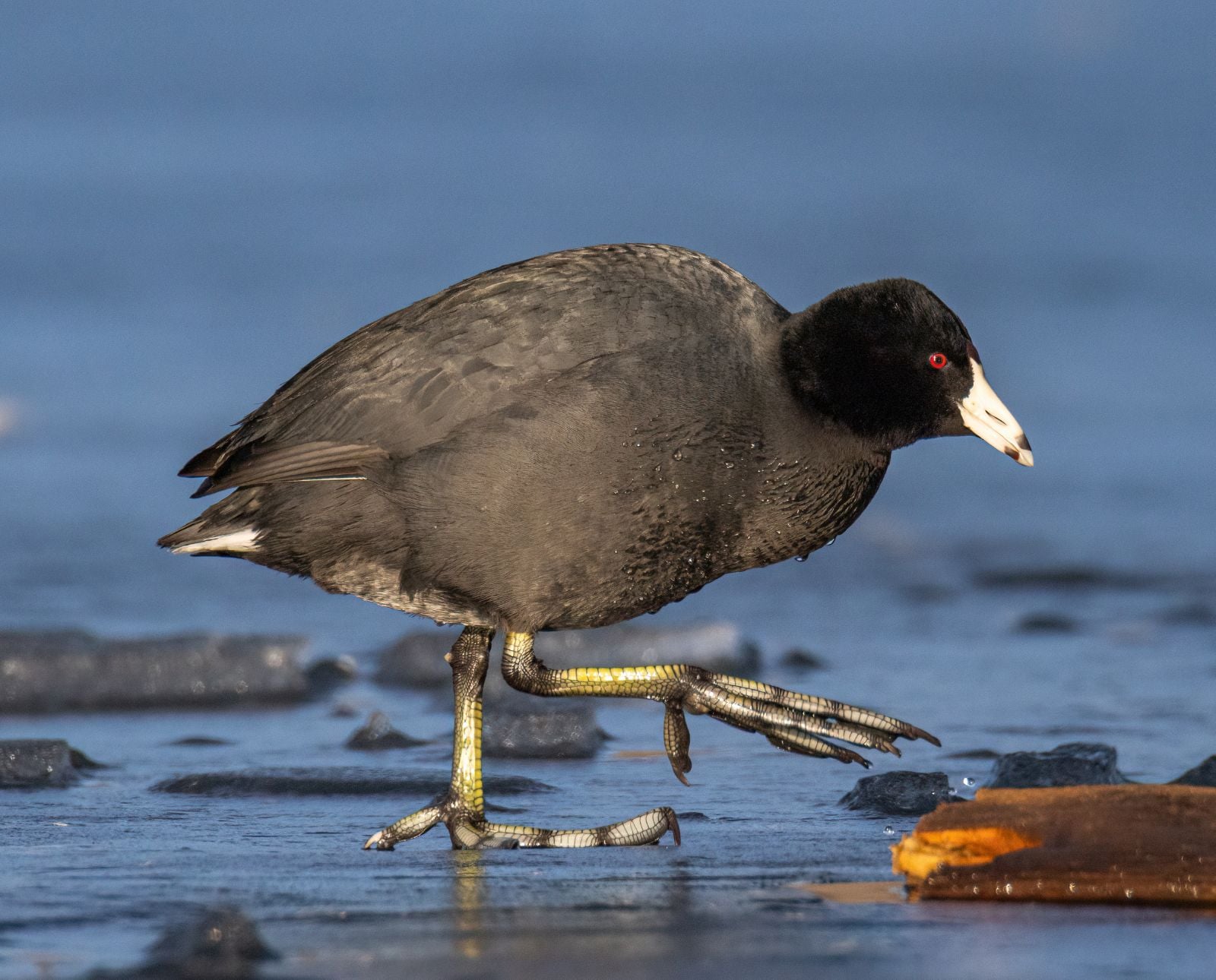
Contrary to popular belief, American coots are not ducks—they are rails. Coots are a part of the Rallidae family, which includes other species of rails like the Virginia rail, clapper rail, king rail, gallinules, soras, and more. The most obvious giveaway is their legs. Instead of having webbed feet like a duck, they have what’s called “lobate feet.” This means their feet have long, wide, lobed toes which allow them to swim in water and walk less awkwardly on land.
American Coot Identification, Habitat, and Behaviors
The American coot is a dark grey waterbird with a black head, deep red eyes, a white beak with a tiny black band around the front of it, and a white forehead that tops out with a thin patch of red. It has a chicken-shaped body—quite plump in fact—and slender, mottled legs and feet that turn from a pale greenish-yellow to black bars.
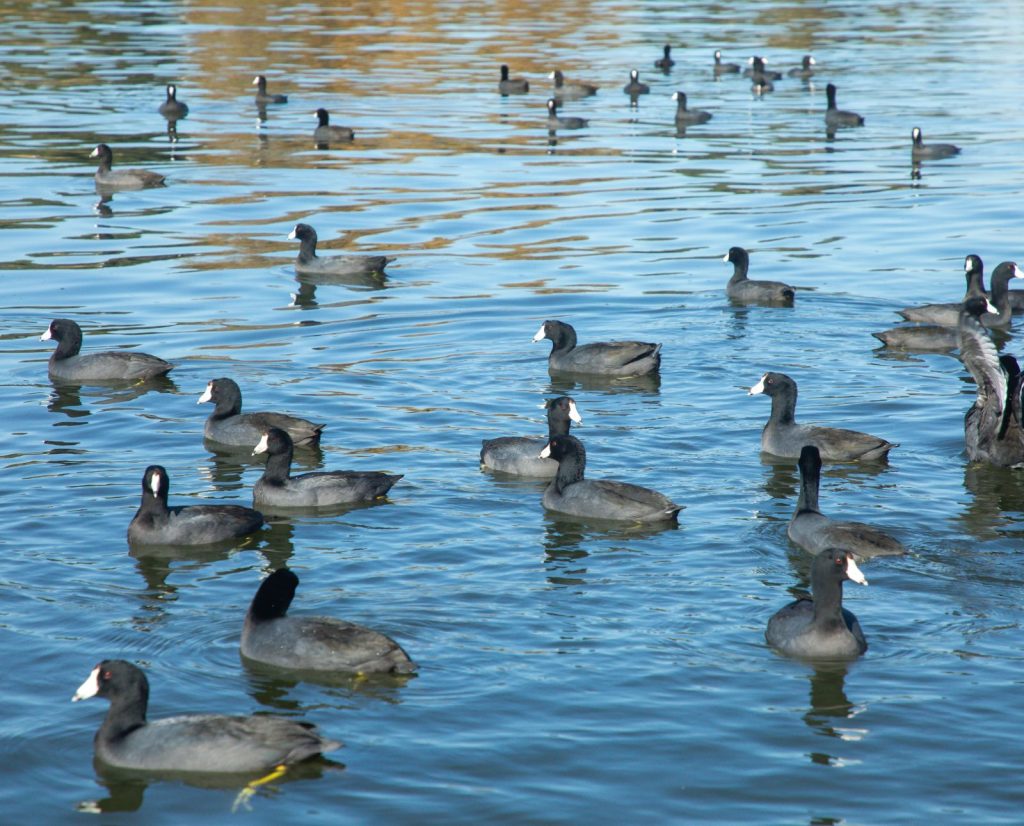
These rails live considerably more social lives than more secretive rails. They are quite at home in storm ponds, golf courses, city ponds, busy cottage country areas, and many other types of areas with water.
The American coot has exceptionally strong legs that are used not only for swimming and diving while they feed, but also for fighting over territory with other coots. According to the Cornell Lab of Ornithology and Audubon Society, it is not uncommon for coots to rear up and slash at an opponent during a brawl. Additionally, American coots cannot take flight immediately. Instead use their legs to get a long, running start across the surface of the water before going airborne. In tight areas, coots will instead try to bolt into dense aquatic cover for protection or dive underwater to avoid detection.
Like most rails, American coots enjoy marshy habitat in ponds and lakes with shallow waters where they can feed both above the surface of the water as well as below it on a wide range of aquatic plants and seeds, nodding its head as it feeds. It’s generally understood that during breeding season the American coot may consume more animal matter to support the development of eggs (Cornell Lab of Ornithology).
American Coot Range and Distribution
The American coot is widely distributed across North and Central America. Some populations further south don’t take part in the same migratory habits that birds which breed in the Great Lakes or the Prairie Pothole regions do. These birds can be found from the northern most regions of the Canadian Provinces all the way down to the Gulf Coast into the northern parts of Mexico. They’ve been observed as far south as Panama as well. According to the Audubon Society, migratory habits and patterns of American Coots in more northern climates is not well known, though it is generally agreed upon that most coots migrate at night during brighter moon phases and that the birds are present in all flyways.
When migrating, American coots will gather in much larger congregations, especially once they arrive in their winter locations. They’re known to intermingle with much larger rafts of migrating diver ducks as well, sometimes numbering in the hundreds.

Breeding and Nesting Habits of the American Coot
According to Ducks Unlimited (DU), American coots are seasonally monogamous, staying together as a pair through mating, nesting, and rearing the young. The male also takes part in incubation of the eggs. Breeding generally takes place in May, and once complete, the female coot will begin to make several nests and eventually will choose one to lay their eggs in. Coot nests are platforms of vegetation over top of the water.
Hens will lay between six to twelve eggs. However, some nests will have more eggs, and in that scenario, it is generally regarded that more than one hen has laid in the same nest. Eggs are a pinkish buff colour, usually with small brown spots on them, though sometimes without. Incubation takes between 23 to 25 days. According to Ducks Unlimited, hatching is asynchronous and it can sometimes take up to four days between when the first egg begins to hatch and when the last hatches. American coot hatchlings are precocial, which means they are able to walk around and feed on their own right after hatching.
After hatching, the young are immediately strong swimmers. At night, they are brooded on a similar nesting platform made by the male coot. These young coots, after a short eight weeks of life, are able to fly competently.
American Coot Conservation Status
It is generally observed that coots are widespread and that populations have been, and remain, quite stable. Partners In Flight estimates that the global population of coots to be 7.1 million birds, and in North America, they are considered a species of low concern. Because they are not a highly regarded or sought after species by hunters, general harvest numbers in North America are quite low compared to other species of waterfowl. In 1999, the annual coot harvest in the U.S was 720,000, but that number fell to around 182,000 in 2020 according to All About Birds.
Because of the wet places that American Coots inhabit, these birds are vulnerable to toxins and pollutants in the waters caused by spills, industrial runoff, and poor agricultural practices. However, according to DU and the Audubon Society, the American coot is known to be far more resilient than dabbling ducks to pollutants.

American Coot Hunting Tips
American Coots offer a very unique opportunity for unorthodox waterfowl hunting. These birds love to feed close to shore and in very shallow water, and this can set up a waterfowl hunter for excellent jump shooting. Glassing makes this entire process much easier, and if you can use a quality pair of binoculars to get the whereabouts of some coots before making your approach, either on land or via a canoe or kayak, it will help you prepare for your eventual shot.
Though coot decoys exist, they are considered a “confidence” decoy, meaning that they inspire confidence in other duck species to come into a spread. If you’re looking for coots, focus on the type of habitat that they prefer, mark a few spots that fit the bill, and slowly paddle your way through them, being ready to shoot at any given moment. This is much easier to accomplish if one person is paddling a canoe, and another is at the bow, ready for business.
For more coot hunting information, check out this guide to hunting American coots.
Are Coots Good to Eat?
Despite various slandering ideas about the bird, American coots are exceptionally delicious on the plate. Though I’ve never plucked a coot whole, I have recently discovered a recipe in Duck, Duck, Goose by Hank Shaw for a coot gumbo. So far, it has become my favorite method for cooking these birds. You’ll need a few of these little marsh dwellers in order to make a good batch, but that’s all the more reason to get a couple of friends out in the marsh and spend an afternoon hunting coots when nothing else is going on.
While coots may not have the same reputation as mallards or pintails, they offer open-minded hunters opportunities for good shooting and table fare. The abundance and adaptability of this species doesn’t make it immune to conservation issues facing wetlands, and its presence is tied to the health of the marsh. The prolific yet often-overlooked American coot is a unique bird worth appreciating.